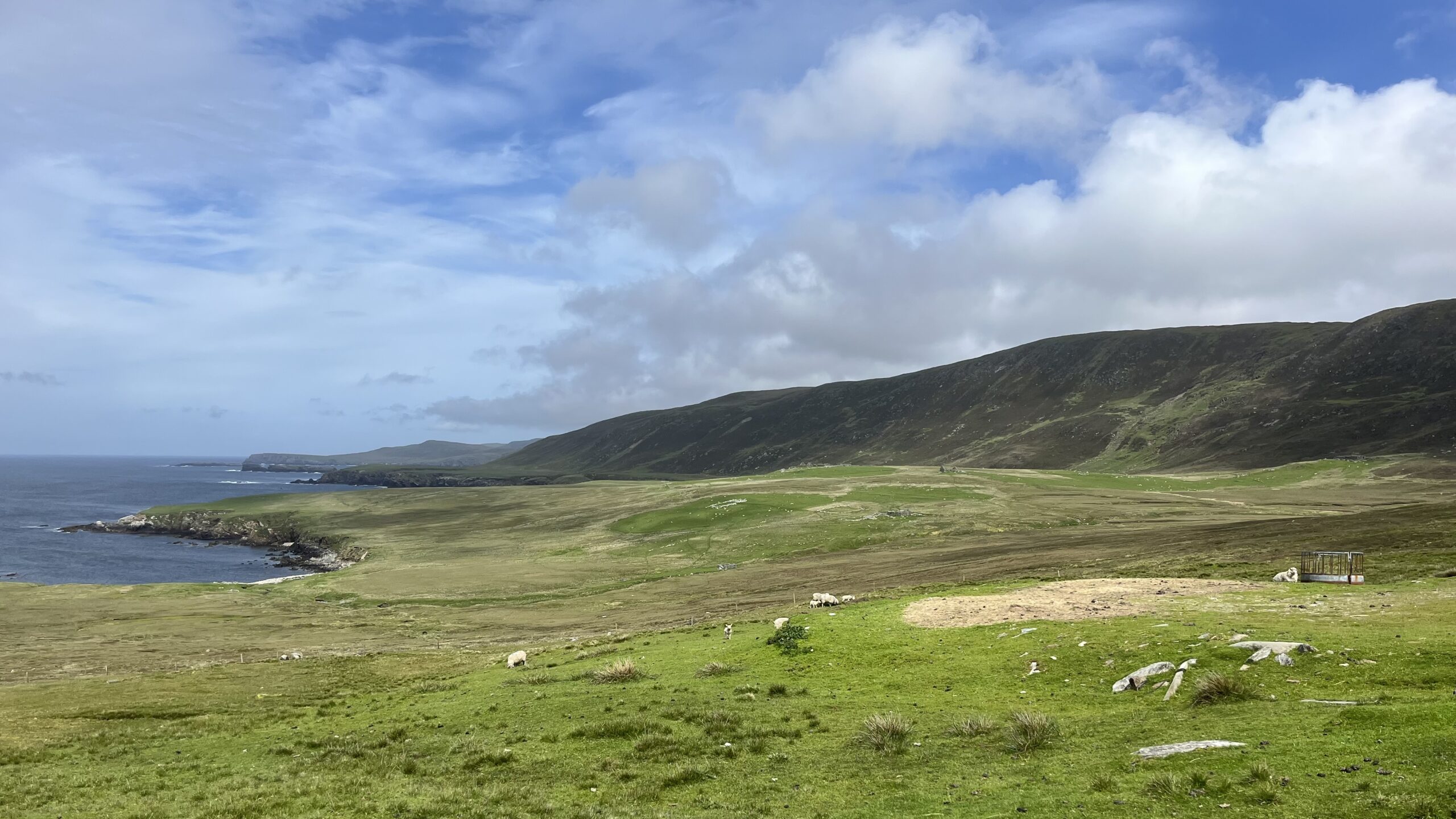
The name tells you everything. Old Norse: ‘völlr’ for level ground, ‘fjall’ for hill.1Trail Track (NB There are several other statements on this website that I know to be wrong but I think this etymology in correct.) https://trailtrack.co.uk/fells/scotland-valla-field Between a craggy ridge and sea cliffs sits a narrow platform, barely a kilometre wide, which is precisely what you get. The name nowadays though is usually given to the high point on the ridge, the second highest on Unst.
Now it is just sheep. But scattered across this platform are at least seven abandoned crofts, clustered around one called Collaster. The peats cut on the high ridge were not carried down by the usual Shetland pony. Wire cables did the job instead.2Cluness, Andrew T. THE SHETLAND ISLES. Page 199. 1956. Robert Hale Limited. Someone up here was thinking.
Every abandoned place needs its legends, and Vallafield is not short of them.
Early in the nineteenth century, a man called Sandy Winwick was walking home from Colvadale, crossing the boggy summit ridge in fading light. He stopped to smoke in the shelter of Gulla Hammar, a rock face above his croft. Then he heard music.3WESTWOOD, JENNIFER AND SOPHIA KINGSHILL. The Lore of Scotland: A guide to Scottish legends. VALLAFIELD. Arrow Books. 2011.
First it held him. Then it frightened him.
He jumped up, grabbed his pocket-knife, and the moment steel touched his fingers the music stopped dead. He ran.
Back at his croft, breathless, he told his family what had happened and sang the tune to his daughter. She played it on her fiddle. The tune survived. It is called “The Trowie Reel”, or simply “Vallafield.”
The trows of Shetland were remarkably careless about letting humans steal their music. Across Scotland, fairy melodies had a habit of escaping into human hands. Whether that says something about the trows, or about us, is worth a thought.
- 1Trail Track (NB There are several other statements on this website that I know to be wrong but I think this etymology in correct.) https://trailtrack.co.uk/fells/scotland-valla-field
- 2Cluness, Andrew T. THE SHETLAND ISLES. Page 199. 1956. Robert Hale Limited.
- 3WESTWOOD, JENNIFER AND SOPHIA KINGSHILL. The Lore of Scotland: A guide to Scottish legends. VALLAFIELD. Arrow Books. 2011.
Leave a Reply