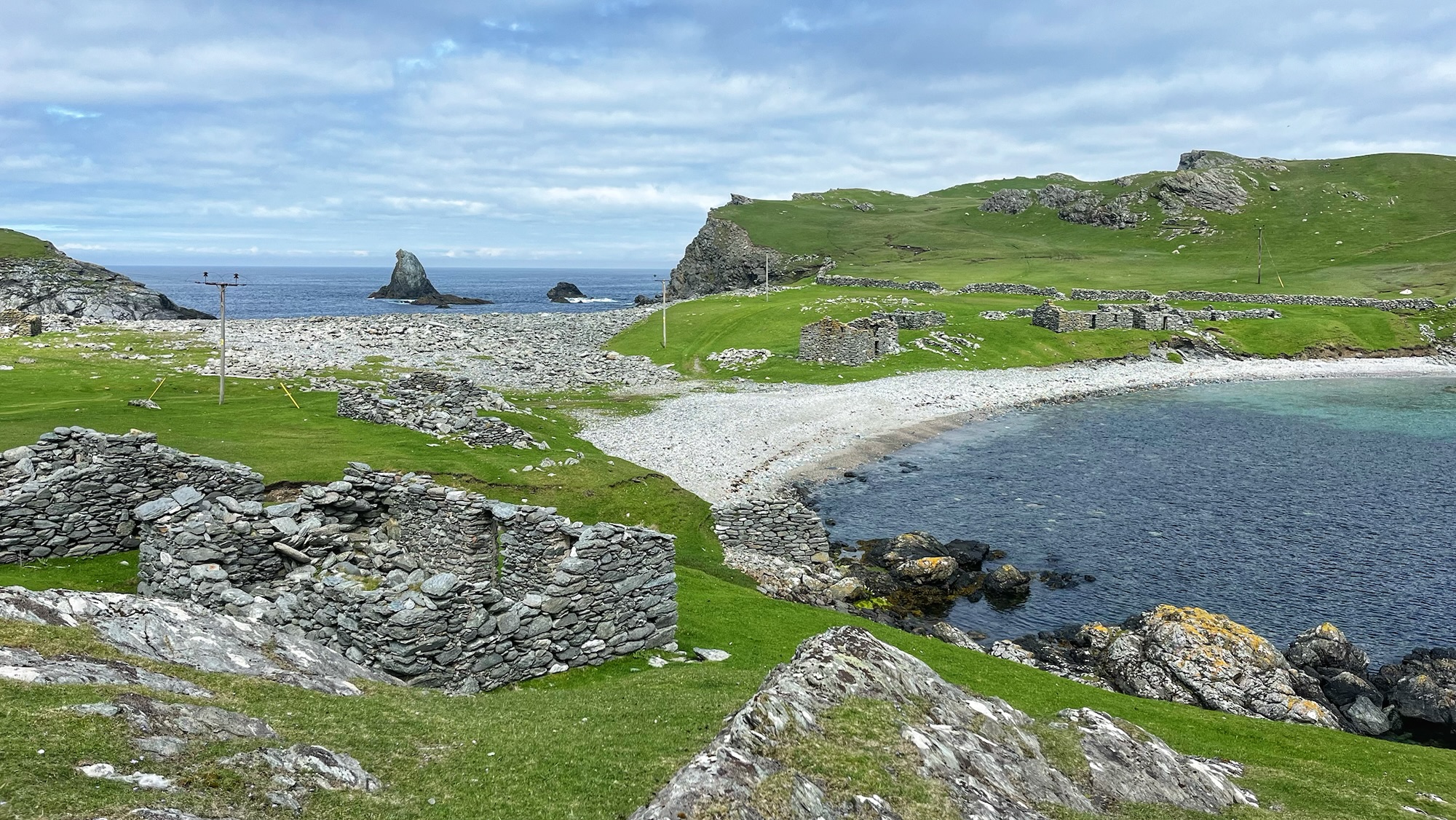
The name means “fat land.” Which is rather good, given what happened here.
For roughly five centuries, up to sixty sixareens, open wooden boats with a crew of six, launched from this beach and rowed — or sailed, when the wind was kind — eighty kilometres into the open Atlantic, well past the continental shelf, to fish for cod and ling. They did this twice a week. In boats with six oars and a square sail. In the North Atlantic1Fethaland Information Board, 2 June 2026.2Fedeland,fishing station and prehistoric house at Isle of Fethaland. Ancient Monuments UK. https://ancientmonuments.uk/126347-fedelandfishing-station-and-prehistoric-house-at-isle-of-fethaland-shetland-north-ward.
The men slept in thirty-six stone lodges between voyages. Every autumn, the roofs were lifted off and stacked away, to stop the winter storms taking them. Every spring, they went back on. This was considered perfectly normal.
That rock shaped like a hunched woman, still sitting above the beach, gazing seaward, was presumably not considered a cheerful sight.3Cluness, A.T., The Shetland Isles, 1956
The station closed in the early twentieth century. The roofs came off for the last time. Nobody put them back.
What remains is the beach, the stones, the stacks of rock out to sea, and the rather pointed fact that people thought this was worth doing for five hundred years.
Fat land. Thin odds.
- 1Fethaland Information Board, 2 June 2026.
- 2Fedeland,fishing station and prehistoric house at Isle of Fethaland. Ancient Monuments UK. https://ancientmonuments.uk/126347-fedelandfishing-station-and-prehistoric-house-at-isle-of-fethaland-shetland-north-ward
- 3Cluness, A.T., The Shetland Isles, 1956
Comments
One response to “Fethaland: Where Sixty Sixareens Braved the Atlantic”
[…] Voe now. Serene. Quiet. Almost insulting in its calm, given what happened here on 20 July 1881 [1]. My previous post covered the haaf station at Fethaland, but the station at Gloup is something else […]