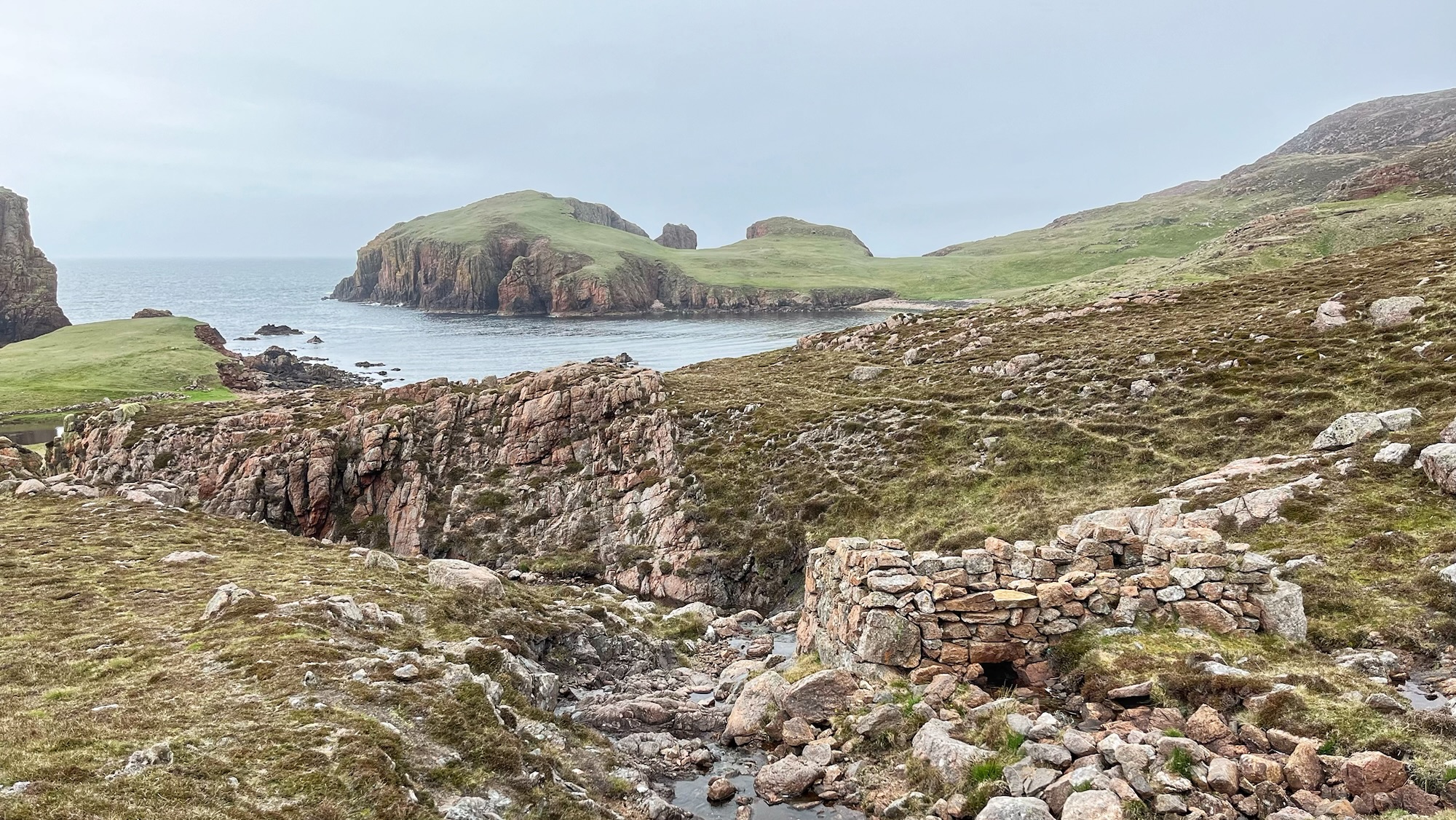
If it is not brochs, it is clack mills. On Shetland, you cannot seem to avoid one or the other, which is really no bad thing.
This one sits at North Ham on the spectacular coast of Muckle Roe. “Ham” comes from the Norse for harbour. A weatherworn signpost points the way, just about legible if you squint hard enough.
The pink granite ruins speak of Shetland’s quietly stubborn character. Forget the vast communal mills of the British mainland. These horizontal watermills were something altogether more personal — built by crofters, for crofters, serving just a handful of families at a time. The ultimate in self-reliance.
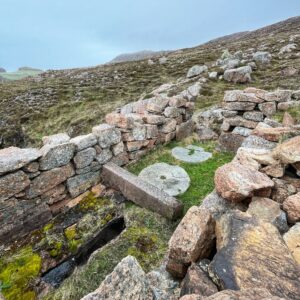
The design is the classic “Norse” form, a tradition stretching back centuries. Inside the roofless walls, the last pair of small grinding stones still lie on the floor, no longer in their original position but present nonetheless. Then something rather surprising catches the eye: a concrete lintel, also on the floor, evidence of repairs carried out sometime in the early twentieth century.
That small block of concrete tells quite a story. Medieval technology, still being patched up and put to use long after it had vanished almost everywhere else in Britain. On Shetland, old things tend to last.
Source: Historic Environment Scotland. “North Ham, horizontal mill north east of Town Loch, Muckle Roe, Shetland North.” Ancient Monuments , https://ancientmonuments.uk/126345-north-hamhorizontal-mill-north-east-of-town-lochmuckle-roe-shetland-north-ward.