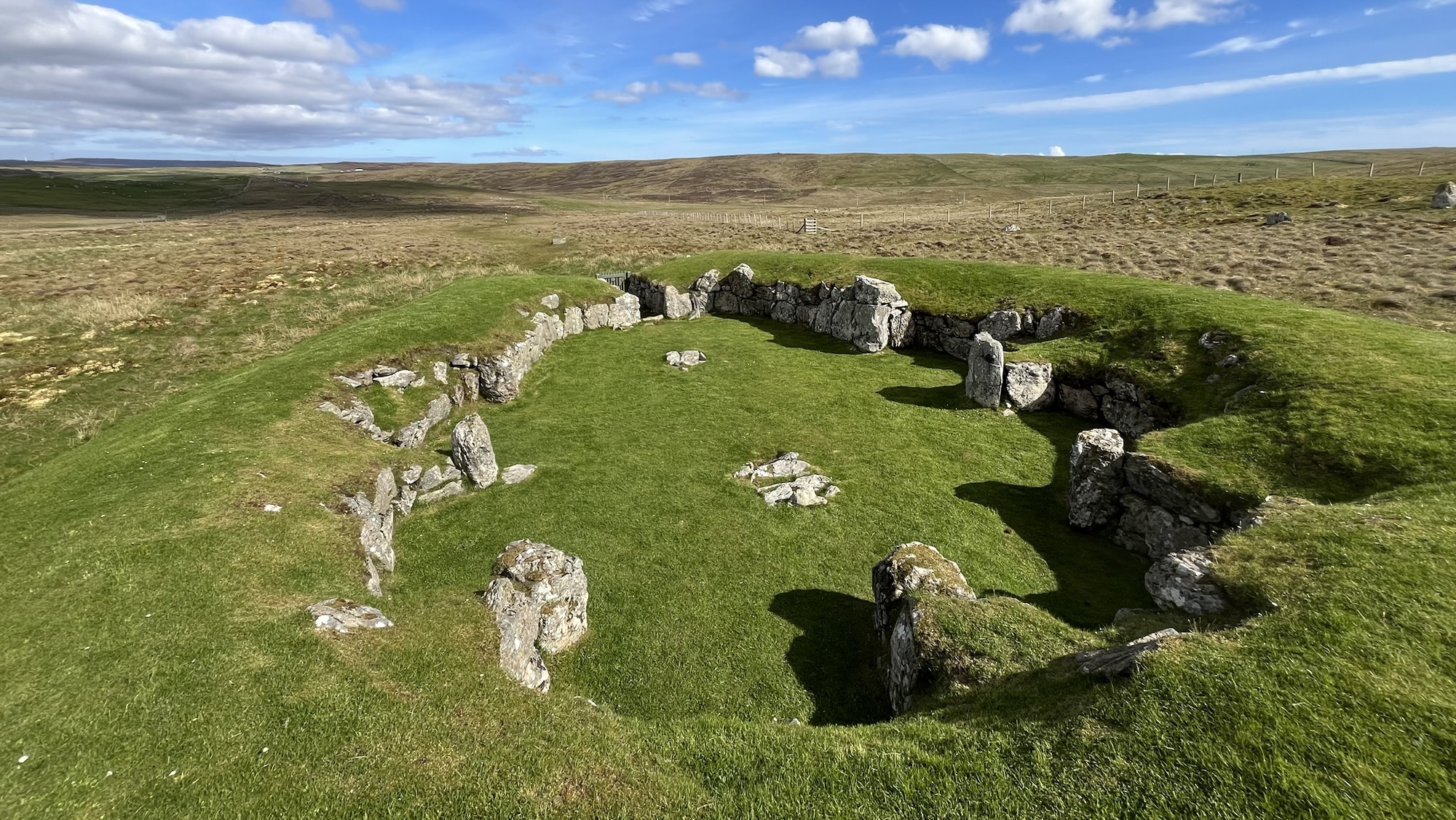
A wide-angle lens is a master of deception. It makes the walls of Stanydale Temple look rather squat. I reckon they are about 1.5 metres in height.
The Temple is a Neolithic pile of undressed stone. Of course, it’s not really a temple, folk have called it so since 1949. This is because it shares a plan with structures in the Mediterranean. It might well have been a village hall or the home of the chieftain. The archaeologists are not certain.1Goodlad, Laurie. “Shetland’s top archaeological sites.” Shetland.org, 6 Jan. 2021, https://www.shetland.org/visit/inspiration/shetlands-top-archaeological-sites.2“Stanydale Temple.” On-site Information Boards, Shetland, 27 May 2026.
The architecture is heel-shaped. This was apparently all the rage for Neolithic burial chambers. The walls are twelve feet thick. Inside lies an oval chamber with six shallow recesses at the rear.3Laing, Lloyd. Orkney and Shetland: An Archaeological Guide. David & Charles, 1974.
Excavations revealed charred spruce in two central postholes. Spruce is not a native of these islands. The timber likely arrived as driftwood from North America. Seven hundred metres of finished wood was required for the roof. This is quite an achievement for a treeless wilderness.
The “temple” was the heart of a farming community. It sits in a hollow out of sight of the sea. It is “shrouded in mystery and intrigue“. Certainly a lovely spot if you enjoy looking at ruins that refuse to explain themselves.
- 1Goodlad, Laurie. “Shetland’s top archaeological sites.” Shetland.org, 6 Jan. 2021, https://www.shetland.org/visit/inspiration/shetlands-top-archaeological-sites.
- 2“Stanydale Temple.” On-site Information Boards, Shetland, 27 May 2026.
- 3Laing, Lloyd. Orkney and Shetland: An Archaeological Guide. David & Charles, 1974.