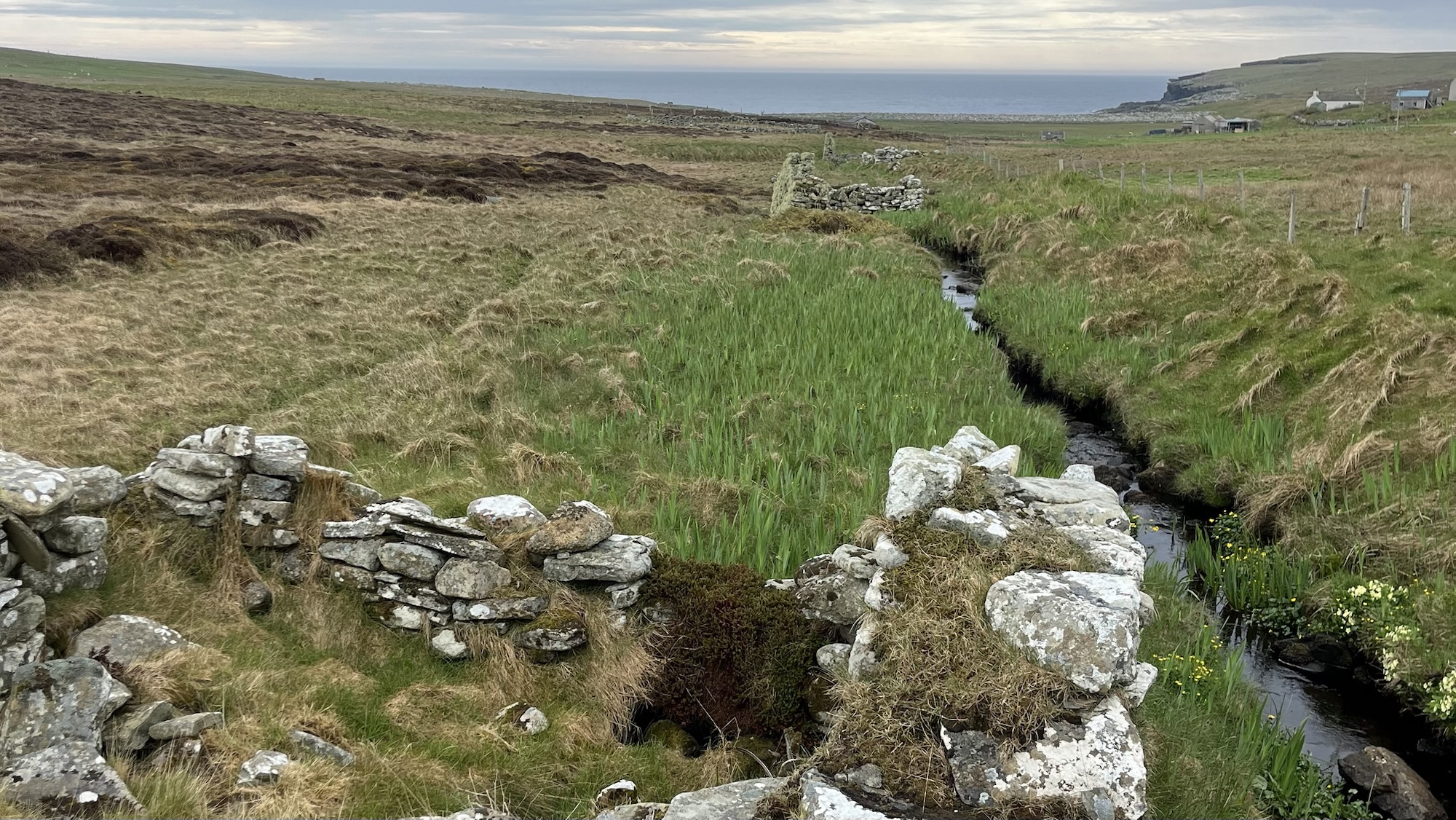
Beneath a wide Shetland sky, a line of stone ruins follows the Burn of Clumlie toward the sea. These are “clack mills” — what is left of a row of nine horizontal water mills along a 450m stretch of the burn that once ground grain for local crofters north of Troswick.1Historic Environment Scotland. “Troswick, water mill complex N of.” Trove.scot, 11 July 2012, https://www.trove.scot/designation/SM2859.
The engineering is rather clever. Where mainland Britain favoured vertical wheels, these mills used a horizontal paddle wheel in a lower chamber to turn millstones in the room directly above. This “Norse” design proved so reliable it held its ground across Shetland for over a thousand years. The mills at Clumlie probably date to the 19th century, yet they speak to a neighbourly tradition of sharing sluices and lades along a single stream.2Westwood, Jennifer, and Sophia Kingshill. The Lore of Scotland: A Guide to Scottish Legends. Arrow Books, 2011.
The mills were not merely useful. They were odd, lonely places thick with superstition. Millers kept one eye open for the Noggle, a mischievous water-spirit in pony form said to seize the wheel and stop all work. Others found the mills rather more rewarding. Legend holds that the fiddle tune “Winyadepla” came to a man dozing at a watermill after he overheard a troop of trows playing music.
Seven of Clumlie’s mills still stand. They are quiet witnesses to a life where hard work and old magic were barely a whisker apart.
- 1Historic Environment Scotland. “Troswick, water mill complex N of.” Trove.scot, 11 July 2012, https://www.trove.scot/designation/SM2859. ↩︎
- 2Westwood, Jennifer, and Sophia Kingshill. The Lore of Scotland: A Guide to Scottish Legends. Arrow Books, 2011. ↩︎
Leave a Reply