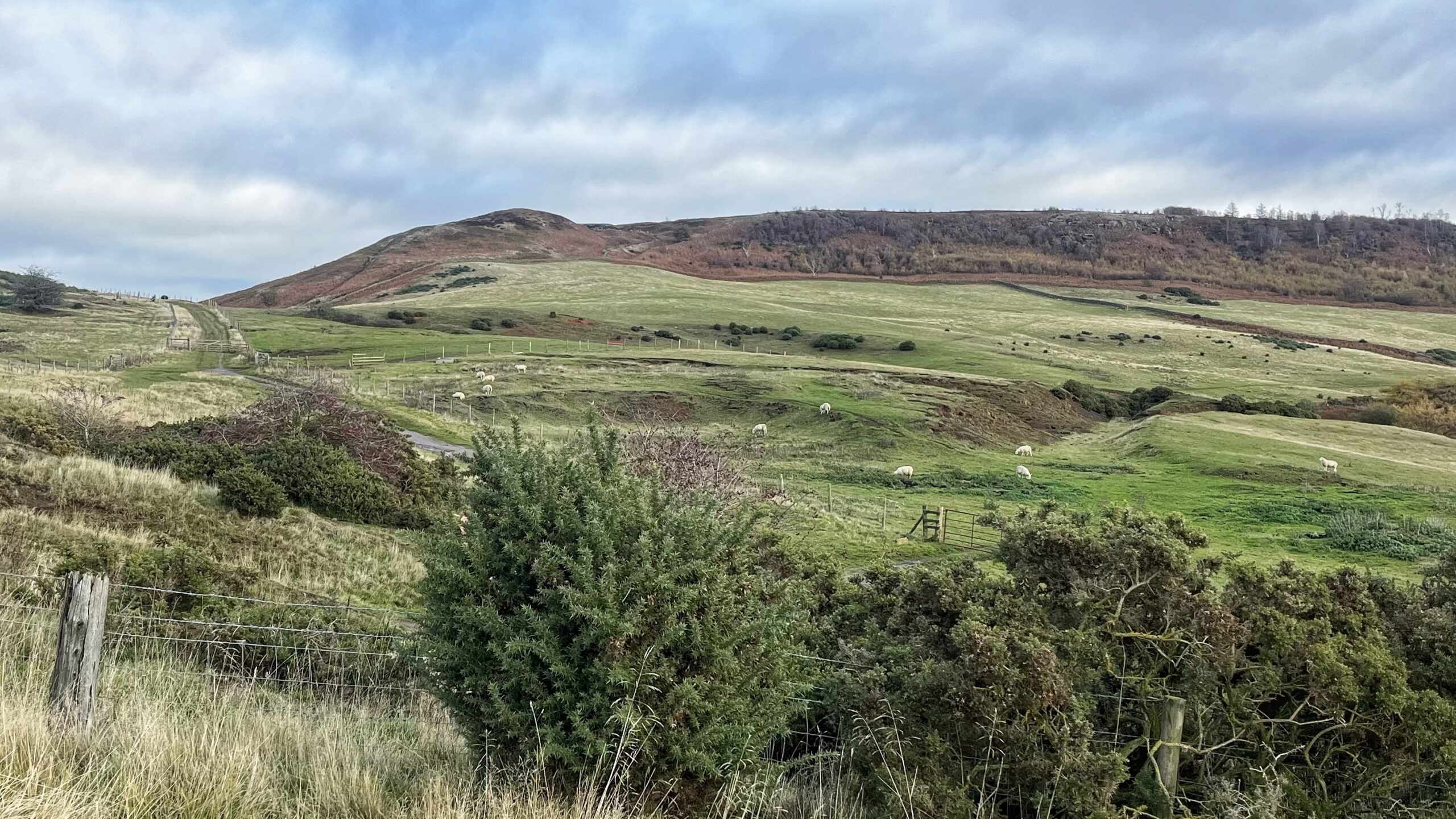
Walkers and cyclists on Aireyholme Lane mostly pass this way without a second glance. Today, the sheep have the humps and bumps to themselves. In 1919, 386 people worked here.
The original mine entrance, driven into the hill under Roseberry, lies in that patch of gorse and hawthorn left of centre. It has been backfilled with agricultural rubbish, and the shrubs have moved in. The deep cutting right of centre carried the tramway to the eastern drift, which ran under Little Roseberry and on beneath Newton Moor. Just in front of the sheep, the concrete beds of the haulage engines and what remains of the pony stables can still be seen but every year are sinking further under turf and moss.
Teesside’s blast furnaces needed ore, and the Main Seam, found in the Eston Hills in the 1850s, set off a frantic search for more. The Norton Iron Company took the lease at Roseberry in 1870, was taken to court the following year for failing to meet its obligations, and paid the landowner £689. Joseph Dodds, the Stockton MP, and a partner took over in 1874 and finished a tramway to the Great Ayton branch railway in the winter of 1880. The seam was 5 feet 5 inches thick but only 28 to 29 per cent iron, close to the limit of what could pay, though it lay near the surface and drained itself. By 1883 the mine had yielded just 1,216 tons. Dodds sold the lease in 1882 to Stevenson, Jacques and Company, who soon went into liquidation. Dodds himself later embezzled £13,800 from an elderly client, resigned his seat and died poor in 1888.
The mine reopened in 1907 under James Joseph Burton of the Tees Furnace Company and became the largest of the three ironstone mines around Roseberry. The workings spread east until they covered more than 107 hectares underground. In 1917 it produced 203,594 tons of ore, which makes the 1,216 tons of the 1880s look like a sample. Demand collapsed in the early 1920s, no buyer could be found for the stone, and work stopped in June 1924. The machinery went under the hammer in February 1931.
Source: Middleton, Penny. Roseberry Ironstone Mine. The North York Moors National Park Authority. Northern Archaeological Associates Ltd. NAA 13/105. September 2013.
Leave a Reply