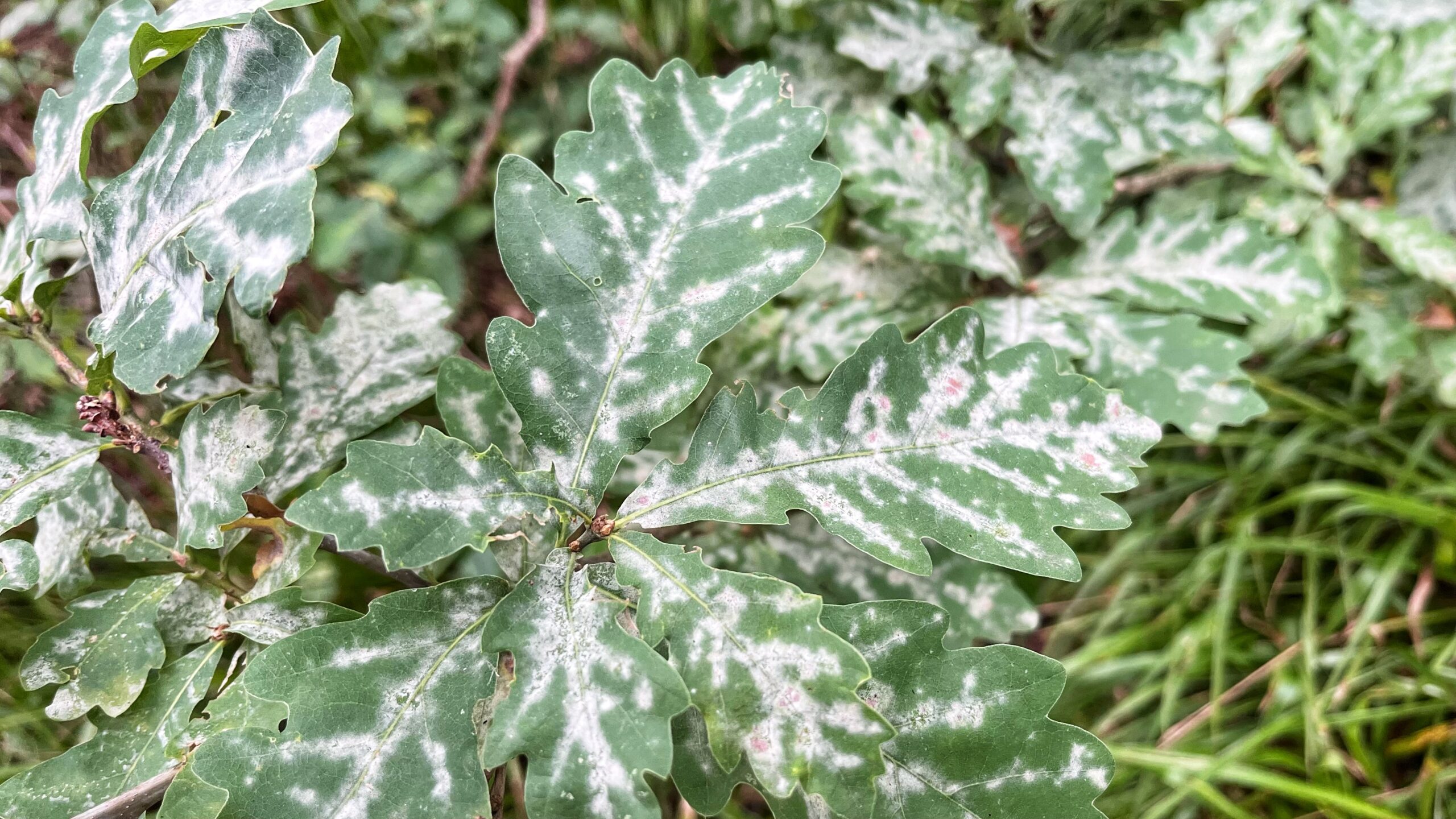
Back on my own patch after two weeks away, and the oaks in Newton Wood have gone a ghostly white, as though someone had taken a flour sifter to the whole wood. Powdery mildew turned up in Europe in 1907 and has been putting a dampener on the British summer ever since.
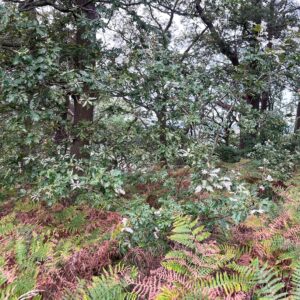 The parasite began its life on tropical fruit trees, then set its sights rather higher and conquered ancient British oaks. Cheeky little thing. It helps itself to half the leaf’s carbon fixation, and cuts stomatal conductance by fifteen to thirty per cent. Come a hot spell, the tree starts leaking water into the warm air like a punctured hosepipe.
Mature trees shrug the whole business off. Same vandalism, every single year, and they just carry on regardless. A nuisance, nothing worse. The parasite is not interested in killing its host. It would rather keep the tree alive and come back for another go next summer.
Sources:
- Lonsdale, David. “Powdery mildew of oak: a familiar sight with some hidden surprises.” Arboricultural Magazine, Spring 2016, pp. 48–52. https://www.ancienttreeforum.co.uk/wp-content/uploads/2016/02/Arb-mag-Spring-2016-powdery-mildew-of-oak.pdf [Accessed 13 Sept 2026]
- “Erysiphe alphitoides.” Wikipedia, 28 Aug. 2026. https://en.wikipedia.org/wiki/Erysiphe_alphitoides [Accessed 13 Sept 2026]
- “Erysiphaceae.” Wikipedia, 24 Aug. 2026. https://en.wikipedia.org/wiki/Erysiphaceae [Accessed 13 Sept 2026]
Leave a Reply