Memory plays odd tricks. Yesterday mine dredged up a scene from some Disney film, the heroine wandering through a meadow with butterflies and birds fluttering about her like a doting entourage. Animators loved surrounding young women with woodland creatures. Saved them writing dialogue.
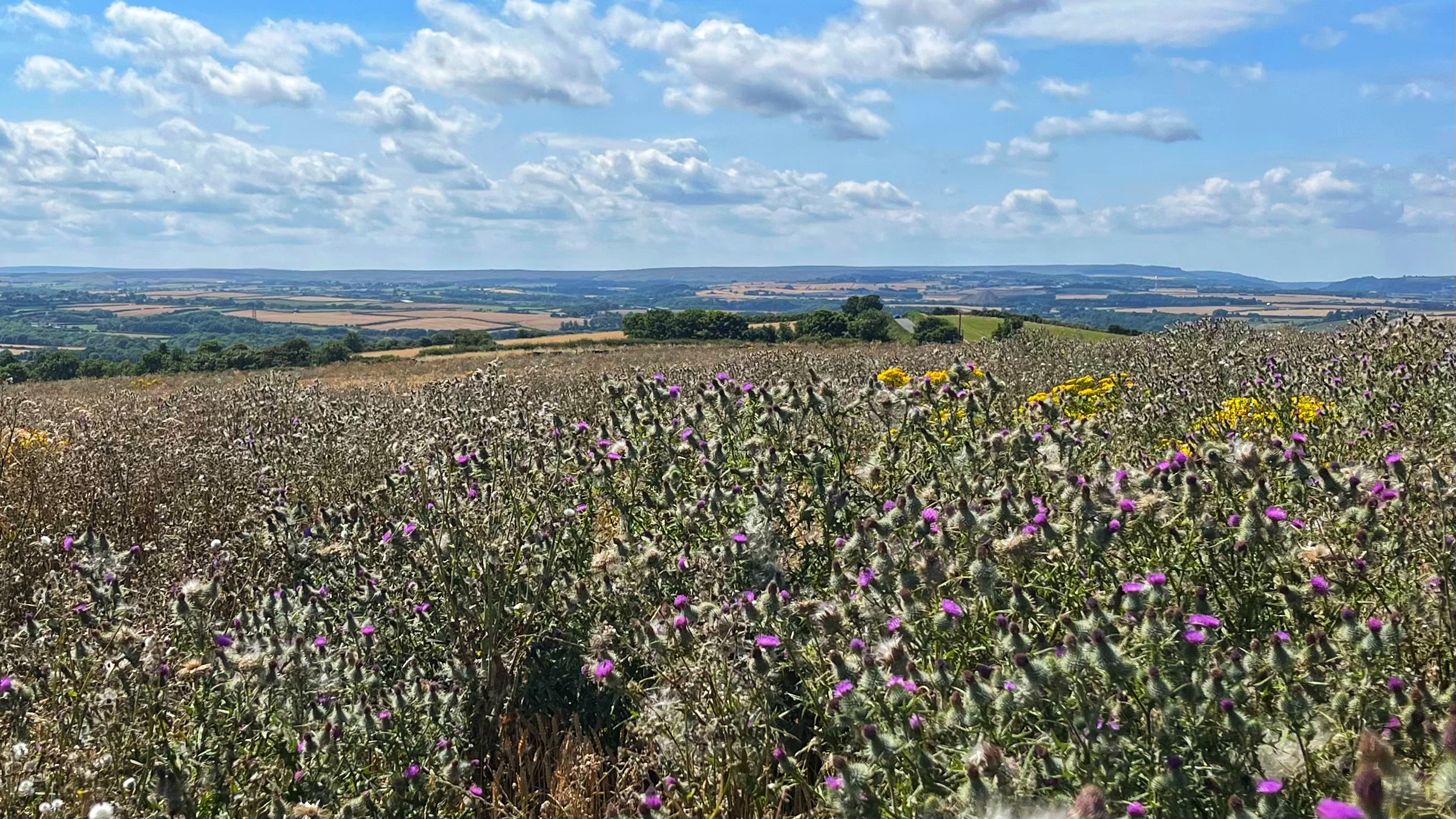
This field needed video, really, to do it justice. Thistles stretched as far as the lens could see. Painted Ladies and other butterflies, hundreds of them, hoverflies galore, all gorging on the nectar. Thistledown drifted across on the breeze and settled in soft drifts in the clearings. A Roe deer poked its head above the purple sea, then bounded off. No sign of the quail that have been reported here, mind.
I had gone along to open up the Public Footpath running beside the field, a typical volunteer job the National Trust puts on at this time of year.
The field has only just come into the Trust’s hands, after years of neglect, or perhaps it had simply been “set-aside”. What the grand plan is for it, I do not yet know, beyond it becoming a nature link between the Trust’s properties at Hummersea and Boulby. Turning a field of thistles into a diverse nature reserve, however lovely the Painted Ladies find it, sounds a tall order.
There is UK legislation covering some thistles, though narrower than most people assume. Law has a habit of arriving after the horse has bolted, or in this case after the seeds have blown clean over the hedge.
Under the Weeds Act 1959, two thistle species are classed as injurious weeds: Spear thistle and Creeping thistle. That does not make it illegal to have thistles on your land. The Act lets the authorities, in England now through Natural England, serve a notice requiring an occupier to stop these weeds spreading where they threaten agricultural land, especially grazing or crops. Ignore the notice and you have committed an offence. The point is to stop the spread onto farmland, not to wipe out every last thistle. They are native plants, valuable to bees, butterflies and seed-eating birds, so nobody is under any general duty to destroy them.
Spear thistle, which I think dominates here, is a biennial, and that is the key to beating it. Year one, it sits as a flat rosette of leaves. Year two, it flowers, sets seed, and dies. Stop the seeding and the battle is usually won.
Control comes down to digging or grubbing, mowing, hand-pulling, or a selective broadleaf herbicide, though I should think the Trust would take a dim view of that last one.
Whatever the plan turns out to be, as The Terminator said, “I’ll be back.”
Leave a Reply