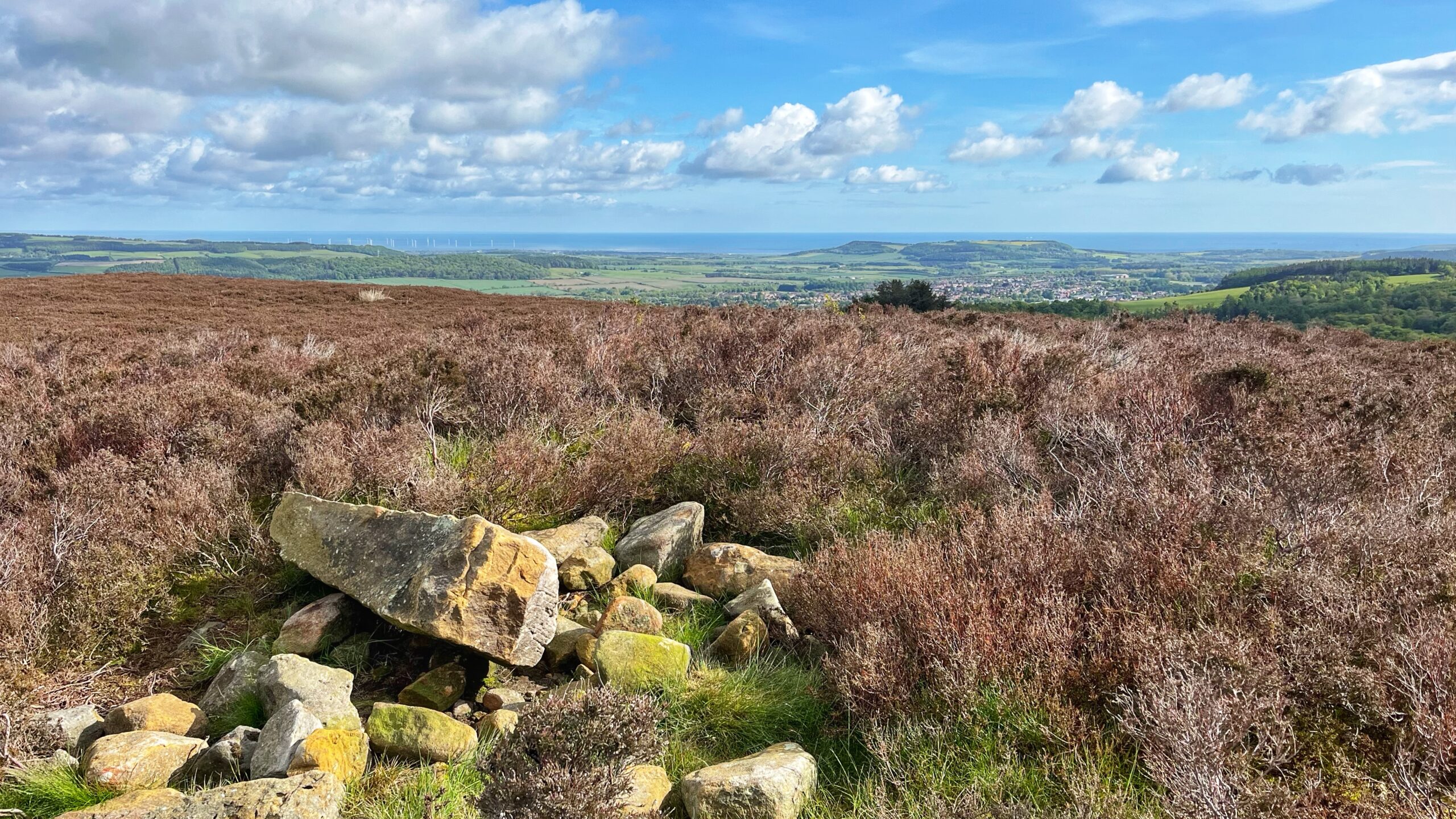
Word had reached me that this nineteenth-century boundary stone, marking the old parish line between Hutton Lowcross and Newton, had fallen over1NYMNPA HER Records (Monuments). Round cairn and boundary stone on top on Hutton Moor. HER No: 16526.. It has not been broken, nor properly buried — just balanced upright and packed around with a few small stones. Frankly, it is rather remarkable that it stood for over 200 years. Or perhaps this is not its first trip to the ground.
Had I been Lord of the Manor in 1815, the date cut into the stone, I would have ordered one two feet longer and dug a proper hole. But perhaps Thomas Kitchingman Staveley — whose initials TKS are also inscribed — knew perfectly well that he was erecting it on a Bronze Age round cairn, and thought a spade a step too far. Then again, perhaps TKS simply could not be bothered.
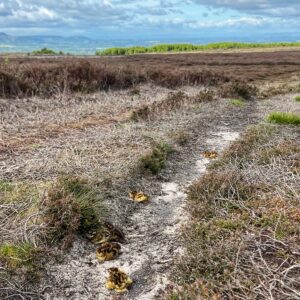
Crossing the moor, I nearly put my boot through a brood of grouse chicks. Their mother flew off in a terrible flap — quite forgetting the time-honoured ruse of feigning a broken wing. Some instincts, it seems, are less reliable than others.
- 1NYMNPA HER Records (Monuments). Round cairn and boundary stone on top on Hutton Moor. HER No: 16526.
Leave a Reply