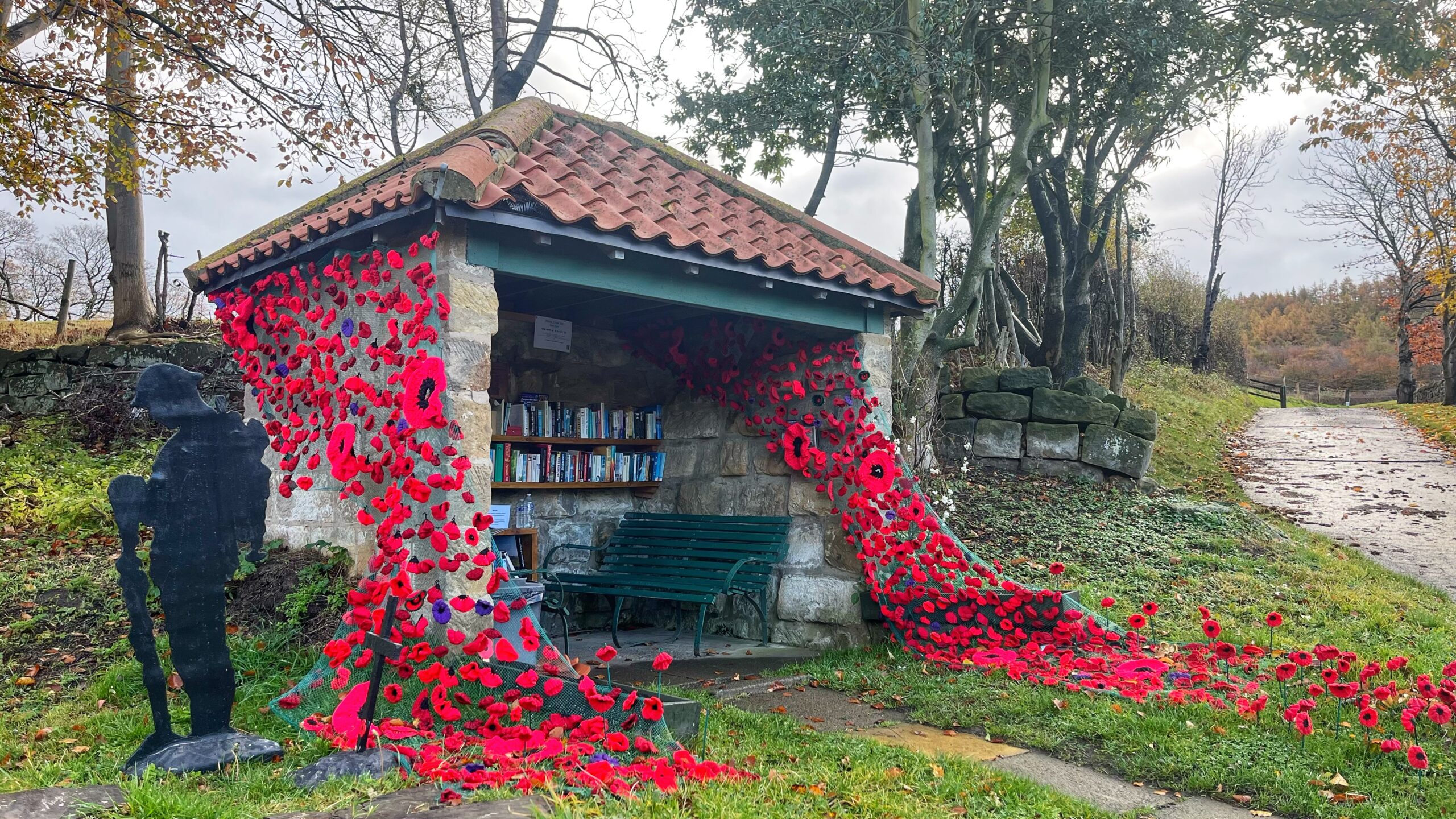
Most people take it for a bus shelter. It is in fact a war memorial.
Kildale has about 130 residents and has never passed 200, yet 17 of its men died in the First World War. Even that memorial caused a quarrel. A parish meeting reversed the first choice of site, and it ended up on the path halfway to the church door.
After the Second World War, the Lord of the Manor, Mr Godfrey Turton, thought a similar church memorial might not appeal to the Nonconformists. So, rather than just add an additional plaque on the existing memorial, the parish settled instead on a public shelter and garden within an enclosure under the beech trees. The stone was probably carted from the moors by local farmers.
In 1949 the parish compared the cost of various roofs and chose tiles on a hipped pyramid. It left off the gutters, since they could “always be added later”.
Originally there were to be two names on the memorial plaque, both having given their lives in World War II:
- Pte. Samuel C.B. Liddle
- Sgt. Eric B. Tones (R.A.F.)
But a third was added and that name has a story. Sgt. Francis T. Chambers (R.A.F.) came from the Midlands, taught in Middlesbrough and briefly rented a cottage at Little Kildale. There he met Beryl Tones, sister of Eric Tones, one of the other fallen. He married her but was himself killed in 1945. That original plaque is now in the church replaced by a new one which includes those 17 fallen of the First World War.
Today the shelter holds a book exchange. Walkers on the Cleveland Way can eat their sandwiches inside, and schoolchildren once gathered there each morning for the bus.
Source: Anthony, Cedric. “Glimpses of Kildale History”. Geni Printing. 2012.
Leave a Reply