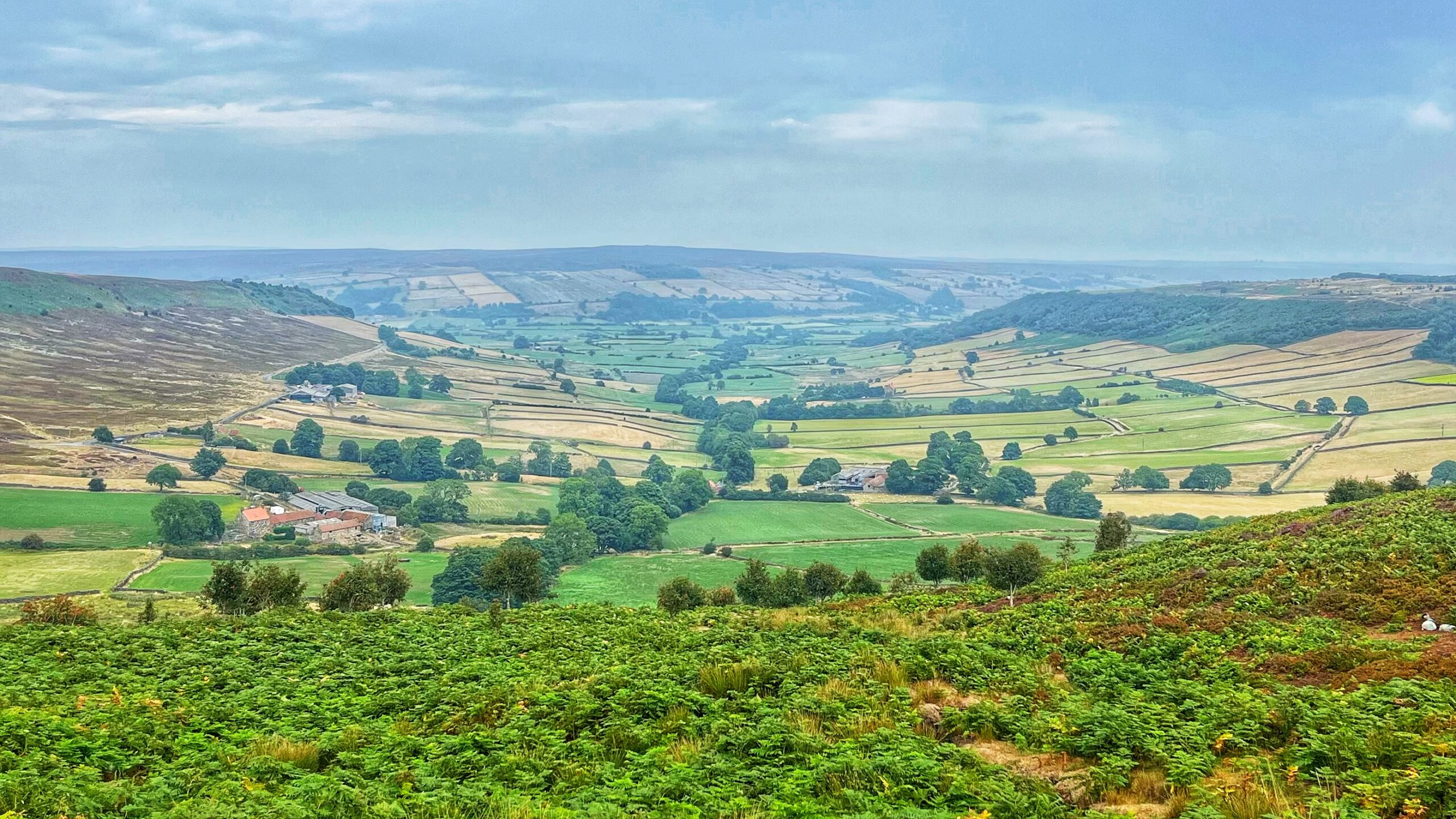
The North York Moors dales are broader than you expect, every single time. Stand on Danby Rigg and look down at Little Fryup Dale and you will see exactly what I mean: a proper patchwork quilt of a valley, laid out below like someone tipped a box of green and gold offcuts onto the hillside. We had no idea a rain cloud was on our tail that day. Sheer luck saw us safely inside Danby Lodge before it caught up with us.
Fryup is an odd name for a place, and nobody is entirely sure where it comes from. One source claims it comes from the Old English personal name Friga1High Stepping. Yorkshire Evening Post. 10 March 1999.. Wikipedia takes a different view, suggesting the element Fre may nod to the Norse goddess Frigg instead. Take your pick.
The “up” part is on firmer ground. It comes from the Old English hōp, meaning a valley, and specifically a hanging one. Friga’s valley, then, whoever Friga was.
The dale looks the picture of peace now, but it very nearly was not. Victorian entrepreneurs had their sights set on the ironstone beneath it, and the Whitby Gazette reported in 1863 that the “top seam”, about twelve feet thick, had been discovered and that it was of similar character to the well-known Rosedale ironstone. That seam ran the length of Great Fryup’s east side, but it was Little Fryup Dale that got singled out as the route for a railway, one meant to join the Esk Valley line then under construction. The paper noted that several applications had already reached Lady Downe’s agent, all hoping to lease the royalty to work the valuable iron stone2FRYUP. Cleveland Iron Stone. Whitby Gazette – Saturday 17 January 1863..
Lady Downe, it seems, did not share their enthusiasm. The railway never came, and the dale kept its peace.
Leave a Reply