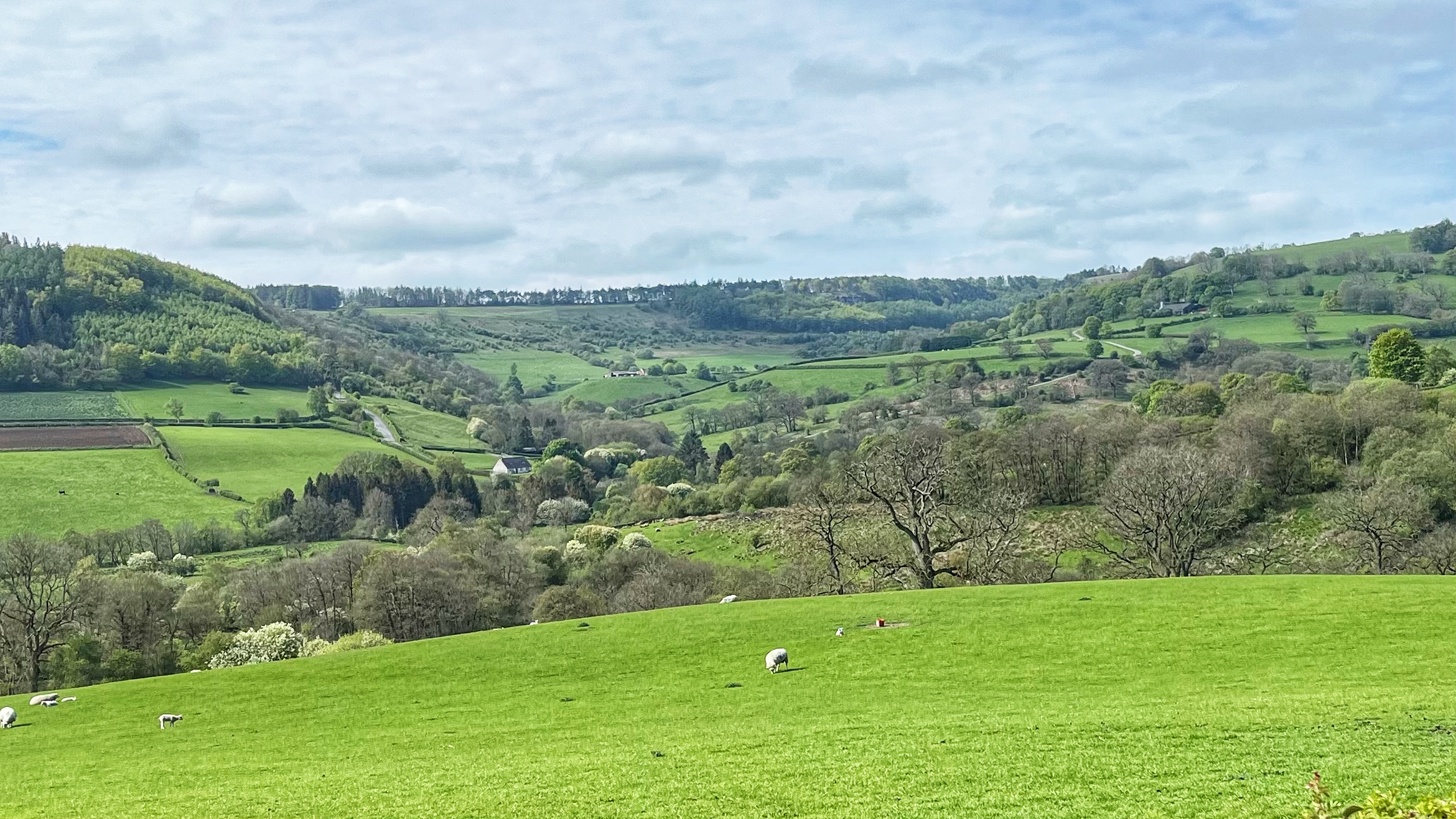
Look at this photograph of Gowerdale. Green, serene, and — rather importantly — entirely free of Victorian ironwork. It came within a whisker of being otherwise.
By 1856, Britain’s great Railway Mania was already ancient history — or at least a decade-old hangover. The mid-1840s had seen 263 Acts of Parliament passed in a single year, authorising over 9,500 miles of new track. Fortunes were made, then lost. About a third of those railways were never built. Sensible investors had since learned to sit on their hands.
Yet in October of that year, the good people of Helmsley and Kirbymoorside held a public meeting at the Helmsley Court House, fired up about getting a railway of their own. Lord Feversham was in the chair. The engineer Robert Hodgson had been called in from Newcastle to survey the ground.1“Proposed Extension of Railway Communication to Helmsley and Kirbymoorside.” Yorkshire Gazette, 11 Oct. 1856, p. 11. British Newspaper Archive, https://www.britishnewspaperarchive.co.uk/viewer/bl/0000266/18561011/061/0011.
His report proposed a line of some 22 miles from Thirsk, skirting the Hambleton Hills, plunging through a tunnel of 2,500 yards under Murton Common, emerging into Gowerdale — right where you are looking — then crossing Ryedale on a viaduct 85 feet high before climbing into a second tunnel of 2,420 yards under Helmsley Moor. The estimated cost: a fairly staggering £403,532.
Hodgson’s report was received, noted, and promptly argued with. A Thirsk gentleman named Joseph Rider wrote to the Yorkshire Gazette four times between October and November 1856, insisting that a better, cheaper, and altogether more sensible route could be found — up along Caydale and then tunnelling under the Hambletons, for something under £200,000.2Rider, Joseph. “Helmsley & Thirsk Railway.” Yorkshire Gazette, 1 Nov. 1856, p. 4. British Newspaper Archive, https://www.britishnewspaperarchive.co.uk/viewer/bl/0000266/18561101/021/0004.
Rider was not without feeling for the landscape. Approaching the brink above Rievaulx, he urged his readers to stop, admire the view, and accept that nature had — rather firmly — said no to a railway through there.3Rider, Joseph. “Helmsley and Thirsk Railway.” Yorkshire Gazette, 25 Oct. 1856, p. 4. British Newspaper Archive, https://www.britishnewspaperarchive.co.uk/viewer/bl/0000266/18561025/025/0004. He even promised to plant out all earthworks so thoroughly that “no person, after a very few years, should be able to know there was a line, or to trace its course.“4Rider, Joseph. “Helmsley & Thirsk Railway.” Yorkshire Gazette, 1 Nov. 1856, p. 4. British Newspaper Archive, https://www.britishnewspaperarchive.co.uk/viewer/bl/0000266/18561101/021/0004. How tremendously reassuring.
His grand ambition did not stop at Helmsley. He imagined the line extended eastward to connect Hull and Newcastle in a great artery of commerce, reaching eventually to Carlisle and Glasgow. All of this, he was quite certain, would be “of immense public as well as private advantage.“5Rider, Joseph. “Helmsley and Thirsk Railway.” *Yorkshire Gazette*, 8 Nov. 1856, p. 4. *British Newspaper Archive*, https://www.britishnewspaperarchive.co.uk/viewer/bl/0000266/18561108/030/0004.
Nothing came of any of it. Not one sleeper was laid. Not one shovel broke the ground of either Gowerdale or Caydale. The dale in the photograph looks today precisely as it did when Rider was sharpening his quill, and one is inclined to raise a small, quiet cheer about that.
The engineering difficulties were real enough — enormous viaducts, two long tunnels, and gradients that an engineer called “very objectionable” were not a recipe for attracting cautious post-Mania investors.6“Proposed Extension of Railway Communication to Helmsley and Kirbymoorside.” Yorkshire Gazette, 11 Oct. 1856, p. 11. British Newspaper Archive, https://www.britishnewspaperarchive.co.uk/viewer/bl/0000266/18561011/061/0011. The committee, having heard everything, apparently decided that the course appeared “easy and inexpensive” only in the imagination of Mr Rider.7Rider, Joseph. “Helmsley and Thirsk Railway.” *Yorkshire Gazette*, 8 Nov. 1856, p. 4. *British Newspaper Archive*, https://www.britishnewspaperarchive.co.uk/viewer/bl/0000266/18561108/030/0004.
Helmsley eventually did get a railway — a somewhat circuitous route via Gilling. The question worth pondering is this: if Mr Hodgson’s route was accepted, would that Gowerdale in the photograph still be worth looking at?
- 1“Proposed Extension of Railway Communication to Helmsley and Kirbymoorside.” Yorkshire Gazette, 11 Oct. 1856, p. 11. British Newspaper Archive, https://www.britishnewspaperarchive.co.uk/viewer/bl/0000266/18561011/061/0011. ↩︎
- 2Rider, Joseph. “Helmsley & Thirsk Railway.” Yorkshire Gazette, 1 Nov. 1856, p. 4. British Newspaper Archive, https://www.britishnewspaperarchive.co.uk/viewer/bl/0000266/18561101/021/0004. ↩︎
- 3Rider, Joseph. “Helmsley and Thirsk Railway.” Yorkshire Gazette, 25 Oct. 1856, p. 4. British Newspaper Archive, https://www.britishnewspaperarchive.co.uk/viewer/bl/0000266/18561025/025/0004. ↩︎
- 4Rider, Joseph. “Helmsley & Thirsk Railway.” Yorkshire Gazette, 1 Nov. 1856, p. 4. British Newspaper Archive, https://www.britishnewspaperarchive.co.uk/viewer/bl/0000266/18561101/021/0004. ↩︎
- 5Rider, Joseph. “Helmsley and Thirsk Railway.” *Yorkshire Gazette*, 8 Nov. 1856, p. 4. *British Newspaper Archive*, https://www.britishnewspaperarchive.co.uk/viewer/bl/0000266/18561108/030/0004. ↩︎
- 6“Proposed Extension of Railway Communication to Helmsley and Kirbymoorside.” Yorkshire Gazette, 11 Oct. 1856, p. 11. British Newspaper Archive, https://www.britishnewspaperarchive.co.uk/viewer/bl/0000266/18561011/061/0011. ↩︎
- 7Rider, Joseph. “Helmsley and Thirsk Railway.” *Yorkshire Gazette*, 8 Nov. 1856, p. 4. *British Newspaper Archive*, https://www.britishnewspaperarchive.co.uk/viewer/bl/0000266/18561108/030/0004. ↩︎
Leave a Reply