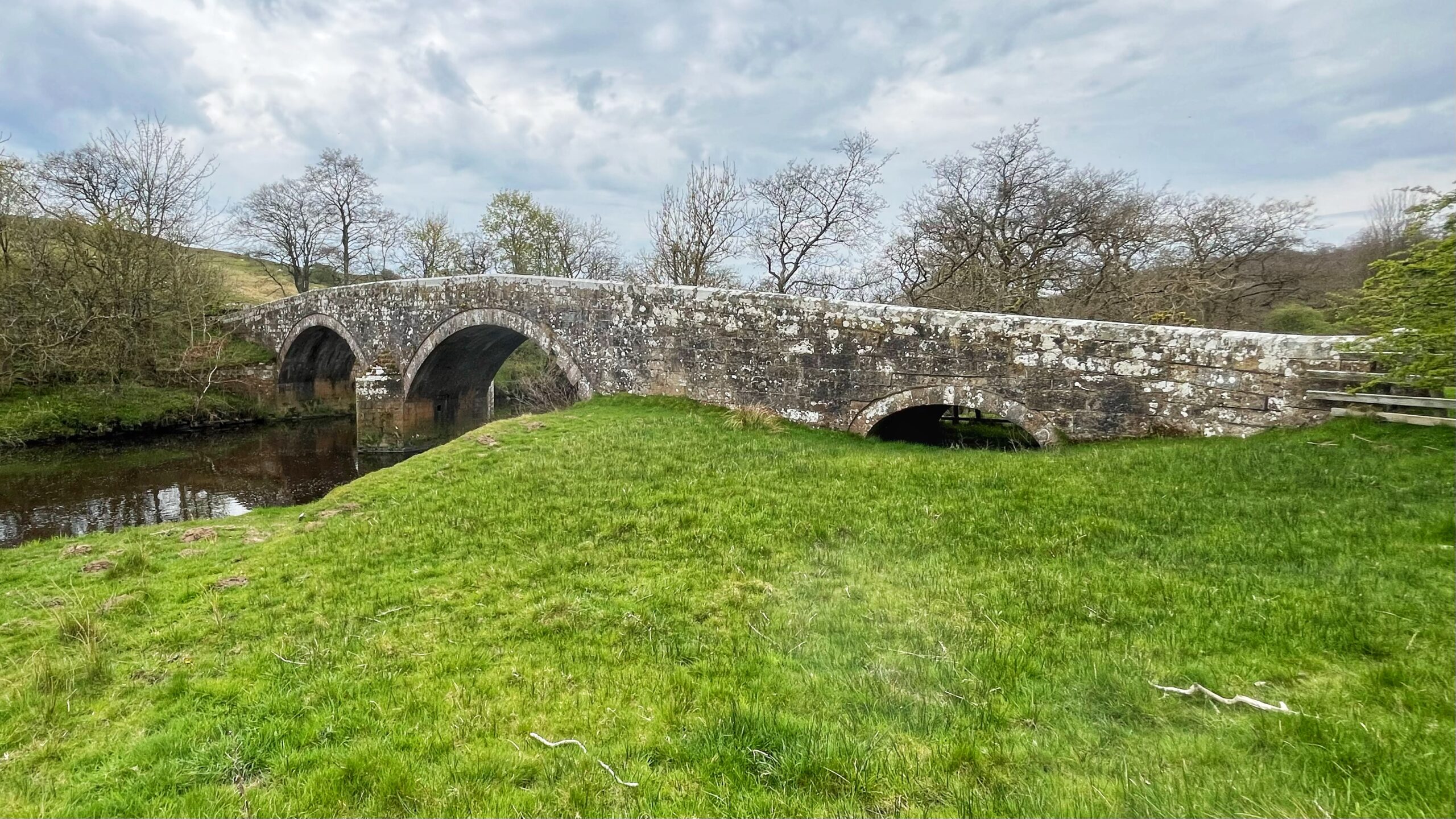
Built in 1715, Rede Bridge crosses the River Rede in rural Northumberland with two confident stone arches and a smaller flood arch on the right bank. It is Grade II listed.1Historic England listing (Entry 1044962). https://keystothepast.info/search-records/results-of-search/results-of-search-2/site-details/?PRN=N8082 It is, by any measure, too good a bridge for a field path.
So why build it at all?
The most persuasive answer involves cattle. This was almost certainly a drove road — the route by which livestock were moved from the upland Tyne valley south to the great fairs at Stagshaw and Corbridge. A stone signpost near the bridge, carved with a “C” for Corbridge, apparently backs this up. The bridge had to be solid because the River Rede, before the Catcleugh Reservoir tamed it in the early twentieth century, flooded violently and often.
Then the railway arrived downstream. A new crossing was built nearer Redesmouth where a village had sprung up near the railway junction, and the old drove road was simply ignored. It became “the old green road” — popular, one local farmer recalled, with “walkers and car-bound courting couples.“2Allen, Robert, quoted in “Woolshed 1: Robert Allen — Northumbrian Farmer, Poet and Historian.” Woolshed 1, 19 Dec. 2008, https://woolshed1.blogspot.com/2008/12/robert-allen-northumbrian-farmer-poet.html.
Three centuries of cattle, drovers, and romantics.
The bridge still stands. The road it carried has been forgotten.
- 1Historic England listing (Entry 1044962). https://keystothepast.info/search-records/results-of-search/results-of-search-2/site-details/?PRN=N8082
- 2Allen, Robert, quoted in “Woolshed 1: Robert Allen — Northumbrian Farmer, Poet and Historian.” Woolshed 1, 19 Dec. 2008, https://woolshed1.blogspot.com/2008/12/robert-allen-northumbrian-farmer-poet.html.
Leave a Reply