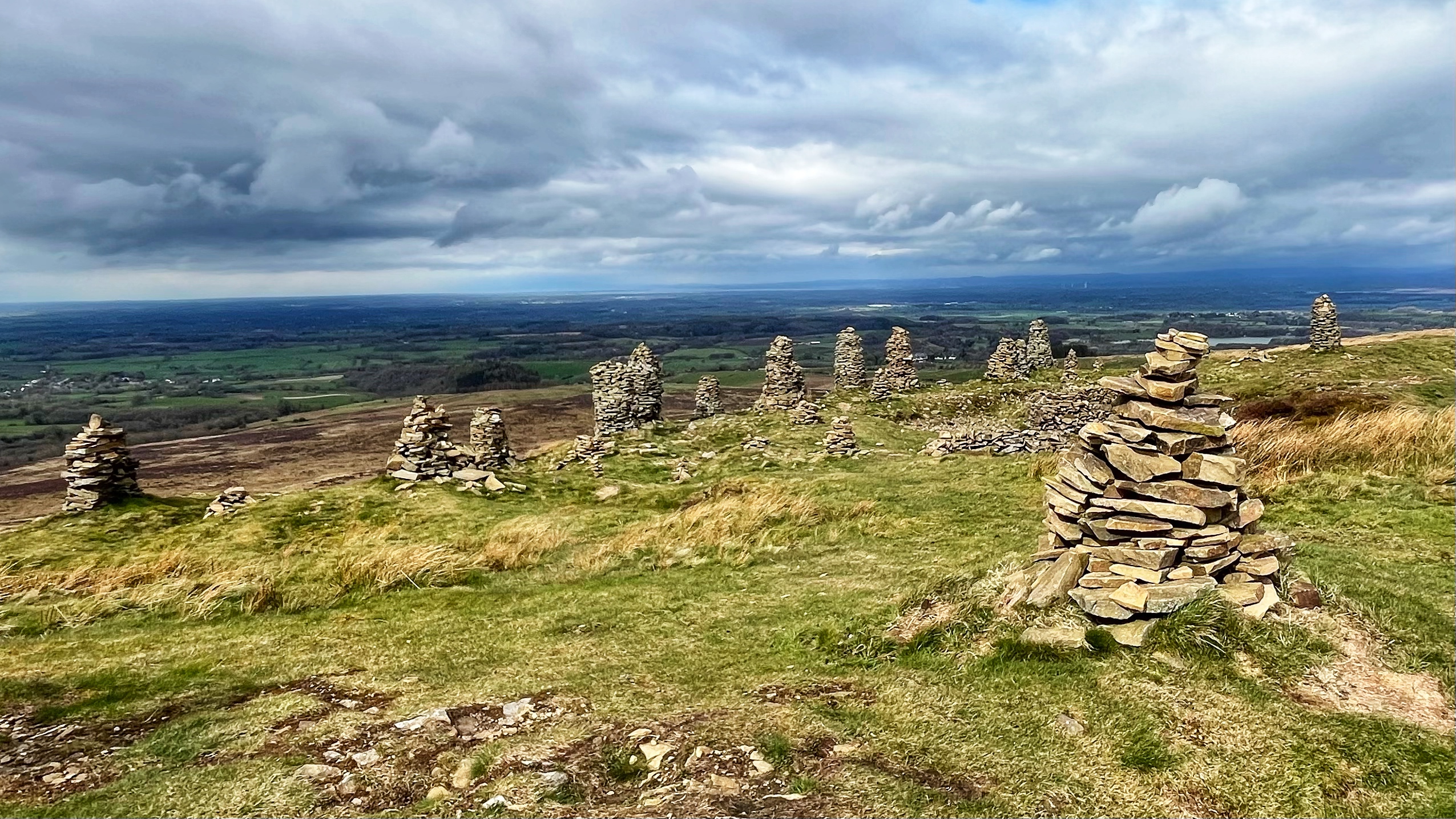
Stand on Talkin Fell in Cumbria and you are surrounded by towers of stacked stone. Locals call them curricks. They are not modern art. They are not random. They are, in a quiet way, astonishing.
The word ‘currick’ descends from Cumbric — a Celtic language, closely related to Old Welsh, spoken across northern England over a thousand years ago.1Miller, Bryan. *Map Reader’s Companion for Upland England*, cited in: “What’s a Currick?” Drow ‘n’ Smirr, screel.co.uk, https://www.screel.co.uk/walks/cumbria/whats-a-currick/ It shares its root with the Welsh ‘carreg’ and the Irish ‘carraig’, both meaning ‘rock.’2Wright, Joseph, “The English dialect dictionary, being the complete vocabulary of all dialect words still in use, or known to have been in use during the last two hundred years; founded on the publications of the English Dialect Society and on a large amount of material never before printed.” 1898. Vol I A to C. Page 845. Available online: https://ia800704.us.archive.org/0/items/englishdialectdi01wriguoft/englishdialectdi01wriguoft.pdf So does the village name Castle Carrock below the fell. The fell, the village, and the stone piles crowning the summit all carry the echo of the same forgotten language.3Brown, David. “Talkin Fell from Castle Carrock.” Mud and Routes, https://www.mudandroutes.com/routes/talkin-fell-from-castle-carrock/
A single currick might guide a traveller. But Talkin Fell has dozens. That changes everything. Such numbers point instead to ritual, memorial, or burial — each generation adding stones to a tradition already ancient when they arrived.4“cairn, n.” Oxford English Dictionary, Oxford University Press, https://www.oed.com/dictionary/cairn_n These are not signposts. Of course, they could be, perhaps just as likely, a communal folly.
Talkin Fell also likely served as a lookout post. For centuries, the people of this border country kept watch from high ground for Scottish raiders crossing the hills.5Miller, Bryan. *Map Reader’s Companion for Upland England*, cited in: “What’s a Currick?” *Drow ‘n’ Smirr*, screel.co.uk, https://www.screel.co.uk/walks/cumbria/whats-a-currick/ The original currick might have marked this watch-point. Stone piles with a rather grimmer purpose than they appear.
Next time you pass a pile of rocks on a hillside, ask yourself: who put them there, and for what purpose?
- 1Miller, Bryan. *Map Reader’s Companion for Upland England*, cited in: “What’s a Currick?” Drow ‘n’ Smirr, screel.co.uk, https://www.screel.co.uk/walks/cumbria/whats-a-currick/
- 2Wright, Joseph, “The English dialect dictionary, being the complete vocabulary of all dialect words still in use, or known to have been in use during the last two hundred years; founded on the publications of the English Dialect Society and on a large amount of material never before printed.” 1898. Vol I A to C. Page 845. Available online: https://ia800704.us.archive.org/0/items/englishdialectdi01wriguoft/englishdialectdi01wriguoft.pdf
- 3Brown, David. “Talkin Fell from Castle Carrock.” Mud and Routes, https://www.mudandroutes.com/routes/talkin-fell-from-castle-carrock/
- 4“cairn, n.” Oxford English Dictionary, Oxford University Press, https://www.oed.com/dictionary/cairn_n
- 5Miller, Bryan. *Map Reader’s Companion for Upland England*, cited in: “What’s a Currick?” *Drow ‘n’ Smirr*, screel.co.uk, https://www.screel.co.uk/walks/cumbria/whats-a-currick/


Leave a Reply