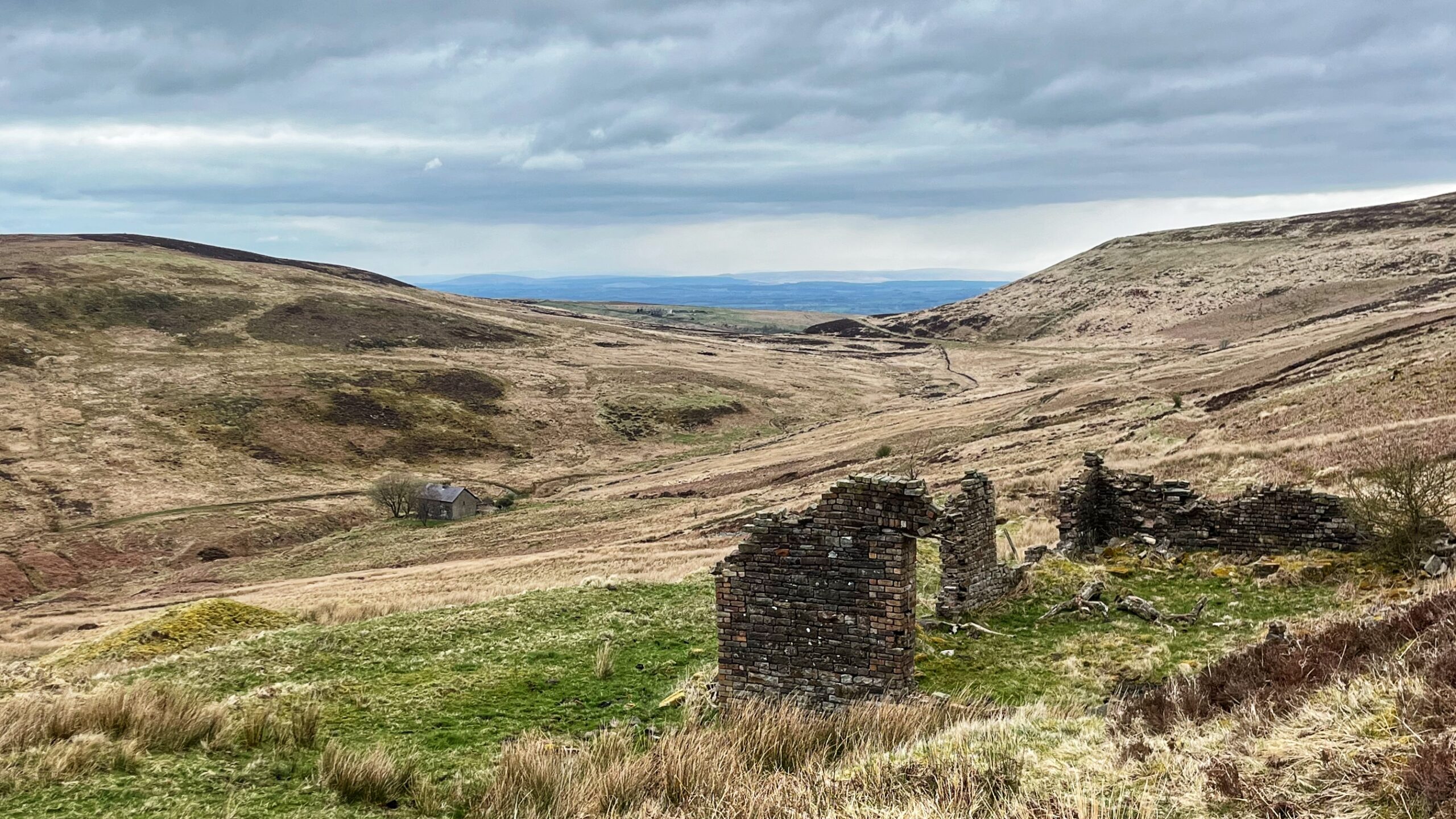
An unexpected find in the King’s Forest of Geltsdale. What stands here now is a hollow shell, but once it was the pulse of Gairs Colliery, a lonely Cumbrian mine with a knack for odd decisions and even odder management. A railway once ran from this spot up to the col. You can still trace its faint line if you squint and use a bit of imagination.
Most people know Stephenson’s Rocket, the poster child of early locomotives. You would think it rolled neatly off the stage and into a museum. Not quite. It ended up in the hands of James Thompson, a local grand thinker with a taste for tinkering. He bought the thing, patched it up, and put it back to work hauling coal in this quiet valley.1“Lord Carlisle’s Railways.” Northern Mine Research Society, 2 Apr. 2016, https://www.nmrs.org.uk/mines-map/coal-mining-in-the-british-isles/cumbria/lord-carlisles-railways/ So much for a graceful retirement.
There was talk of showing it off at the Great Exhibition in 1851, but Thompson died before that plan got off the ground. The engine drifted back to Newcastle, then on to London, and eventually to York, where it now sits, polished and admired, far from the mud it once knew.
By the 1920s, Gairs was thriving, full of men and noise. Then, by the late 1930s, it simply stopped. Not for lack of coal, so the story goes, but because the boss could not get his car up the track.2Richards, Mark. “Geltsdale.” North Pennines National Landscape, 2024, https://northpennines.org.uk/wp-content/uploads/2022/09/Geltsdale-new-leaflet-final.pdf You could not make it up.
What remains is a quiet lesson. Big ideas may build the world, but stubborn people often decide when it stops.
- 1“Lord Carlisle’s Railways.” Northern Mine Research Society, 2 Apr. 2016, https://www.nmrs.org.uk/mines-map/coal-mining-in-the-british-isles/cumbria/lord-carlisles-railways/ ↩︎
- 2Richards, Mark. “Geltsdale.” North Pennines National Landscape, 2024, https://northpennines.org.uk/wp-content/uploads/2022/09/Geltsdale-new-leaflet-final.pdf ↩︎
Leave a Reply