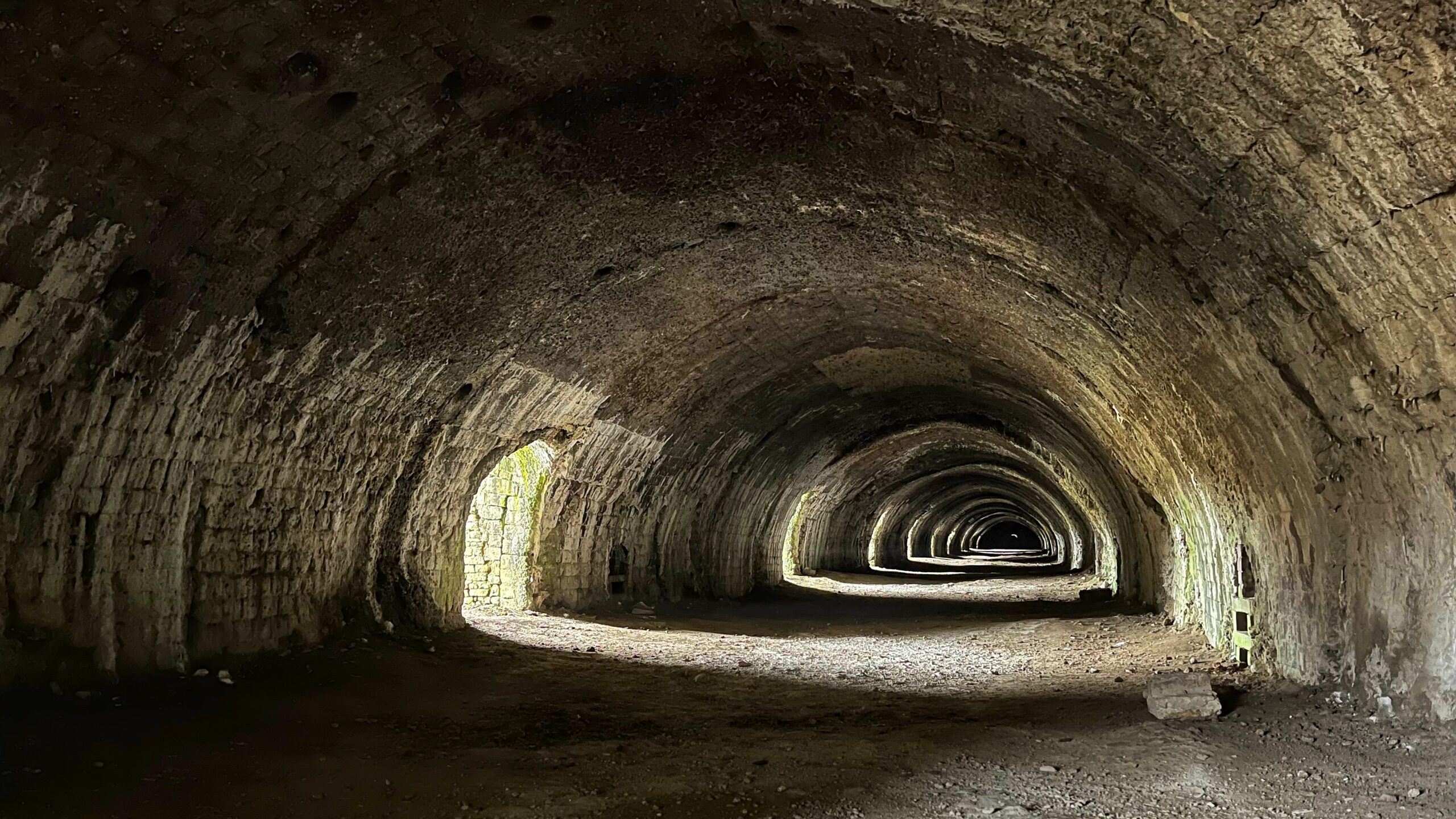
Langcliffe Quarry was once a place of serious industry, producing lime from the late 1800s to the early 1900s. The remains of three types of kiln still stand here: the Triple Draw, the Hoffmann, and the Spencer. Together, they tell the story of how lime production lurched from the pre-industrial age into the modern world, which is the sort of thing that I find rather interesting.
The star of the show is the Hoffmann Kiln, which burned more or less without stopping from 1872 to 1931. Friedrich Hoffmann patented the design in 1858, along with his co-inventor Albert Licht, and it was nothing short of a revolution. The kiln’s 22 chambers were joined in a continuous tunnel running around a central smoke chamber, so that as one chamber burned, the heat crept forward to warm the next two or three. Nothing was wasted. The Victorians were absolutely ruthless about that sort of thing.
Each chamber was packed with limestone, then sealed tight with steel sheets, bricks, and clay. Coal was dropped down chutes to keep the fire going. A clever flue system pulled the heat through narrow passages under the stacked limestone, drying it as it went. Waste heat and gases were dragged out through flue holes at floor level, into the central smoke chamber, and then up a chimney nearly 70 metres tall. Iron dampers kept the whole thing under control.
Behind the burning zone, finished chambers cooled before the lime was shovelled out and loaded onto railway wagons in the adjacent siding. Around 90 people kept this operation running without pause.
The kiln itself is a substantial beast: 128 metres long, 29 metres wide, and 8 metres high. A raised platform carrying a tramway ran around it, sitting 2.5 metres above the standard gauge rail tracks on either side.
Working inside must have been, to put it mildly, deeply unpleasant. The heat was savage, and lime burns skin on contact, particularly when wet. The men who packed the lime smeared themselves with goose fat or lard to avoid blistering. That is the sort of detail that makes you grateful for a desk job.
In nearly 70 years, the fire was only put out three times: once for a major overhaul in the 1890s, then in September 1931 when the kiln finally closed, and briefly again after it reopened in November 1937 before shutting for good in 1939.
The great chimney collapsed on 19 January 1951, one day before it was due to be demolished. People had come from miles around to watch. Nobody saw it fall. The chimney, it seems, had the last laugh.
During the Second World War, the tunnel was possibly used to store explosives and chemicals. Some bricked-up entrances at the back suggest that something was going on, though no one is entirely saying what.
Source: All information gathered from information boards on site.

Leave a Reply