A day of rest after yesterday’s National Trust volunteering. The body, it turns out, has opinions.
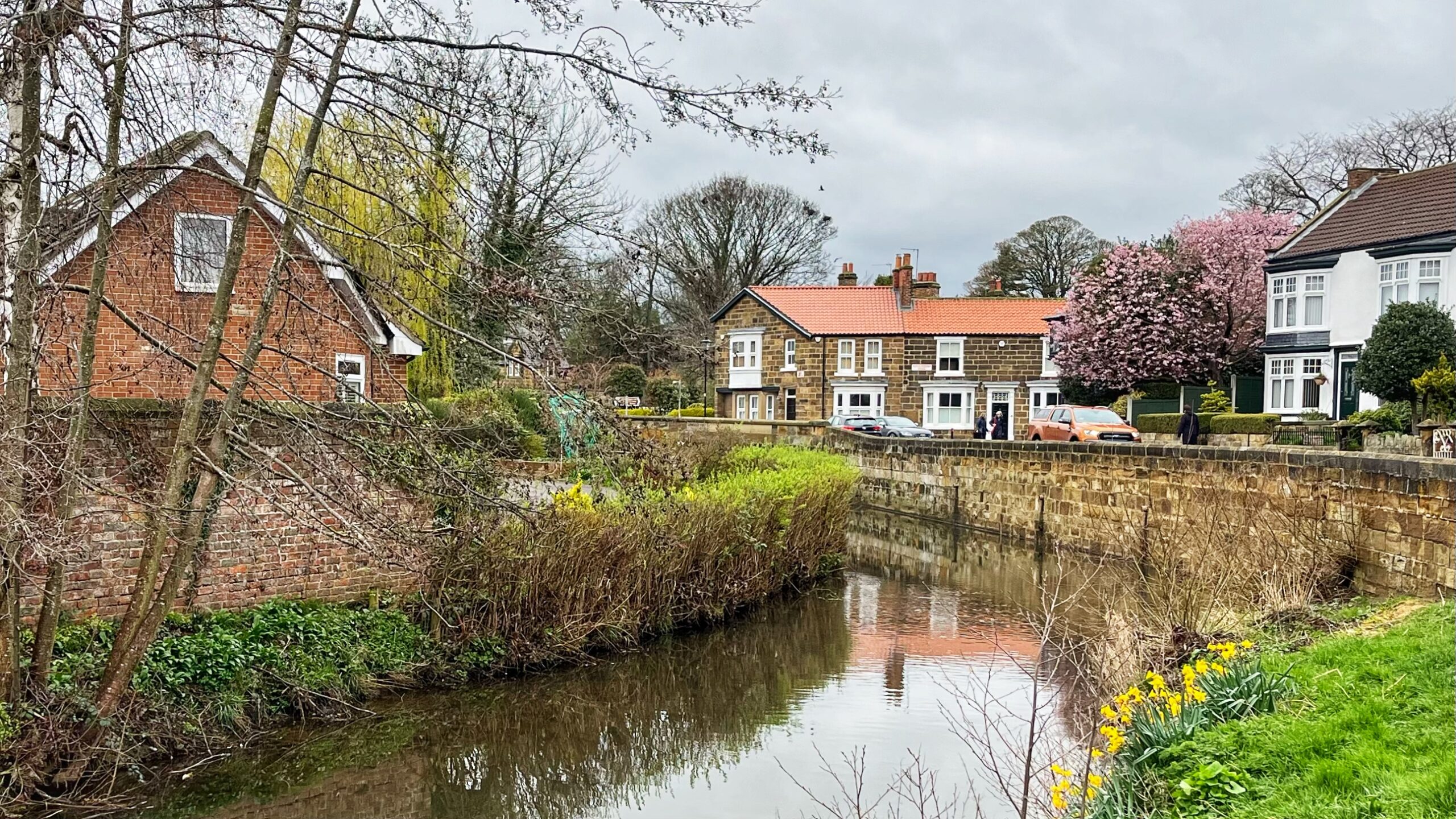
So — the River Leven at Great Ayton. A stone wall keeps the High Street dry and throws its reflection onto water so calm it seems almost embarrassed to move. Daffodils and a pink-blossomed tree do their best to liven things up. Right of centre stands a solidly built, two-storey Yorkshire sandstone cottage — the sort of house that looks as though it has never once doubted itself — with a rather cheerful terracotta-tiled roof and neat white-framed sash windows.
This was once Wynford House, a Temperance Hotel, which invited men to “sit, read, talk, or think” and then go home safely. Noble stuff1o’Sullivan, Dan. “Great Ayton: A history of the village”. 1983. Pages 16/17..
Great Ayton had long felt the Quaker influence, so a temperance hotel is hardly a surprise. What is a surprise was the local press. The Cleveland Repertory & Stokesley Advertiser supported the cause in 1845, yet took a thoroughly dim view of the speakers sent to advance it. Some were called “ridiculous,” better suited to “coal and lead mines” than to an audience of “Aytonians.” The reporter warned that “noisy insolence” and “vulgar screaming” were rather more likely to produce disgust than converts. One substitute speaker spoke for an hour and a half — twice as long as anyone had bargained for — leaving the audience “restless and anxious to disperse.” His manner was described as an “ear sore.” High praise it was not2Cleveland Repertory & Stokesley Advertiser. Vol. III, No. 9. September 1, 1845. “AYTON TEMPERANCE FESTIVAL”,.
Temperance was, in fairness, one of the great social movements of 19th-century England. Alcohol abuse drove widespread poverty, and the first English temperance societies were founded in 1830. Interestingly, doctors of the day routinely prescribed alcohol to “build up” patients, so early reformers took a measured line — spirits were taboo, but beer in moderation was perfectly fine. Small mercies3‘Temperance Buildings in England’. 2026. The Historic England Blog <https://heritagecalling.com/2026/01/08/temperance-buildings-the-way-out-of-darkest-england/> [accessed 18 January 2026].
Since reformers avoided alcohol-focused spaces, they simply built their own — hospitals, billiard halls, temperance hotels, and, most magnificently, a “public house without the beer.”
The optimism alone deserves a round of applause.
- 1o’Sullivan, Dan. “Great Ayton: A history of the village”. 1983. Pages 16/17.
- 2Cleveland Repertory & Stokesley Advertiser. Vol. III, No. 9. September 1, 1845. “AYTON TEMPERANCE FESTIVAL”,
- 3‘Temperance Buildings in England’. 2026. The Historic England Blog <https://heritagecalling.com/2026/01/08/temperance-buildings-the-way-out-of-darkest-england/> [accessed 18 January 2026]
Leave a Reply