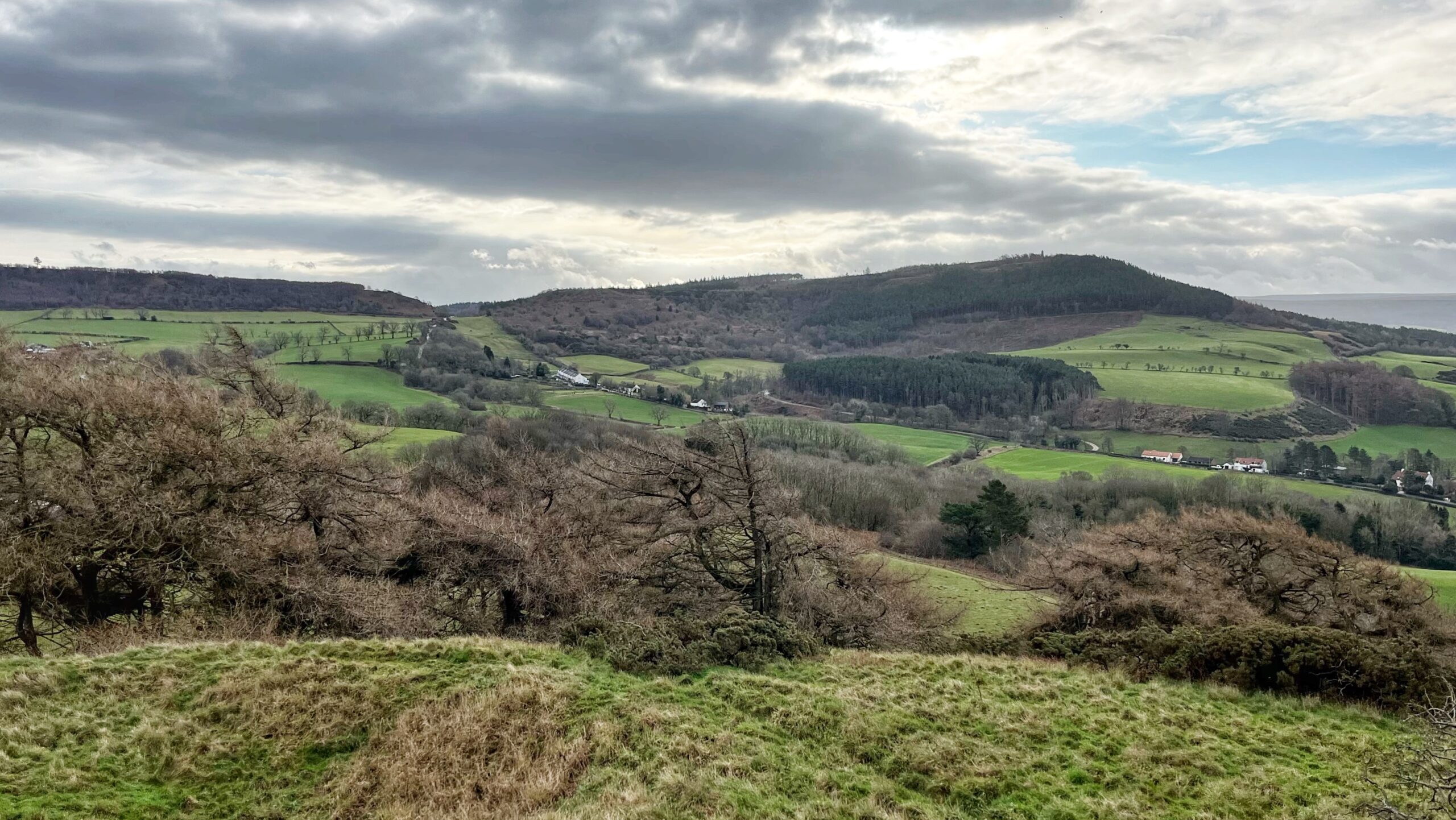
A view from Cliff Rigg looking across to Gribdale Gate and Easby Moor, where the monument to Captain James Cook stands like a stubborn finger pointing at the sky. It is a landscape that seems quiet until you realise how much has happened here while humanity was busy elsewhere.
Gribdale Gate is a well known col in the Cleveland Hills, the narrow way into Lonsdale. There is no sign of any valley called Grib, which rather spoils the tidy logic people like to imagine. The word “Gate” likely comes from the old Proto Germanic “gatan”, meaning an opening or passage, which fits the place well enough. Local legend adds a touch of theatre. Each New Year, an old man is said to appear, open Gribdale Gate, walk through, and vanish again. Whether he still bothers now that a cattle grid guards the spot remains an unanswered question. Progress has a habit of ruining a good mystery1BLAKEBOROUGH, R. ‘Stories of Local Lore, Forgotten Legends. | Northern Weekly Gazette | Saturday 12 July 1902 | British Newspaper Archive’. 2022. Britishnewspaperarchive.co.uk [accessed 3 November 2022].
Frank Elgee believed the Gate once carried far more than walkers and sheep. During the last Ice Age, he argued, meltwater burst through here when a glacial overflow found its escape. The ice sheet ended near the 174 metre contour, around Gribdale Terrace, the row of white cottages sitting just left of centre. His evidence lay scattered underfoot in the fields, erratic pebbles dropped by retreating ice like a tideline. Above, at 225 metres, Gribdale Gate itself stood free of this drift. Elgee never stated how thick the glacier face might have been, though simple sense suggests at least fifty metres of ice would have been needed to force water through the pass. In those days Roseberry Topping would have stood almost surrounded, rising from the frozen mass like a Greenlandic “nunatak “ refusing to be buried2Elgee, F. Geological Notes. Northern Weekly Gazette – 13 September 1902. https://www.britishnewspaperarchive.co.uk/viewer/bl/0003075/19020913/215/00233Elgee, F. Geological Notes. Northern Weekly Gazette – 25 April 1903. https://www.britishnewspaperarchive.co.uk/viewer/bl/0003075/19030425/122/0014.
- 1BLAKEBOROUGH, R. ‘Stories of Local Lore, Forgotten Legends. | Northern Weekly Gazette | Saturday 12 July 1902 | British Newspaper Archive’. 2022. Britishnewspaperarchive.co.uk [accessed 3 November 2022]
- 2Elgee, F. Geological Notes. Northern Weekly Gazette – 13 September 1902. https://www.britishnewspaperarchive.co.uk/viewer/bl/0003075/19020913/215/0023
- 3Elgee, F. Geological Notes. Northern Weekly Gazette – 25 April 1903. https://www.britishnewspaperarchive.co.uk/viewer/bl/0003075/19030425/122/0014
Leave a Reply