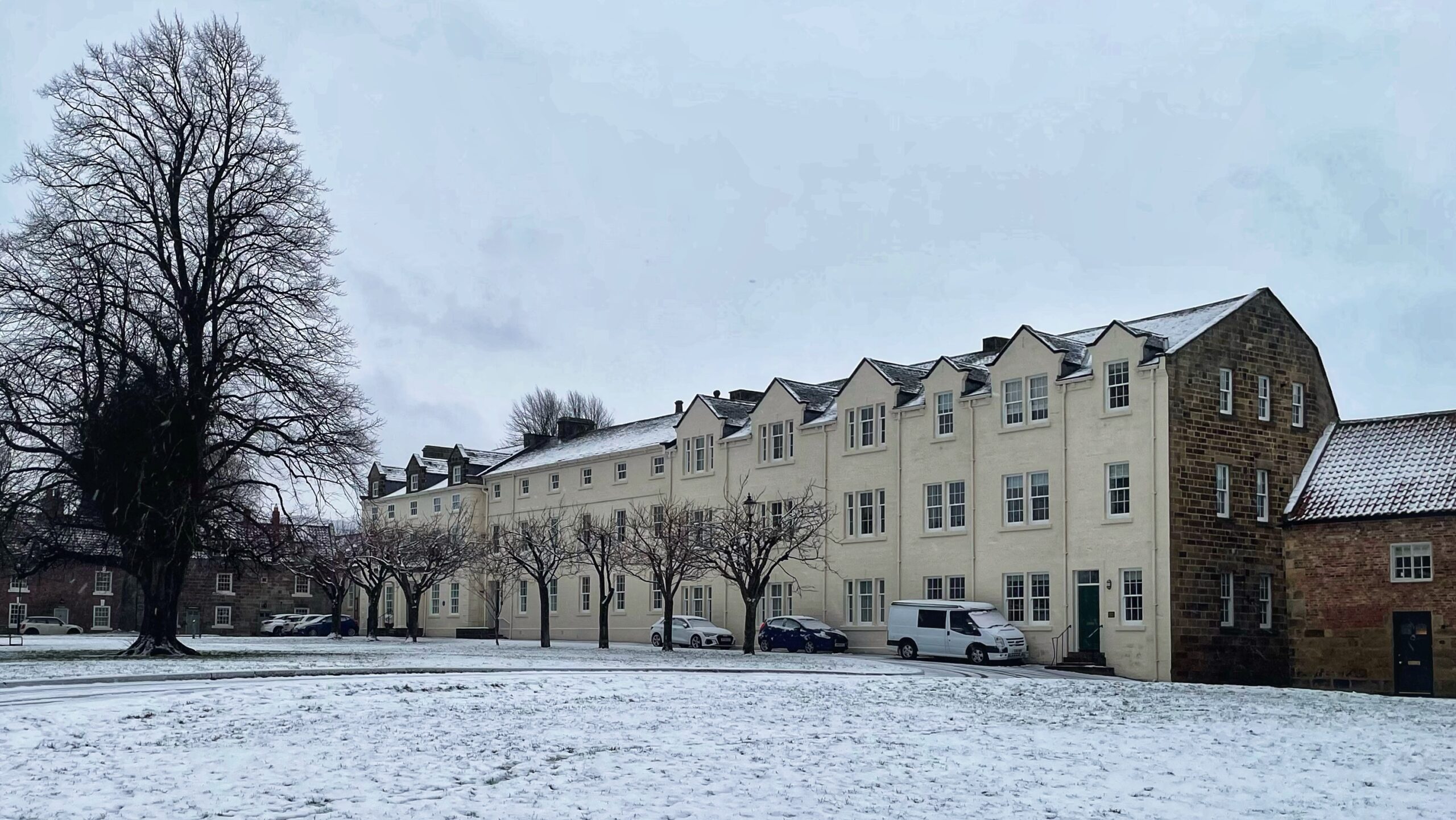
A dreich Sunday morning left the village unusually quiet—an ideal moment to post a piece that has been waiting patiently on the back burner for the right photo.
Old buildings are silent witnesses to history. Their stones and timbers absorb human lives, ambitions, and compromises, even when those stories fade from memory. If we know where to look, an unassuming façade can reveal a past far richer than it first appears. Ayton School is one such place. At a glance, it seems a straightforward Quaker school founded in the 1840s. Look closer, and its origins, purpose, and daily life prove far more surprising.
Despite standing at the heart of Great Ayton, the school was never intended for local children. Instead, it served the “labouring classes” connected with the Society of Friends across the North of England. More specifically—and unusually—it focused on the children of “mixed marriages,” where one parent was a Quaker and the other was not. The aim was to give these children a solid Quaker education and maintain their link to the faith. Life at the school was deliberately spartan. Boys were trained in agriculture, girls in domestic service, and the first intake numbered just sixteen pupils: eight boys and eight girls.
When it came time to build anew, William Holmes of Newcastle was commissioned to design what was described as a “severely plain three-storey block” facing the village green. Though the result was a dignified five-bay house, Quaker principles demanded absolute economy. Holmes embraced this with near-legendary zeal. The school’s benefactor, Thomas Richardson, who visited daily, admired his relentless efficiency, writing:
“I must say that William Holmes is the greatest economist that ever I met in working up materials and keeping the men at work.”
Holmes’s obsession bordered on the extreme. George Dixon, the first school Superintendent, recalled being woken at two in the morning by Holmes knocking on the wall, anxious to know whether a partition was brick or merely timber framing. Thanks to this tireless supervision, the entire project—including ovens and steam apparatus—came in at under £500.
Ingenuity extended beyond construction. Long before “upcycling” became fashionable, the existing Georgian house on the estate was cleverly adapted. A former granary became the boys’ dormitory. A farm archway was enclosed to form the entrance to the Meeting House. The sloping field down to the River Leven was reshaped into playgrounds and terraces.
Even the kitchen reflected this blend of austerity and innovation. Alongside an ancient brick oven—used to bake the much-derided “brown Geordie” bread—stood a remarkably advanced system of four iron ovens. Designed by Alfred Kitching, they could cook for eighty people at once using only a small fire. A rope-and-pulley food lift completed the arrangement, carrying meals upstairs and returning empty dishes below.
Ayton School’s plain walls conceal a story of social purpose, rigorous thrift, and quiet innovation. It stands as a reminder that even the most modest buildings may hold extraordinary histories—a shame if such stories fade away from memory.
Source:
Alston Watson, G. “Ayton School — The Centenary History 1841-1941″. 1941. Headley Brothers.”
Leave a Reply