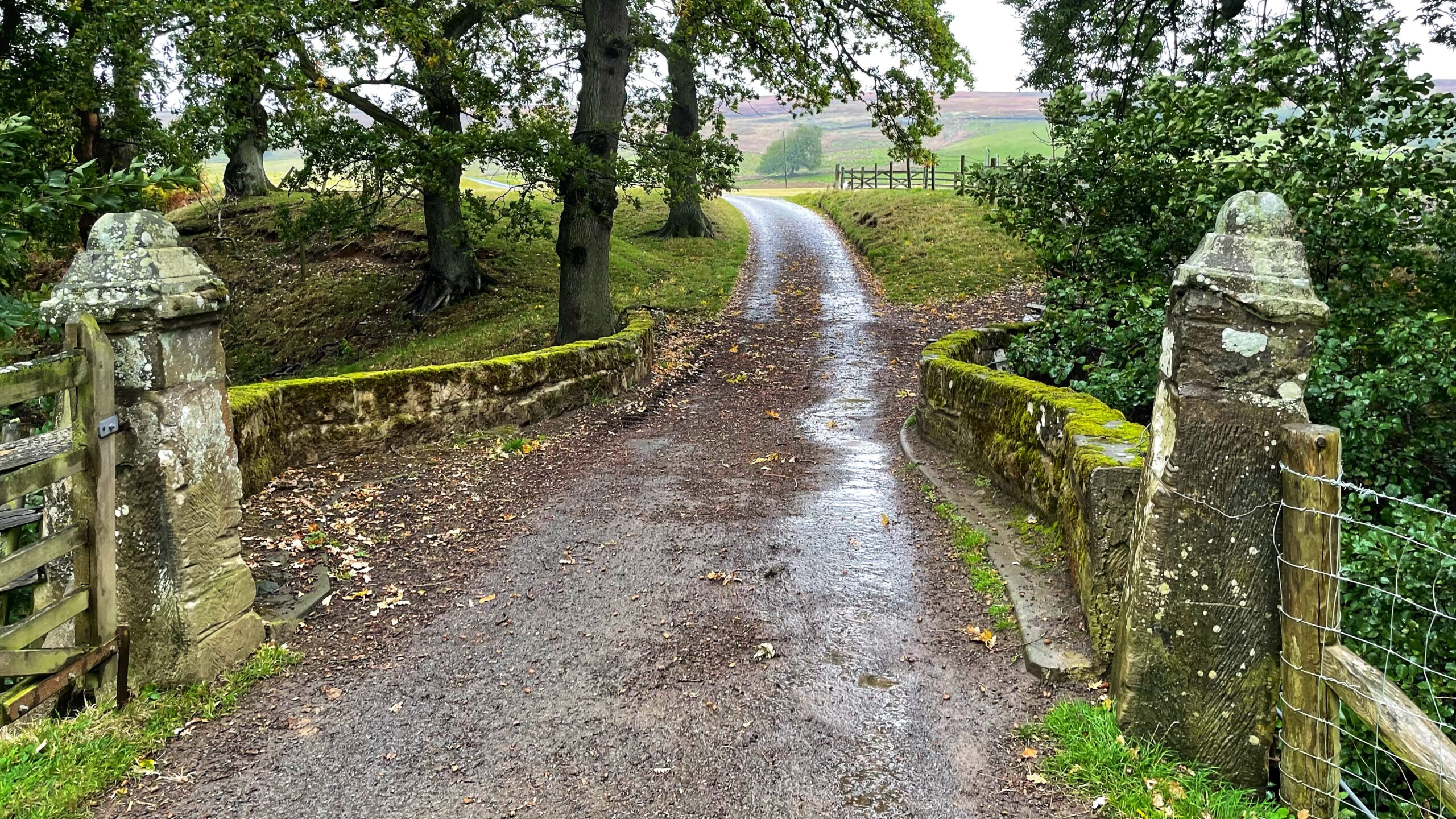
This bridge in Baysdale is more than a quaint curiosity. Its single arch spans Black Beck with quiet dignity, yet the quirky little parapets give it certain character. These are later additions, added in the seventeenth or eighteenth century by someone with a flair for decoration but little sense of symmetry. The bridge was originally built to serve a Cistercian priory, which has long since disappeared, its stones reused in the farm now in its place. The bridge, unlike the priory‘s former residents, has behaved impeccably ever since.

The Priory of St Mary was founded here in 1189, when Guy de Bovincourt decided that a quiet valley was just the place to deposit a wayward group of nuns. About a dozen of them arrived, together with their prioress, and a century later the bridge was built to ease their access.
The trouble was that the ladies of Baysdale were not inclined towards the cloistered ideal. Discipline, obedience and poverty may have been the theory, but practice told another story. One prioress earned censure for her “excess and perpetual misdeeds.” Her successor, Joan de Percy, did no better: in 1307 she was dismissed for wasting the priory’s property and pursuing “perpetual and notorious misdeeds.” She was exiled to a convent at Sinningthwaite, which was less a punishment than a relocation of the problem.
Agnes de Thormondby added variety to the scandal sheet. She was reported to have succumbed three times to the “caresses of the flesh.” Her brief departure from the convent was followed by an equally brief return, her repentance accepted, perhaps because the community was already short of staff.
This was not the nuns first attempt at communal life. They began at Hutton Lowcross, where they quickly disgraced themselves. From there they moved to Thorpe, now Nunthorpe, where again their neighbours likewise tired of them. Finally then, they were dispatched to Baysdale, a place so remote that it seemed the safest possible location for a nunnery in perpetual disgrace.
Their end came not from misbehaviour but from Henry VIII, who abolished them along with almost every other monastery. Baysdale Priory vanished, its nuns scattered, its reputation sealed. The bridge, however, remained. Unlike its wayward charges, it stood firm, a patient lump of stonework that has never once been reprimanded for excess, disobedience, or “notorious misdeeds.”1NYMNPA HER No: 2489. Historic England. List Entry Number: 1021020. Baysdale Abbey Bridge. https://historicengland.org.uk/listing/the-list/list-entry/1021020?section=official-list-entry2‘Houses of Cistercians nuns: Priory of Basedale’, in A History of the County of York: Volume 3, ed. William Page (London, 1974), British History Online https://www.british-history.ac.uk/vch/yorks/vol3/pp158-160 [accessed 1 October 2025].
- 1NYMNPA HER No: 2489. Historic England. List Entry Number: 1021020. Baysdale Abbey Bridge. https://historicengland.org.uk/listing/the-list/list-entry/1021020?section=official-list-entry ↩︎
- 2‘Houses of Cistercians nuns: Priory of Basedale’, in A History of the County of York: Volume 3, ed. William Page (London, 1974), British History Online https://www.british-history.ac.uk/vch/yorks/vol3/pp158-160 [accessed 1 October 2025]. ↩︎
Leave a Reply