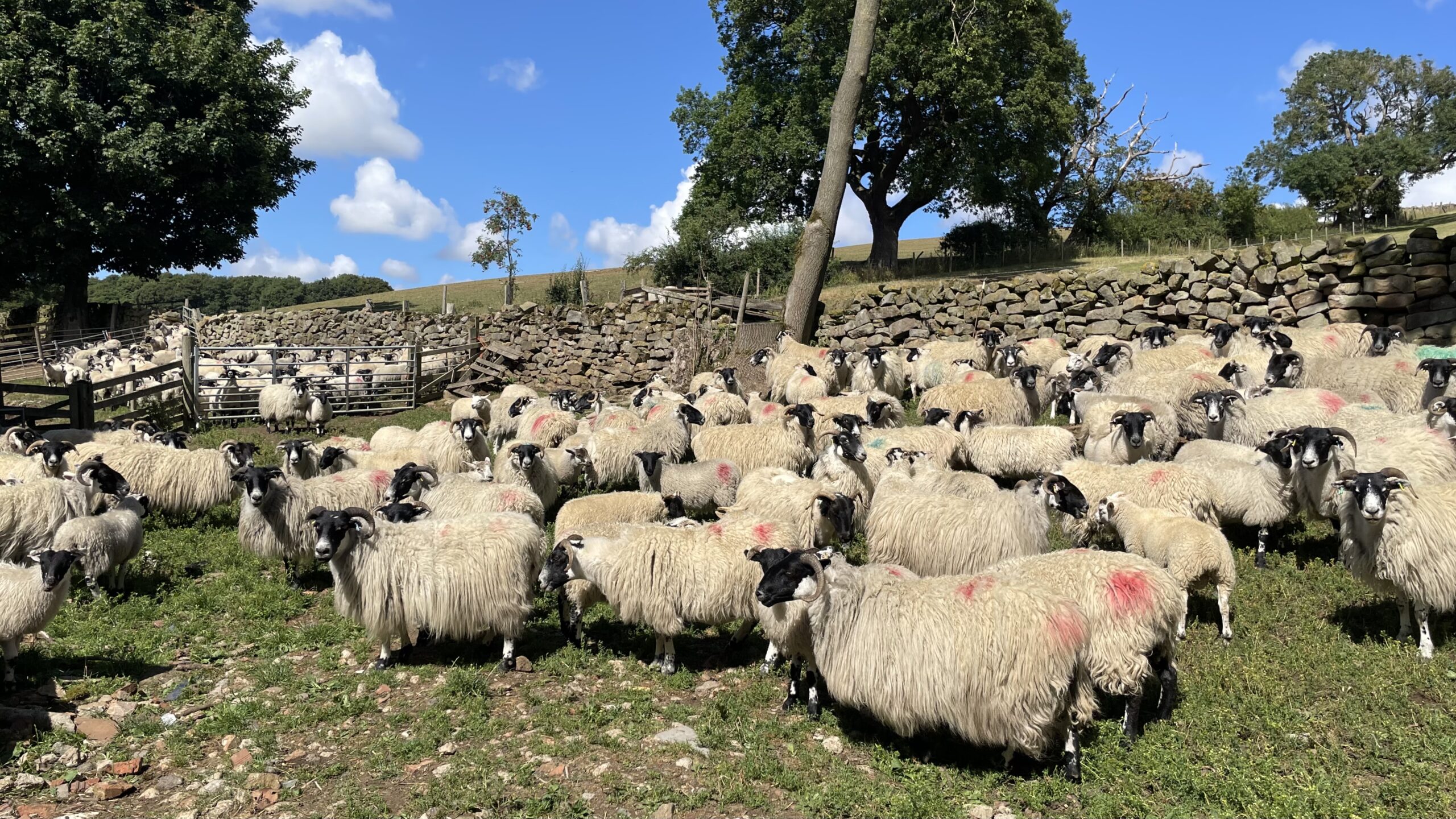
Old Molly Metcalfe counting sheep
Yan tan tether mether pip she counted
Up upon Swaledale steep and bleak
Yan tan tether mether pip she said…
So sang Jake Thackray about a Yorkshire shepherdess. It is tempting to think her sheep-counting chant is native to Yorkshire alone, but its roots run far deeper. The method likely began with Cumbric, a lost Celtic language from which Welsh descends. It then shifted and reshaped across the North, each isolated dale and hill farm stamping its own mark on the words. From Whitby to the Lakes. Most versions begin with Yan and Tan, but the tune changes subtly from one dale to the next, always keeping the rhythm1“COUNTING THE SHEEP WELSH FASHION” BY FRANK RIMINGTON. !Transactions of the Scarborough Archaeological and Historical Society No. 29. Publication date 1992. https://archive.org/details/scarborough028/page/38/mode/2up.
In Borrowdale, deep in the Lake District, the count goes like this:
Yan, Tyan, Tethera, Methera, Pimp, Sethera, Lethera, Hovera, Dovera, Dick, Yan-a-Dick, Tyan-a-Dick, Tethera-a-Dick, Methera-a-Dick, Bumfitt.
The surprise is not just the survival of Celtic numbers in this Norse-tinged corner of England, but how they endured. Handed from father to son, never written down, they warped under the weight of time and dialect. What survives is a chant — two pairs of rhyming words, then a jarring final word to mark the end of a group of five. That last word echoes the act of counting on fingers, and the five-beat rhythm turns it into a sort of chant or jingle.
No one ever counted beyond twenty. At twenty, a notch — or score — was cut into a tally stick, and the count began again. That is where we get the word “score” in phrases like “three score years and ten,” the Biblical lifespan.
Traces of these old numbers may still echo in the nonsense of children’s rhymes: “Eena, meena, mina, mo,” or “Hickory, dickory, dock.” All now stripped of meaning.
Where the numbers came from remains disputed. When they were first studied in the 19th century, scholars guessed they were a remnant of the Celtic language once spoken here before the Angles arrived. That theory still has supporters. There is little doubt some Celtic speakers lingered on in the margins as English settlement spread.
Another theory holds that these numbers were brought in later by Welsh migrants. But that would require a wave of Welsh-speaking shepherds descending upon northern England in a short space of time — which seems unlikely, and is unsupported by evidence.
What may explain the wider spread is movement within the medieval farming system. The Cistercian abbey at Furness, with flocks spread across Cumbria and Yorkshire, likely moved workers between estates. Shepherds who counted in Celtic numbers in one field may have brought the same chant to another. That is how things used to spread — not through books, but through boots in the mud.
Now how many sheep in the photo. Yan Tan Tether Mether Pip … 💤
- 1“COUNTING THE SHEEP WELSH FASHION” BY FRANK RIMINGTON. !Transactions of the Scarborough Archaeological and Historical Society No. 29. Publication date 1992. https://archive.org/details/scarborough028/page/38/mode/2up
Leave a Reply