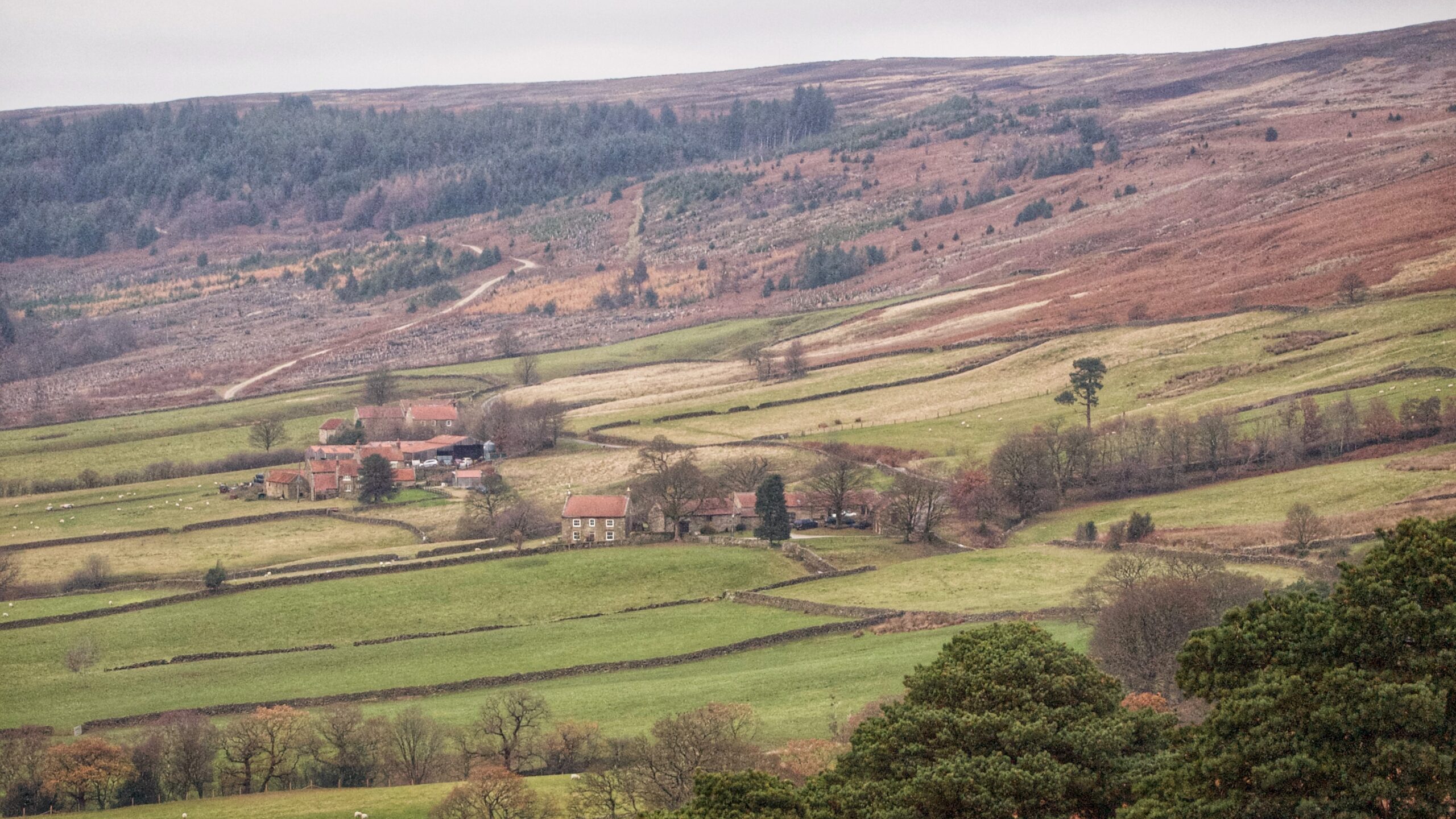
The wood I have been helping replant has been named Barker Plantation from the first OS map of 1853. It was seeking the root of that name (who was Barker?) that led me down this rabbit hole. Barker Plantation lies barely a quarter of a mile from Groat Hill, where Nicholas Barker lived. He would have been 27 when those surveyors visited the dale, so it would hardly have been named after after him. But there must be a family connection. It seems too much of a coincidence to dismiss.
As I touched upon in my previous posts — ‘The Old Schoolroom, Bransdale’ and ‘John Scarth, a “well-to-do” Bransdale farmer’ — the remote North Yorkshire dale of Bransdale was home to some remarkable characters whose lives frequently intersected with the local courts. Beyond those initial snapshots lies a deeper, interconnected history of personal friction, moral scrutiny, and civic standing between two prominent dalesmen: Nicholas Barker and John Scarth.
The Public and Private Life of Nicholas Barker
Long before his feud with John Scarth reached the courtrooms of York, Nicholas Barker was a prominent figure on Bransdale’s East Side. Managing an extensive agricultural holding at Groat Hill, Barker occupied a place of responsibility in local rural life, yet his personal life was repeatedly touched by legal controversy.
In 1859, Barker appeared before the Kirbymoorside bench when he was charged with unlawfully dismissing his servant, Ann Weatherill 1“THIRD DAY’S EXAMINATION.” York Herald, 20 Sept. 1876, p. 3. British Newspaper Archive.. Two years later, the 1861 England Census recorded Barker—spelled “Breaker”—as a 35-year-old farmer at Groat Hill overseeing 100 acres and employing two farm boys 21861 England Census. The National Archives, Class RG9, Piece 3635, Folio 45, Page 8..
Barker’s standing in the community, however, suffered a significant blow in August 1863 when he was convicted of an assault upon Elisabeth Allenby. The following year brought further public embarrassment during Kirbymoorside Petty Sessions in February 1864. Barker had sworn out a warrant against his 19-year-old domestic servant, Dorothy Jefferson, accusing her of absconding from his service on January 26. In response, Jefferson summoned Barker for an assault committed between January 21 and 26, testifying that her master had subjected her to a series of improper liberties. Although Barker’s counsel denounced the charge as a concoction to escape her employment contract, the magistrates unanimously dissolved Jefferson’s service contract, found Barker guilty of assault, and fined him 10s. plus court costs 3“Kirbymoorside Petty Sessions: Dorothy Jefferson.” Yorkshire Gazette, 20 Feb. 1864, p. 9. British Newspaper Archive..
Despite these courtroom convictions, Barker retained an active role in local agricultural affairs. In March 1873, he served alongside James Mewburn Esq. and George Sigsworth Esq. as an official judge for the prestigious Bilsdale Ploughing Society, evaluating competition ploughing before joining the committee for dinner at the Sun Hotel 4“Bilsdale Ploughing Society.” York Herald, 15 Mar. 1873, p. 4. British Newspaper Archive..
The Parallel Sphere of John Scarth
While Barker managed his tenanted acreage at Groat Hill, John Scarth inhabited a distinct position of local economic independence. Born around 1834 to Isaac and Mary Scarth of Loft House, John belonged to a family of established local standing; his father, Isaac Scarth, had been selected to serve on the North-Riding Grand Jury as early as April 1845 5“North-Riding Sessions: The Grand Jury.” Yorkshire Gazette, 12 Apr. 1845, p. 7. British Newspaper Archive... Loft House now goes under the name Smout House and is in the centre in the photo above.
Scarth grew up at Loft House (just under a mile from Groat Hill) and stepped into local public life as a supporter of Liberal politics 61861 England Census, Class RG9, Piece 3635, Folio 45, Page 8.. In July 1865, Scarth was named to the local election committee for Frederick A. Milbank, the Liberal candidate contesting the North Riding parliamentary division 7“To the Independent Electors of the North-Riding of Yorkshire.” Yorkshire Gazette, 15 July 1865, p. 14. British Newspaper Archive.. Described in legal records as a “man of property” who owned both his home farm and additional land in the neighbourhood, Scarth maintained a traditional dales household where family and domestic servants slept under one roof 8“Extraordinary Charge Against a North Yorkshire Farmer.” Northern Echo, 9 Sept. 1876, p. 3; British Newspaper Archive.9Pateley Bridge & Nidderdale Herald, 16 Sept. 1876, p. 5. British Newspaper Archive..
The 1874 “Pig Weighing” and the Death of Robert Johnson
The uneasy coexistence between Barker and Scarth collapsed following a tragic incident in early 1874. On Saturday, January 31, 1874, Scarth hosted a traditional “pig weighing” festivity at his farmhouse following a pig-killing the previous day. Such gatherings were customary rural celebrations in the North York Moors, marked by generous hospitality and heavy drinking 10“The Outrage Upon an Old School-Master at Bransdale.” York Herald, 9 May 1874, p. 7. Gale Primary Sources..
Among Scarth’s guests that evening was Robert Johnson, the dale’s schoolmaster, a man advanced in years at nearly seventy. As the evening turned boisterous, Johnson became severely intoxicated and eventually fell unconscious. While helpless, Johnson was made the subject of coarse indignities, including having soot and oil rubbed over his face and body.
The following morning at 8:00 a.m., Scarth’s farm servant, Thomas Peckitt, discovered Johnson unconscious in a chair in the house passage, his face marked with black spots. Between 10:00 and 11:00 a.m., Johnson was carried to an unheated hay-house. While he lay there wrapped in hay and sacks, a local labourer named William Baldwin undid the unconscious old man’s braces and exposed him to onlookers. Late that afternoon, Johnson was brought back into Scarth’s parlour, placed on a bed, given tea with brandy, and eventually taken to his lodgings, but he died shortly after from congestion of the lungs brought on by cold exposure.
The Inquest and the Spark of Feud
A formal coroner’s inquest and subsequent special sessions at Helmsley were convened to investigate the old schoolmaster’s death. Due to the graphic and indecent nature of the evidence, the courtroom was cleared of women.
Crucially, Nicholas Barker was appointed foreman of the coroner’s jury and took a leading role in investigating the circumstances surrounding Johnson’s treatment at Scarth’s farm. Barker’s active probing drew the immediate wrath of John Scarth. Court records state that all friendly relations between the two neighbours ceased from that moment. In the months following the inquest, Scarth confronted Barker repeatedly, warning him that “he had followed him up about that Johnson’s affair… and he would mark him for it” 11Pateley Bridge & Nidderdale Herald, 16 Sept. 1876, p. 5. British Newspaper Archive..
What began as bitter words exchanged across farm gates would soon escalate into criminal allegations of poisoned livestock, a staged felony theft, and a sensational courtroom showdown at the York Assizes. All will be revealed in the next exciting episode of …
Outrage at Bransdale
The Sequel – Poison, Prosecution, and Reconciliation
- 1“THIRD DAY’S EXAMINATION.” York Herald, 20 Sept. 1876, p. 3. British Newspaper Archive. ↩︎
- 21861 England Census. The National Archives, Class RG9, Piece 3635, Folio 45, Page 8. ↩︎
- 3“Kirbymoorside Petty Sessions: Dorothy Jefferson.” Yorkshire Gazette, 20 Feb. 1864, p. 9. British Newspaper Archive. ↩︎
- 4“Bilsdale Ploughing Society.” York Herald, 15 Mar. 1873, p. 4. British Newspaper Archive. ↩︎
- 5“North-Riding Sessions: The Grand Jury.” Yorkshire Gazette, 12 Apr. 1845, p. 7. British Newspaper Archive.. ↩︎
- 61861 England Census, Class RG9, Piece 3635, Folio 45, Page 8. ↩︎
- 7“To the Independent Electors of the North-Riding of Yorkshire.” Yorkshire Gazette, 15 July 1865, p. 14. British Newspaper Archive. ↩︎
- 8“Extraordinary Charge Against a North Yorkshire Farmer.” Northern Echo, 9 Sept. 1876, p. 3; British Newspaper Archive. ↩︎
- 9Pateley Bridge & Nidderdale Herald, 16 Sept. 1876, p. 5. British Newspaper Archive. ↩︎
- 10“The Outrage Upon an Old School-Master at Bransdale.” York Herald, 9 May 1874, p. 7. Gale Primary Sources. ↩︎
- 11Pateley Bridge & Nidderdale Herald, 16 Sept. 1876, p. 5. British Newspaper Archive. ↩︎
Leave a Reply