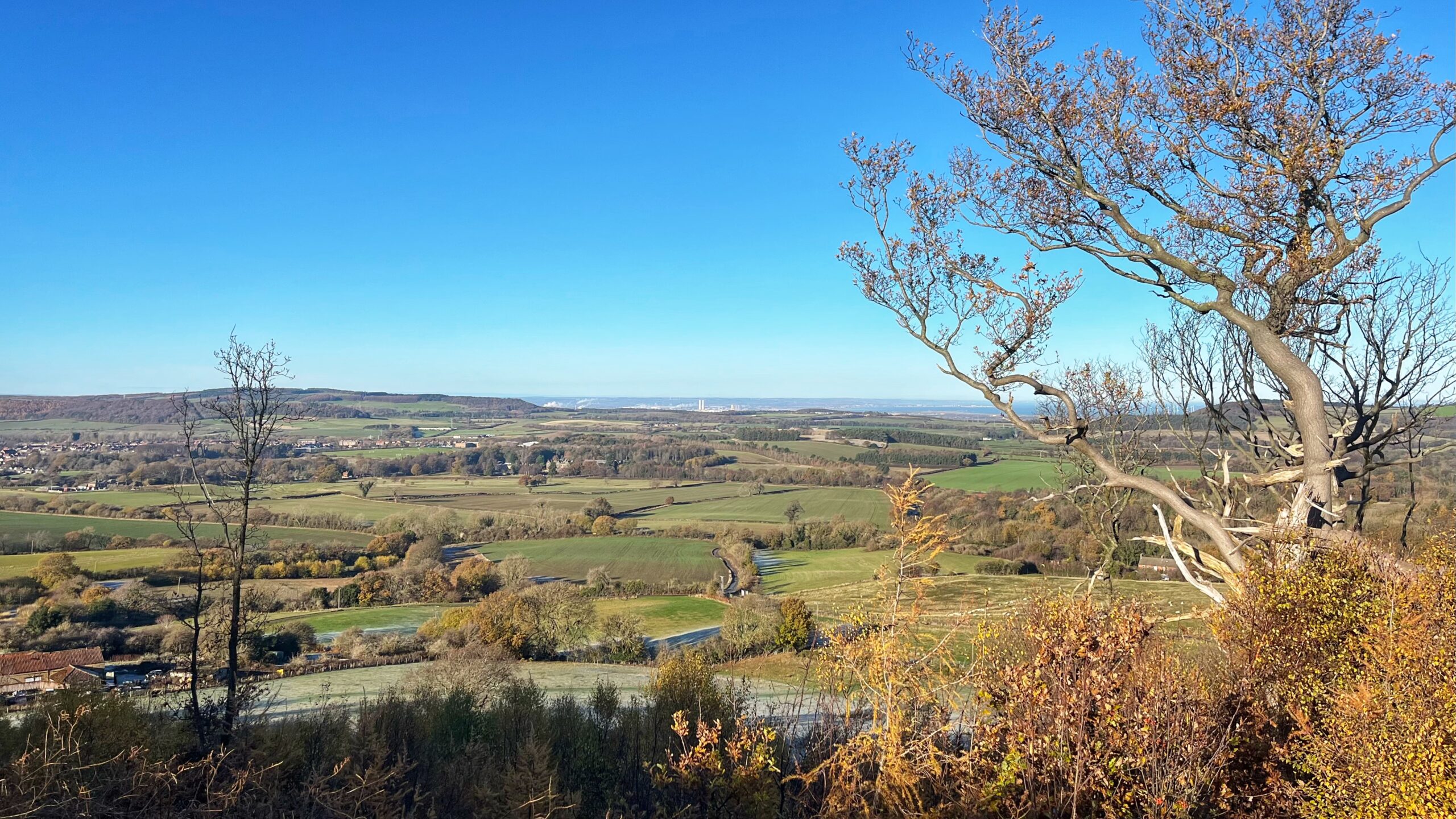
From this view point on the Cleveland Way, the Vale of Guisborough appears tranquil. Fields, woodland and rolling hills stretch towards industrial Teesside, whilst the town edges into the countryside on the left. It is a landscape shaped over centuries by farming, settlement and industry, though not all have left the same mark.
Writing in the Northern Echo in May 1870, a correspondent described Guisborough’s transformation following the discovery of ironstone. The mines nearest the town employed around 500 men and boys, producing some 2,000 tons of stone daily. Industrial prosperity brought expansion, but the correspondent also recorded abandoned workings, describing one scar on the hillside as a “horrid gash”1‘Stray Notes on Cleveland. | Northern Echo | Saturday 14 May 1870 | British Newspaper Archive’. 2022. Britishnewspaperarchive.co.uk <https://www.britishnewspaperarchive.co.uk/viewer/bl/0000087/18700514/010/0004> [accessed 14 August 2022].
The view today offers a different perspective on that transformation. The mines have gone, but industry remains visible on the distant horizon. Guisborough continues to grow westwards, whilst here on the east the vale retains much of its rural character.
Progress leaves its mark. Sometimes the scars fade. The consequences remain.
- 1‘Stray Notes on Cleveland. | Northern Echo | Saturday 14 May 1870 | British Newspaper Archive’. 2022. Britishnewspaperarchive.co.uk <https://www.britishnewspaperarchive.co.uk/viewer/bl/0000087/18700514/010/0004> [accessed 14 August 2022] ↩︎
Leave a Reply