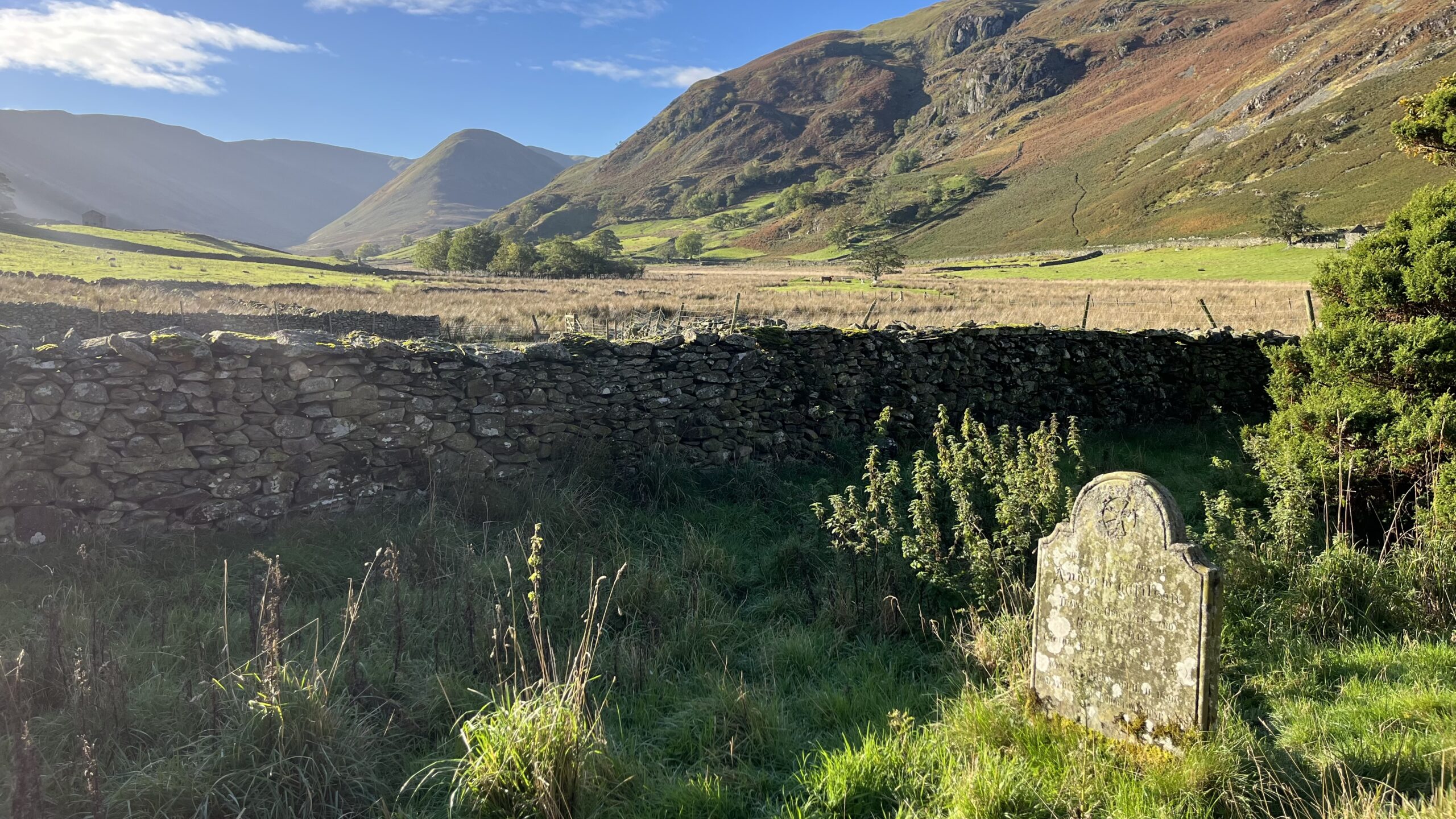
A little taphophilic dabble in Martindale churchyard.
I had heard about this gravestone and wanted to see it for myself. Beneath the lichen lies the story of Andrew Wilson, a journalist whose approach to convalescence left something to be desired1“Andrew Wilson (traveller).” Wikipedia, Wikimedia Foundation, 13 May 2026, https://en.wikipedia.org/wiki/Andrew_Wilson_(traveller)..
Born in Bombay in April 1830, Wilson began his journalistic career in India, editing the Bombay Times. Years of restless travel across Asia and Europe left his health in ruins. Travel broadens the mind, they say. In Wilson’s case, it narrowed everything else.
In 1874, he was heading to Simla to recover when he caught sight of the Himalayas and decided to cross them. He was a complete invalid, unable to walk a hundred yards or climb onto a horse. Most people in that condition might have reconsidered their plans. Wilson had other ideas2“The Late Mr. Andrew Wilson.” Seaham Weekly News, 17 June 1881, p. 2..
 Carried in a wooden litter known as a dandi, he crossed mountain passes reaching 18,000 feet. The expedition became The Abode of Snow, his celebrated account of the Himalayas. Ambition costs very little when other people do the walking.
Wilson eventually settled at Howtown, on Ullswater, in 1875. He died at Bank House on 9 June 1881, aged 513“Death of a Scotch Litterateur.” Dundee Evening Telegraph, 10 June 1881, p. 2..
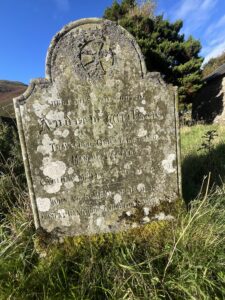
His grave lies here in Martindale churchyard, its inscription softened by lichen and the passage of time. The date of his death is still there, although the weathered numerals take a little deciphering.
A quiet resting place for a man who spent much of his life refusing to sit still.
- 1“Andrew Wilson (traveller).” Wikipedia, Wikimedia Foundation, 13 May 2026, https://en.wikipedia.org/wiki/Andrew_Wilson_(traveller). ↩︎
- 2“The Late Mr. Andrew Wilson.” Seaham Weekly News, 17 June 1881, p. 2. ↩︎
- 3“Death of a Scotch Litterateur.” Dundee Evening Telegraph, 10 June 1881, p. 2. ↩︎
Leave a Reply