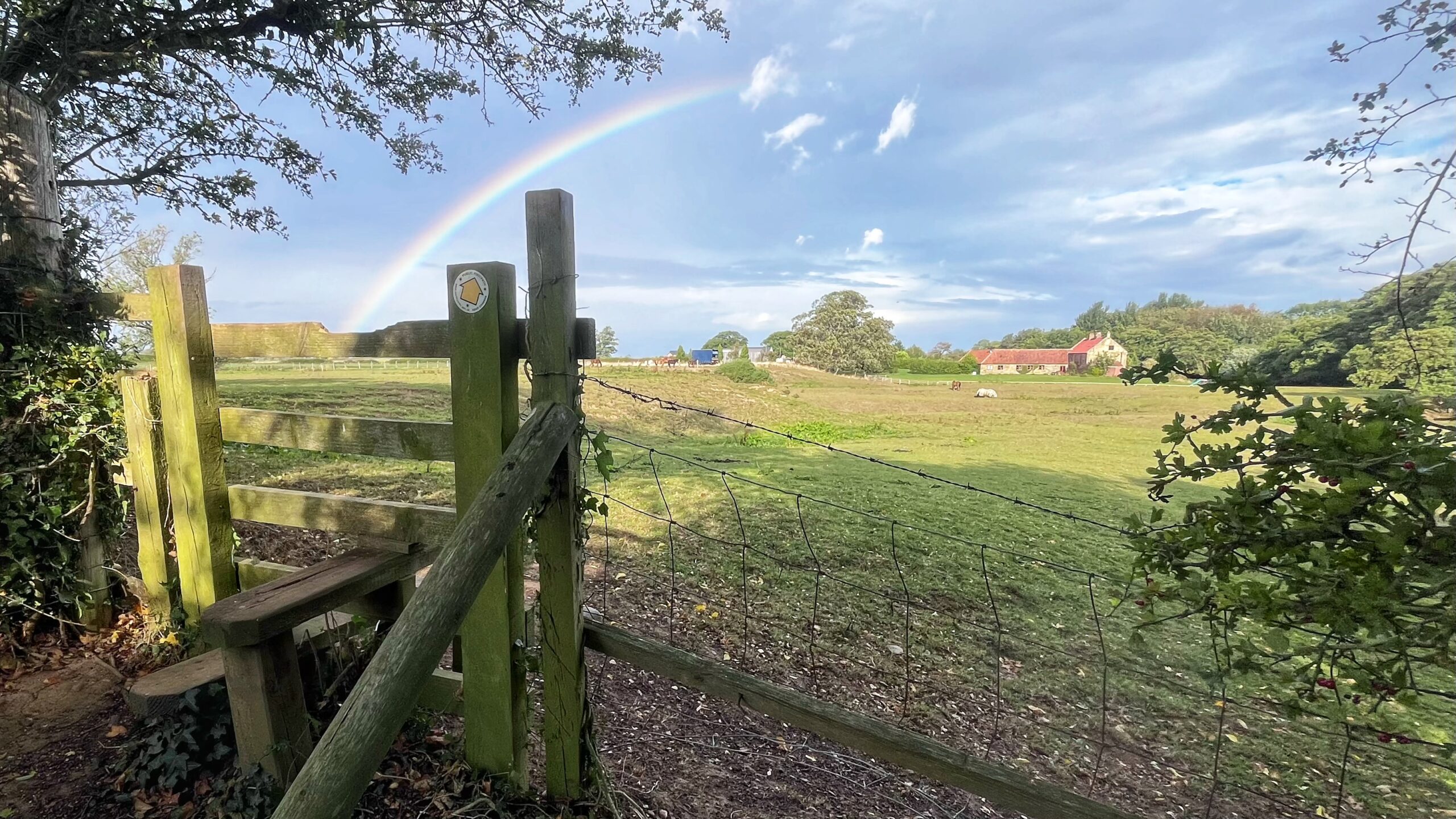
A rainbow always makes a good photo. This one lets me talk about the ubiquitous stile.
Stiles seem to have stood there since the Flood. They have not. They arrived with enclosure, which began in the 13th century and sped up in the 18th and 19th. Fields were fenced, footpaths survived, and livestock needed keeping in. By the height of enclosure, tens of thousands had been built. In the words of one writer, “It was never designed for comfort or accessibility. It was designed for sheep.”1The Future of Stiles: Why Traditional Countryside Barriers Are Being Replaced. The PROW Explorer. 2026. ‘PROW Explorer’. https://www.prowexplorer.com/blog/stiles-the-rise-decline-and-future-of-a-countryside-icon?rq=Stiles%3A%20The%20Rise%2C%20Decline%20and%20Future%20of%20a%20Countryside%20Icon[accessed 28 February 2026]
For anyone who cannot negotiate stiles, the countryside becomes out of bounds. Nobody notices, because nobody counts them. A stile says you may pass, but only if you can climb. Splendid for the nimble. Rather less so for everyone else.
Access guidance now favours the “least restrictive option”. No barrier if none is needed. A gate if one is. A stile as a last resort. Some councils have removed hundreds in the past decade, although progress is patchy, parish by parish.
Some stiles are genuinely old, medieval stone ones among them, and deserve saving. Others are replacements from the 1980s or 1990s, poorly built and without historic value. The trouble is that “heritage” gets waved about as a blanket excuse.
Gates last longer, need less mending and are safer, which matters to landowners. The future of access lies in opening paths, not restricting them.
- 1The Future of Stiles: Why Traditional Countryside Barriers Are Being Replaced. The PROW Explorer. 2026. ‘PROW Explorer’. https://www.prowexplorer.com/blog/stiles-the-rise-decline-and-future-of-a-countryside-icon?rq=Stiles%3A%20The%20Rise%2C%20Decline%20and%20Future%20of%20a%20Countryside%20Icon[accessed 28 February 2026] ↩︎
Leave a Reply