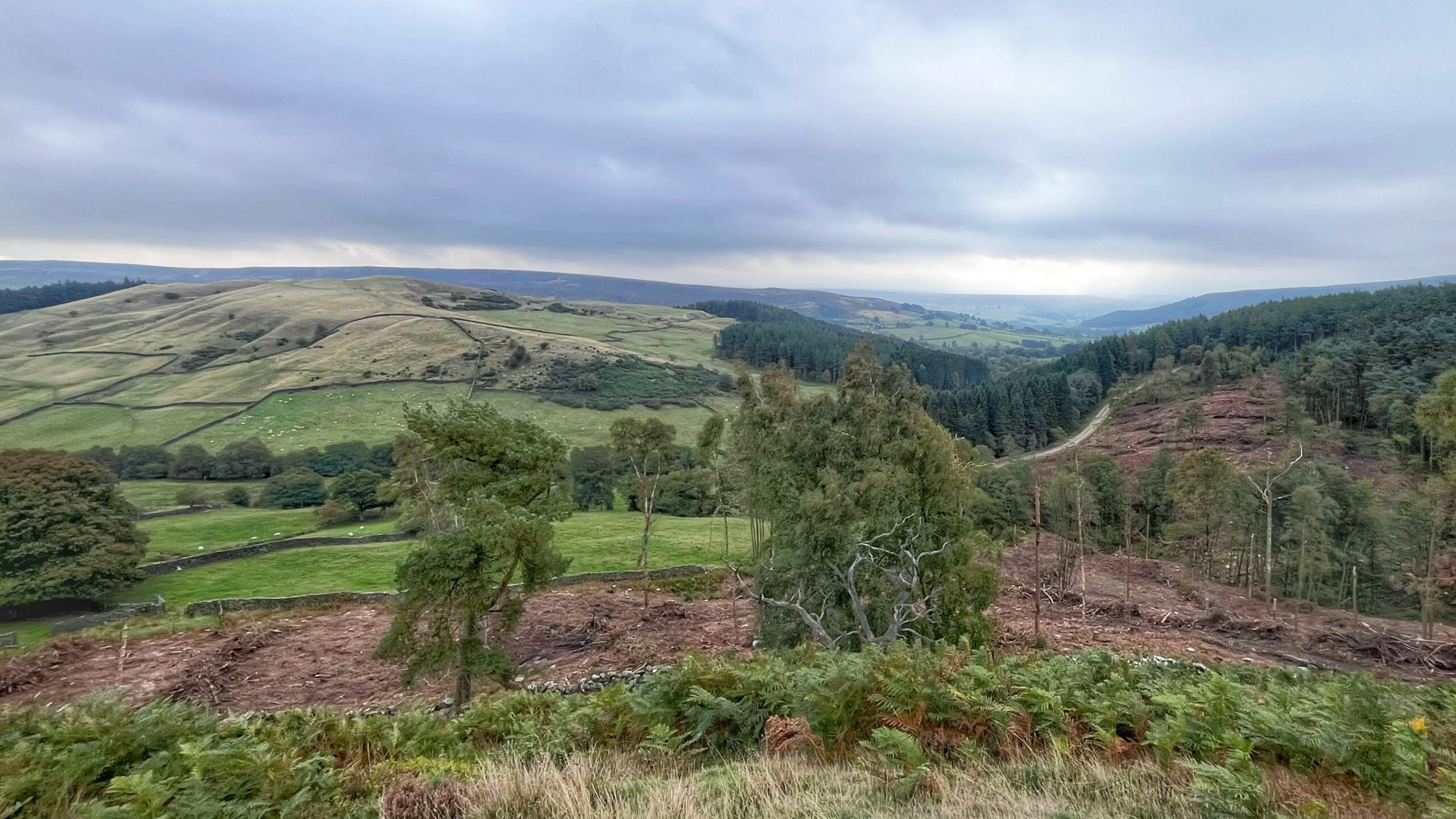
Standing above the cleared plantation by ruins of Clough House there is now a clear view over Raisdale, a landscape that has been fought over by farmers and moorland for centuries.
By 1148, the monks of Rievaulx Abbey controlled upper Bilsdale and its side valleys. They used Raisdale’s valley floors and slopes as grazing land for sheep and cattle, on a grand scale. Then came the Dissolution of the Monasteries in the 16th century, and monastic ranching gave way to scores of small tenant farms. Through the 17th century, these farmers improved the moors bit by bit, walling off high stone “intakes” that pushed cultivation further up the valley sides.
The moor always wants its land back, though. Agricultural depression and rural depopulation in the late 19th and early 20th centuries left farms empty across the dale. Clough House fell to ruin. Its high fields went over to heather as the moorland edge crept back down the hill.
Things picked up again in the mid-20th century. Wartime and post-war schemes for marginal land brought the plough back to these forgotten fields. Clough House found some of its pastures again, fit for more livestock. Commercial forestry took the rest. These are now being felled.
Today, old drystone walls still line the hillsides—enduring monuments to the ebb and flow between human cultivation and the open moors.
Source: Farra, Margaret. A Study of the Land-Use Changes of the North York Moors. PhD dissertation, ProQuest LLC, 2016. ProQuest, order no. 10097250.
Leave a Reply