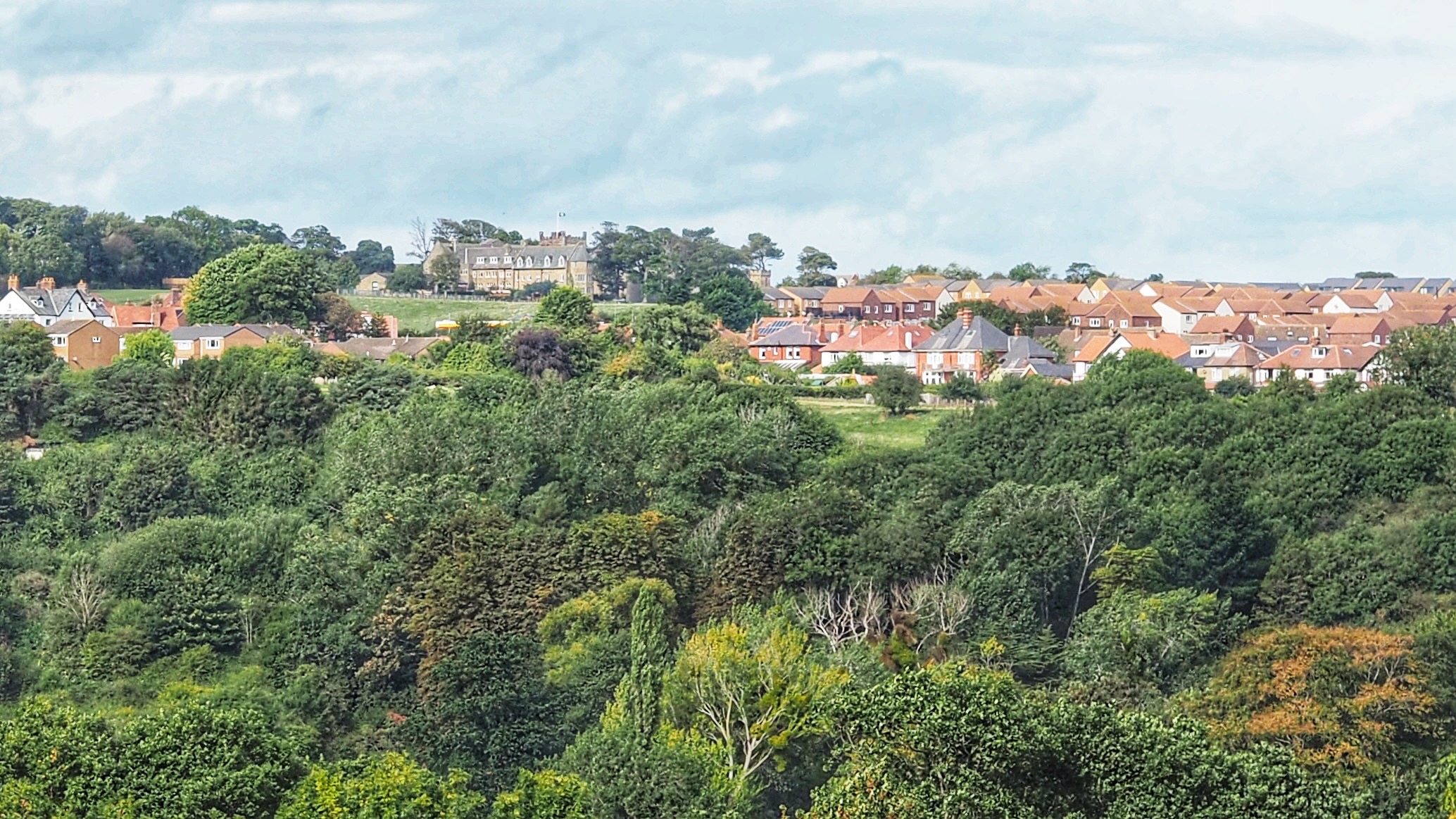
Sneaton Castle has been on my radar for years. Whitby’s suburbs are not inspiring enough for me, though, so I never bothered going that way. Then over the weekend, I caught this view across the Esk valley and thought, well, there it is at last, and dressed rather better than I expected.
The pile went up in 1820, courtesy of one “Colonel” James Wilson, a man Whitby and Sneaton once treated as something close to a local saint. He threw money about Yorkshire like confetti at a wedding he was not paying for, rebuilding St Hilda’s Church just three years later. Publicly he was all charity and good works, generous to the poor, and MP for York from 1826 to 1830. A proper pillar of the community, or so the story went.
Scratch the paint and the picture changes. Wilson’s fortune came from the Cane Grove sugar estate on St Vincent, where several hundred enslaved people were worked, and died, in numbers that tell their own story. He was no gentleman born either, just a common soldier who climbed out of nowhere, and once in Parliament he fought hard against ending slavery, defending the planters’ interests to the last. Ashton Warner, enslaved on that same estate, wrote in his 1831 account of being forced back into bondage by Wilson at the age of ten. That detail alone tells you what sort of pillar he really was.
Wilson died in September 1830 — buried in a mahogany coffin decorated with 32 guns — his debts swallowing the whole estate whole, Cane Grove included. What is left standing today is a Grade II listed hotel and conference centre, handsome enough from a distance, quietly built on misery up close. Worth remembering that the view is never the whole story.
Sources
- Casey, Martin. “WILSON, James (d. 1830), of Sneaton Castle, Whitby, Yorks. and 3 Brunswick Place, Mdx.” The History of Parliament: the House of Commons 1820–1832, edited by D. R. Fisher, Cambridge University Press, 2009. History of Parliament Online, http://www.historyofparliamentonline.org/volume/1820-1832/member/wilson-james-1830.
- Centre for the Study of the Legacies of British Slavery. “James Wilson MP.” Legacies of British Slavery Database, University College London, http://www.historyofparliamentonline.org/volume/1820-1832/member/wilson-james-1830.
- Historic England. “Sneaton Castle (St Hildas Priory) (Grade II) (List Entry No. 1148250).” National Heritage List for England, Historic England, https://historicengland.org.uk/listing/the-list/list-entry/1148250.
- “Sneaton Castle.” Sneaton Castle, https://sneatoncastle.co.uk/.
- “Sneaton Castle.” Wikipedia: The Free Encyclopedia, Wikimedia Foundation, 23 July 2026, https://en.wikipedia.org/wiki/Sneaton_Castle.
Leave a Reply