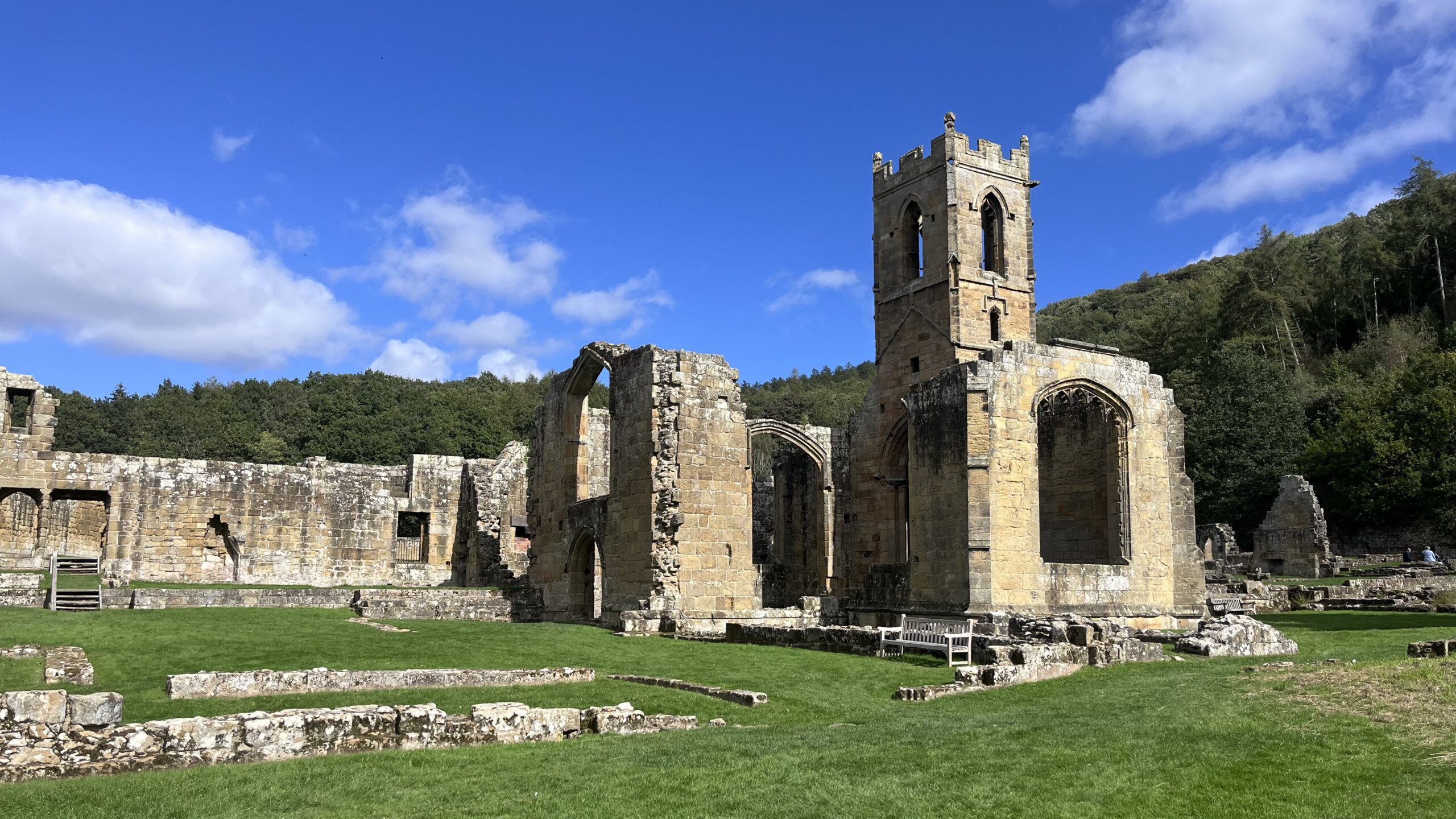
Mount Grace Priory feels like the quietest place in Yorkshire. That was rather the point.
Thomas de Holland, nephew of Richard II, founded it in 1398. It is now the best surviving of the nine Carthusian houses that thrived in medieval England. The monks lived almost as hermits, spending most days alone in cells that each had a garden plot1“Mount Grace Priory: History and Stories.” English Heritage, www.english-heritage.org.uk/visit/places/mount-grace-priory/history-and-stories/. Accessed 20 Sept. 2026.. One day a week they did share a meal … in silence.
Earlier this year, on a guided walk around the priory, an English Heritage guide pointed out priory the prison where a monk was held in the 1450s for “his indulgence in women”. I had already read the tale in a Facebook post from a page for the priory2“Mount Grace Priory, House and Gardens.” Facebook, 23 Sept. 2024, https://www.facebook.com/100064333795665/posts/pfbid0DG2tnzHX3227Jb9CgUR8USoj4jVLeiggZBgvQZexV6ETJrNBpFjKxLmV2PC11v7nl/?[Accessed 20 Sep 2026].. This named him as William Everton of Hinton, and added that a John Welles of London was locked up in 1439 for causing disturbances.
Hinton may mean Hinton Priory in Somerset, itself a Carthusian house3“Hinton Priory.” Wikipedia, Wikimedia Foundation, en.wikipedia.org/wiki/Hinton_Priory. Accessed 20 Sept. 2026.. Offenders from other Carthusian houses might well have been sent north to Mount Grace. That is my guess, but nothing firmer.
Solitude must have frayed tempers now and then. A monk who broke the rules of the order risked confinement in this prison, which stood at the corner of the Great Cloister4“Mount Grace Priory | Historic Yorkshire Guide.” Britain Express, www.britainexpress.com/counties/yorkshire/abbeys/mount-grace.htm. Accessed 20 Sept. 2026..
The Facebook post gives no source, and, frustratingly, I have found no other reference online to either man. I wonder what the English Heritage guidebook has to say.
The post also says that the prison had become a library by the 15th century, yet it places both prisoners in 1439 and the 1450s, which are already in the 15th century. It presumably means later in that century. It’s loose wording of this kind, and the lack of any collaborating (online) source that makes me just a bit uneasy.
Now, I am not averse to repeating myths, so long as it is clear that it is a myth. Anyhow I can’t escape the fact that a wayward monk makes a good story. A monastery that demanded silence has kept its secrets rather well.
- 1“Mount Grace Priory: History and Stories.” English Heritage, www.english-heritage.org.uk/visit/places/mount-grace-priory/history-and-stories/. Accessed 20 Sept. 2026. ↩︎
- 2“Mount Grace Priory, House and Gardens.” Facebook, 23 Sept. 2024, https://www.facebook.com/100064333795665/posts/pfbid0DG2tnzHX3227Jb9CgUR8USoj4jVLeiggZBgvQZexV6ETJrNBpFjKxLmV2PC11v7nl/?[Accessed 20 Sep 2026]. ↩︎
- 3“Hinton Priory.” Wikipedia, Wikimedia Foundation, en.wikipedia.org/wiki/Hinton_Priory. Accessed 20 Sept. 2026. ↩︎
- 4“Mount Grace Priory | Historic Yorkshire Guide.” Britain Express, www.britainexpress.com/counties/yorkshire/abbeys/mount-grace.htm. Accessed 20 Sept. 2026. ↩︎
Leave a Reply