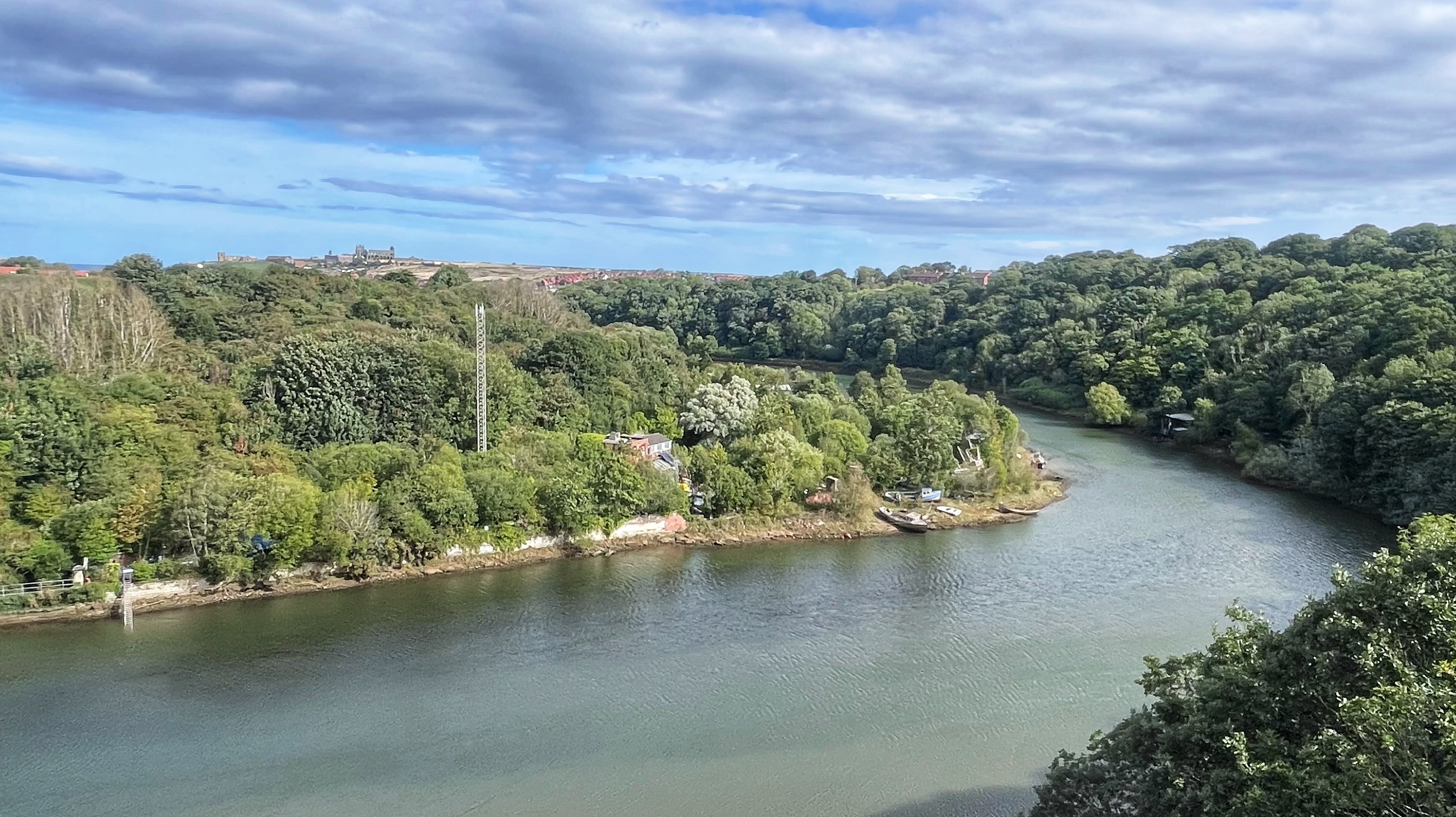
Trees, a few old boats, a river in no hurry at the turn of the tide. Hard to believe this corner once fed a town’s cookers.
The 1853 Ordnance Survey map called the land The Batts. Nothing more. By 1894 a gas works stood here, and by 1914 the map named it: the Whitby Gas Company.
Far below the moors, deep within the Permian rocks, gas had been waiting for millions of years. In the 1930s the D’Arcy Exploration Company, a forerunner of BP, found natural gas in the Eskdale Field between Egton and Whitby. A borehole at Aislaby belongs to that story. Later surveys in the 1950s rated Whitby one of three fields worth another look. None mattered nationally1Wood, Paul. “A Mile beneath Our Feet.” Going Underground, Esk Valley News Quarterly, Summer 2026, p. 56..
Pipes carried gas from that moorland borehole to a new plant beside the Esk at this gas works site, built by the Power-Gas Corporation of Stockton-on-Tees (later to be absorbed into Davy-Ashmore Ltd.) It converted natural gas for home use; one newspaper reader commented it the first of its type in Britain2Hartlepool Northern Daily Mail. 10 Mar. 1961, p. 2. Reader’s letter.3Furnevel, John. “Whitby Gas Works.” RAILSCOT, 23 Mar. 2010, https://www.railscot.co.uk/img/79/709/.. On 23 September 1960 the Minister of Power, Richard Wood, unveiled a plaque. Households had already been cooking on it for a fortnight when the Belfast Telegraph, among others, declared Whitby the first town in the country with natural gas in its main supply4Belfast Telegraph. “Natural Gas.” 23 Sept. 1960, p. 16..
The field was small, yet it served the Whitby area throughout the 1960s and 1970s. North Sea gas then took over nationally, and by 2010 the plant stood abandoned. The trees have had the last word.
- 1Wood, Paul. “A Mile beneath Our Feet.” Going Underground, Esk Valley News Quarterly, Summer 2026, p. 56. ↩︎
- 2
- 3Furnevel, John. “Whitby Gas Works.” RAILSCOT, 23 Mar. 2010, https://www.railscot.co.uk/img/79/709/. ↩︎
- 4Belfast Telegraph. “Natural Gas.” 23 Sept. 1960, p. 16. ↩︎
Leave a Reply