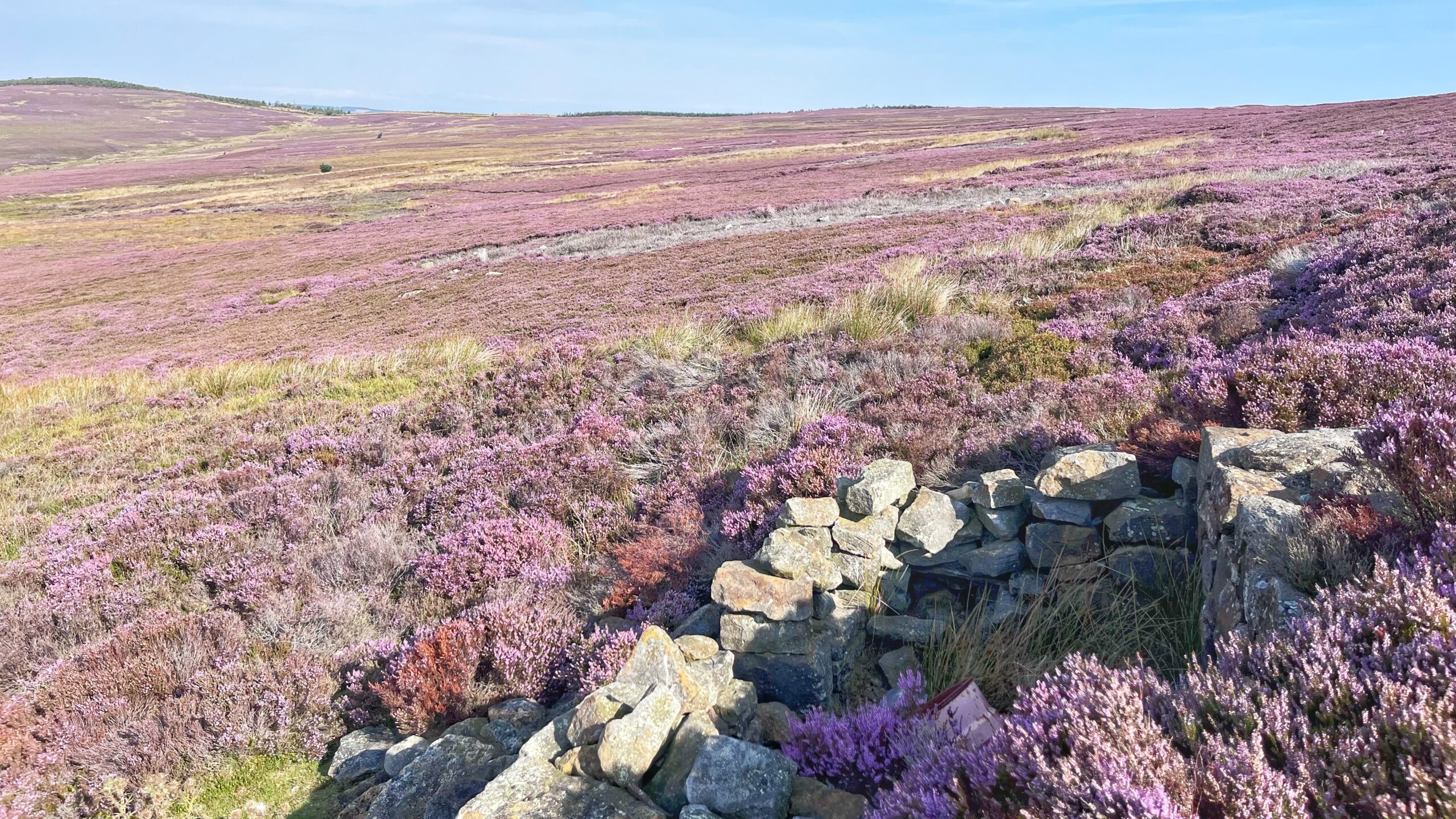
Another shot from yesterday, taken not a hundred yards away. This is Penrod Spring. These days it amounts to little more than a damp patch in the heather, not easy to find. Once, though, it mattered enough that somebody built a dry-stone wall round it, by hand, stone on stone, to mark it out as worth keeping. Nothing much left to say about the spring itself, which leaves the field wide open for a rant.
The Moorland Association is very active on social media, and the pattern of their posts rarely changes: pick a study, take the number that suits the argument, ignore the rest. Their piece on the Langdale Moor fire is a fair sample of the method.1Beeson, Rob. “Heather Management Spared an Estimated 7,000 Tonnes of Carbon at Langdale Moor”. Moorland Association. 24 August 2026. https://www.moorlandassociation.org/post/heather-management-spared-an-estimated-7-000-tonnes-of-carbon-at-langdale-moor2Baker, Sarah J., et al. “Vegetation Management Saved 7,000 Tonnes of Soil Carbon Losses in One of the UK’s Highest Severity Peatland Fires.” Research Square, 17 Aug. 2026, https://doi.org/10.21203/rs.3.rs-10626235/v1.
The fire itself was no small thing. It burned for six weeks in 2025 across the North York Moors, ran deep enough into the peat to set off old military ordnance, and released about 25,000 tonnes of soil carbon, the worst recorded loss of its kind in England.
Buried inside that figure is a genuinely interesting result. Heather patches managed within the previous year came through the fire almost untouched: 77% unburned or lightly burned, nothing at high severity. The researchers, still awaiting peer review themselves, counterfactually put the carbon spared at close to 7,000 tonnes. An estimate of what would have happened if that 77% had burned at the higher severity.
The MA took that finding and ran a fair distance with it. One smouldering pile of cut brash becomes proof that burning beats cutting, though the study calls it one observation, not a trial. A passing line about having “full agency” gets pulled to the front, while the paper’s own emphasis on soil moisture gets pushed to the back. A single fire, measured after the fact, with no control plots, becomes the basis for arguing against limits on burning deep peat.
None of the numbers were invented. The tilt is all in what got left out, and what got promoted to a headline instead of staying in the small print, exactly where it suited the argument to leave it. An effective piece of advocacy journalism, distilling complex carbon-loss calculations and satellite imagery data into a clear narrative: managed heather patches create fire-resistant “islands” that protect carbon stores. Neat, convenient, and rather more certain than the actual science ever claimed to be.
- 1Beeson, Rob. “Heather Management Spared an Estimated 7,000 Tonnes of Carbon at Langdale Moor”. Moorland Association. 24 August 2026. https://www.moorlandassociation.org/post/heather-management-spared-an-estimated-7-000-tonnes-of-carbon-at-langdale-moor ↩︎
- 2Baker, Sarah J., et al. “Vegetation Management Saved 7,000 Tonnes of Soil Carbon Losses in One of the UK’s Highest Severity Peatland Fires.” Research Square, 17 Aug. 2026, https://doi.org/10.21203/rs.3.rs-10626235/v1. ↩︎
Leave a Reply