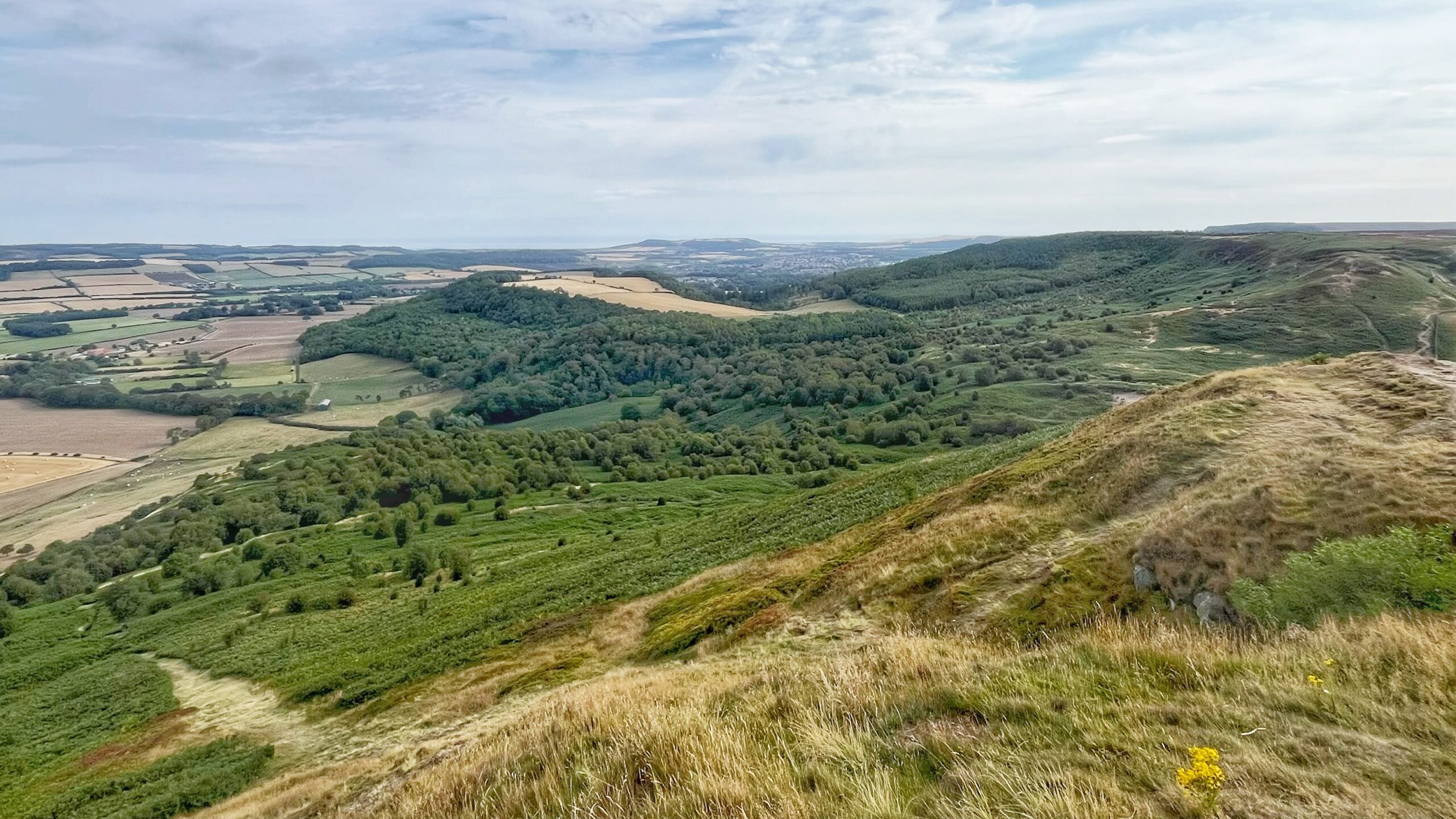
Maps are meant to be read, not buried in an app on a phone. I was doing exactly that the other day when I spotted something odd on the OS sheet: a Public Footpath, marked bold as brass, striking up Roseberry from the north-east. No one walks that way. So naturally I set off to see whether the path still existed, or whether it had gone the way of most good intentions.
Standing on the summit and looking down, the vegetation gave a faint clue, a shadow of a line where the grass grew differently. Lower down, the bracken had swallowed the whole thing whole, supposedly dead centre in the photograph, without so much as a burp. The 1919 OS Six-inch map settles the matter though. A path was there once, and it seems to have run straight past Roseberry Well. That grassy line on the far left of the photo still follows another Public Right of Way. Whether anyone has walked it lately is another matter entirely. I certainly could not tell you the last time I saw anybody on it.
Which raises a proper question, the sort pub arguments are made of. Can a right of way simply vanish because nobody bothers with it any more? It cannot. English and Welsh law is not sentimental about popularity contests, and a PROW does not run on a “use it or lose it” basis, whatever common sense might suggest.
Public Rights of Way count as highways in the eyes of the law, and the old maxim holds firm: “once a highway, always a highway.” Once established, a right of way exists forever, full stop, unless it is formally closed or diverted by legal order. Vegetation does not have that power. Neither does time, nor forgetfulness, nor a farmer with a long memory and a short temper. A path buried under bracken for fifty years is still a path in the eyes of the law, whether or not a single walker remembers it.
Even fences, walls, and buildings cannot kill a right of way outright. They may block it for decades, sometimes centuries, but the underlying right sits there quietly, waiting, like an unpaid debt.
So there it is. A PROW may be forgotten. It may be invisible under three feet of bracken. But it remains legally alive until someone with the proper authority says otherwise, and bracken, whatever its ambitions, holds no such authority.
Leave a Reply