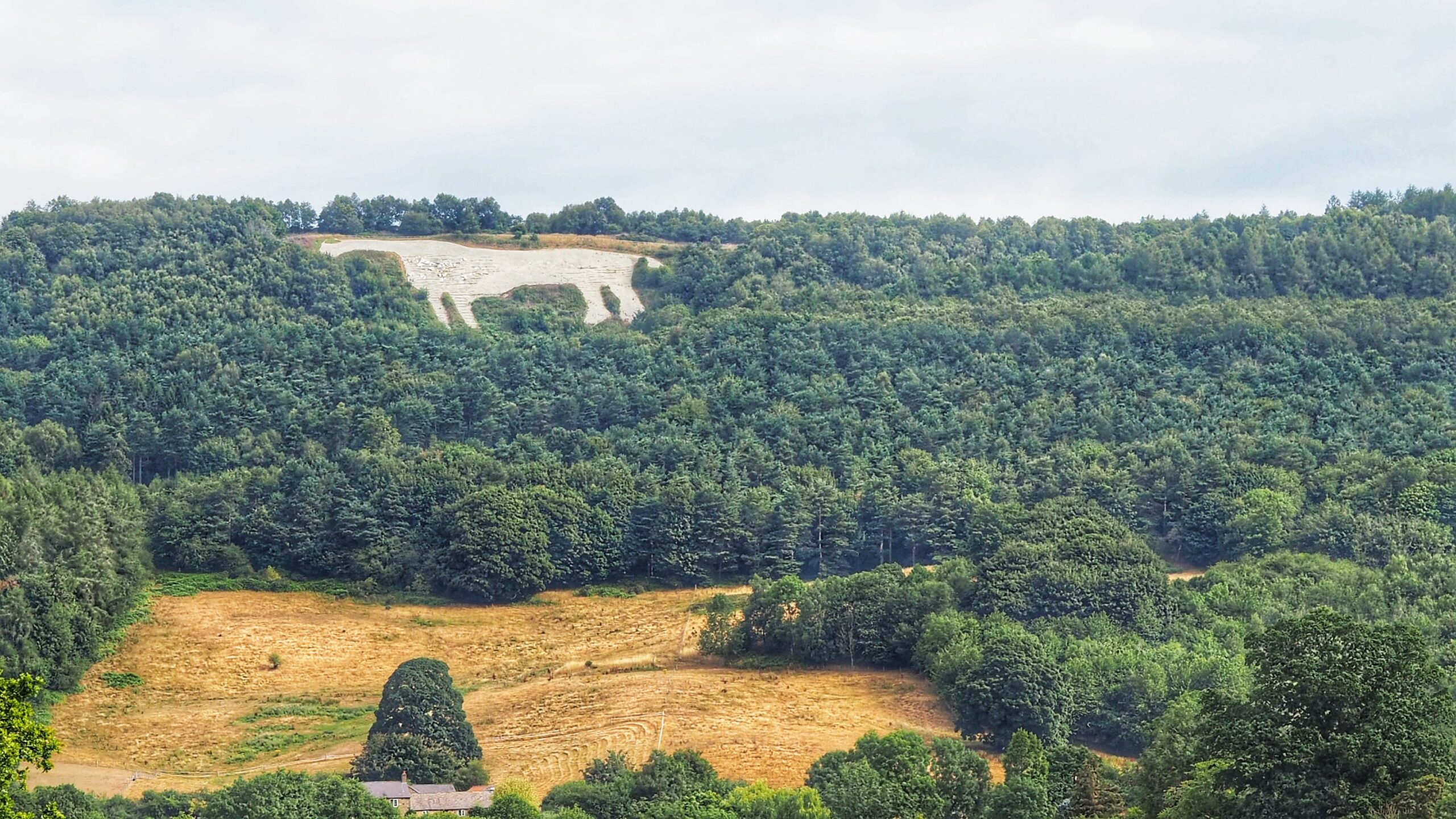
Everyone assumes the horse is ancient. Some pagan relic, carved by shadowy ancestors for reasons lost to the mists of time. Wrong, as it happens.
The Kilburn horse was the work of one Thomas Taylor, a local boy who left for London, made his fortune, and came home with an idea instead of sense. He had seen the Berkshire White Horse and decided Kilburn deserved a rival. In November 1857 he rounded up thirty-two of his old schoolmates and set them loose on the hillside with spades. Two days later, there it stood.1‘Kilburn’s White Horse. | Newcastle Courant | Saturday 27 May 1899 | British Newspaper Archive’. 2022. Britishnewspaperarchive.co.uk <https://www.britishnewspaperarchive.co.uk/viewer/bl/0000086/18990527/004/0002> [accessed 1 August 2022]
Chalk gets the credit too, and wrongly so. The soil underneath is dark red, so the horse relies on six tons of lime just to look respectable, with a fresh coat needed every few years to stop it sinking back into the hillside. Even lime proved no match for the hailstorm of July 1895, when stones the size of cannonballs stripped bare whole legs and left the creature looking distinctly moth-eaten.
A horse knocked up by schoolboys, whitewashed for effect, and patched up whenever the Yorkshire weather turns nasty. Not a bad innings for something masquerading as a monument.
- 1‘Kilburn’s White Horse. | Newcastle Courant | Saturday 27 May 1899 | British Newspaper Archive’. 2022. Britishnewspaperarchive.co.uk <https://www.britishnewspaperarchive.co.uk/viewer/bl/0000086/18990527/004/0002> [accessed 1 August 2022] ↩︎
Leave a Reply