I bought a 1956 guidebook off eBay. Already a good decision.
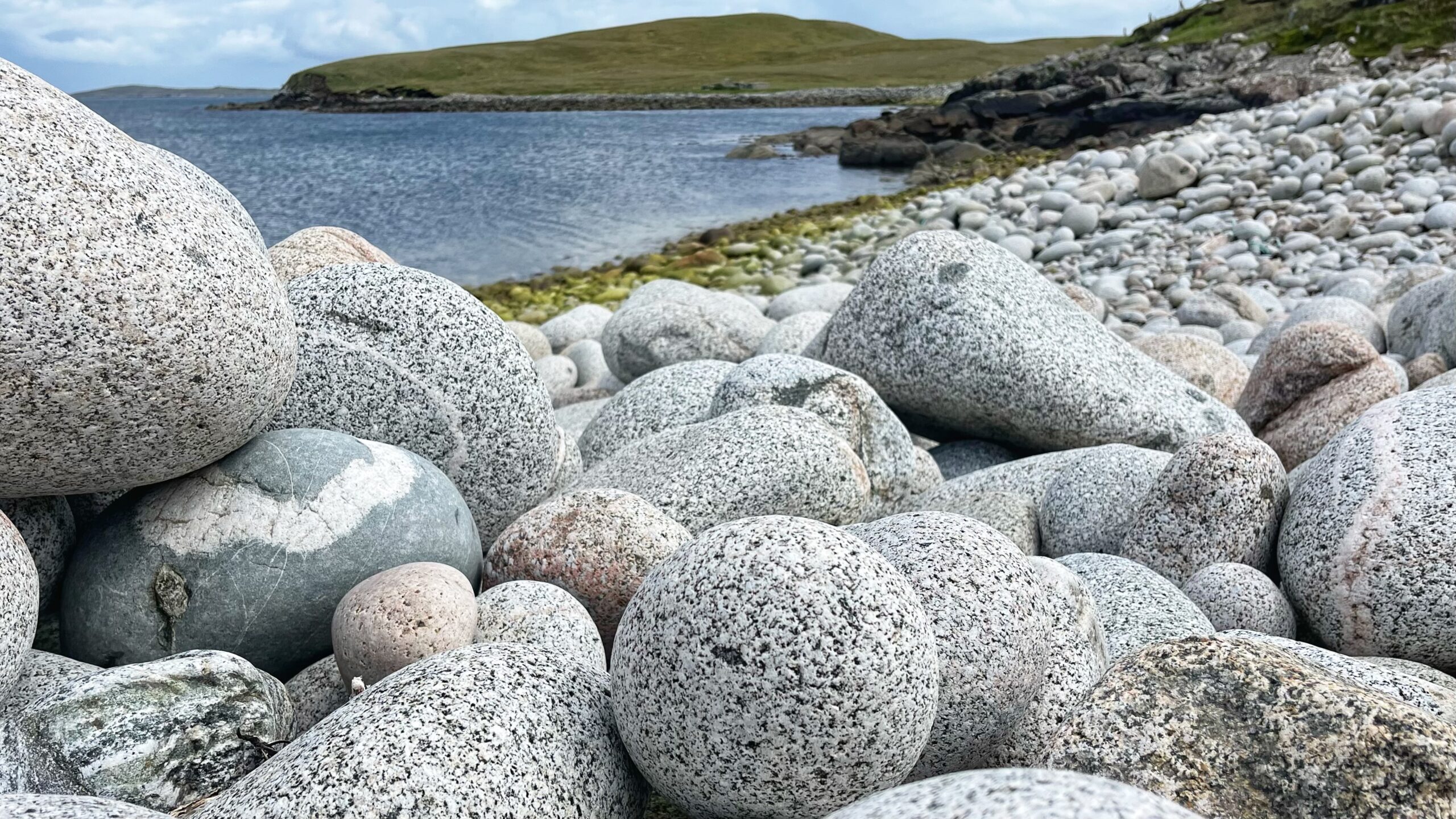
It mentioned a beach at Stavaness with “almost spherical granite boulders.” That was enough. The likely candidate was the Ayre of Billigroot, though calling it an ayre is generous.1Cluness, Andrew T. THE SHETLAND ISLES. Page 225. 1956. Robert Hale Limited. The word comes from the Old Norse “eyrr,” meaning a gravel beach.2Tait, Charles. The Shetland Guide Book. Page 8. The Vikings apparently had an elastic definition of gravel.
The boulders were worth the detour. Not quite spherical, but every one of them would look magnificent in a garden and cost a small fortune at a garden centre. Which raised a question that turned out to be far less simple than it sounds.
Who owns them?
Scotland thinks it owns everything north of the Pentland Firth. Orkney and Shetland quietly disagree.
Udal Law is a Norse system of land ownership so old and so different from anything in Scots Law that Edinburgh lawyers have been baffled by it for six centuries. Under Scots law, the Crown owns all land ultimately. Under Udal Law, the landowner owns the land absolutely, with no superior above him. No written deed required. Possession itself was the title.3Tait, Charles. The Shetland Guide Book. Udal Law. Page 46.
The most striking difference today sits at the water’s edge. Everywhere else in Britain, you own land to the high-water mark. In Orkney and Shetland, ownership extends to the lowest spring tide, plus roughly as far as a horse can wade. The foreshore is not common land. It belongs to whoever owns the land behind it.
This is not theoretical. In the 1970s, an oil company paid the Crown for rights to cross a stretch of foreshore in Orkney. The Crown took the money. The Crown had no authority to give anything. It had to admit this and pay the landowner back.
Someone once went to Harray Loch in Orkney, shot a swan, and took the case to the High Court purely to test whether Udal Law still held. The Crown lost. Swans in Orkney belong to the people.
Scotland mortgaged these islands in 1468. It never paid the debt back. The argument is still open.
- 1Cluness, Andrew T. THE SHETLAND ISLES. Page 225. 1956. Robert Hale Limited.
- 2Tait, Charles. The Shetland Guide Book. Page 8.
- 3Tait, Charles. The Shetland Guide Book. Udal Law. Page 46.
Leave a Reply