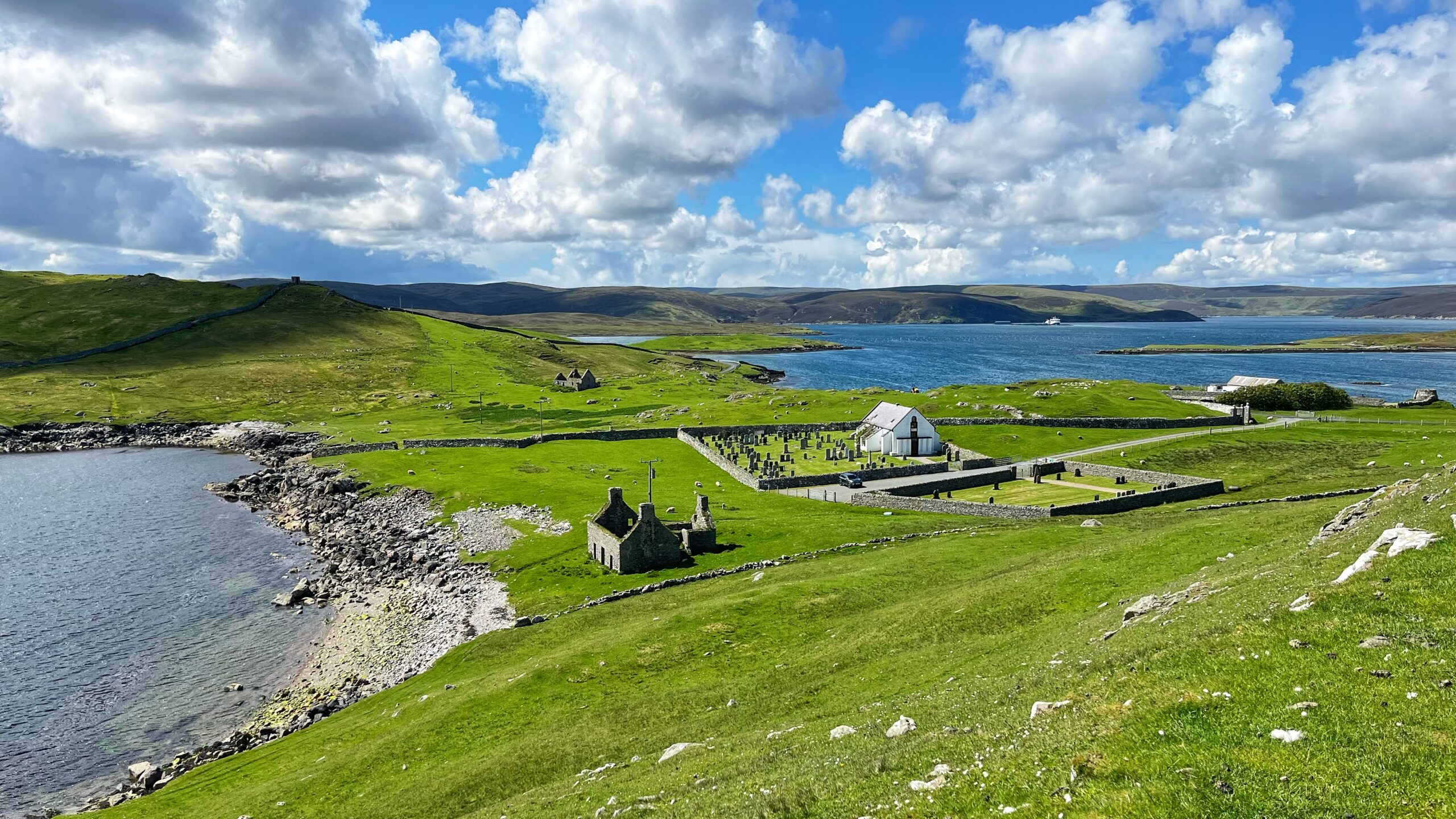
Lunnasting drives a wild, rocky finger of land deep into the eastern mouth of Yell Sound. The men who lived here were something rather more than fishermen. “Never spaek o da Lunnasting men” — the old saying said it all. They were beyond ordinary reckoning.1Cluness, Andrew T. THE SHETLAND ISLES. Page 224. 1956. Robert Hale Limited.
That narrow strip of land is all that keeps Lunna Ness from being an island. The beach below is not natural. The laird had it built in the 18th century so salted ling could be laid out to dry. He also put up the large böd — a store for dried fish, gear and equipment, with the manager’s office above. The laird built everything. He owned everything.2On-site interpretation board. 10 June 2026.
He owned their boats, their sixareens, too. The fishermen had to sell their catches to him at prices he set, which were not generous. He ran the local shops on credit — shops he also owned — so debt was permanent and inescapable. Fall behind on payments and you lost your croft. This was the Truck system, and it ground on until the Crofters Act of 1886 finally put a stop to it.3 Burravoe Old Haa museum 8 June 2026.
That small square silhouette just visible on the skyline to the left is the Hunter monument. The Hunter family owned the estate, and from up there the laird could watch his fishermen and make sure no catch was landing anywhere it should not.
But it is the kirk that is the star of the tourist itinerary. There has been a church at Lunna since medieval times. St Margaret’s came first, though nothing remains but a grassy knoll. The present kirk went up in 1753, built on the site of an earlier mausoleum. It is still in regular use — Shetland’s oldest.
On the right, the west side of the isthmus, a stone harbour sits beside a well-preserved 19th-century lime-burning kiln.
Then came the war. In the autumn of 1940, the Special Operations Executive chose Lunna as the base for what became known as the “Shetland Bus” — a Norwegian naval unit running about 30 fishing vessels back and forth across the North Sea. They carried agents, resistance instructors, refugees and military supplies into occupied Norway, in secret, in all weathers. The base later moved to Scalloway, but Lunna was where it all began.
- 1Cluness, Andrew T. THE SHETLAND ISLES. Page 224. 1956. Robert Hale Limited.
- 2On-site interpretation board. 10 June 2026.
- 3Burravoe Old Haa museum 8 June 2026.
Leave a Reply