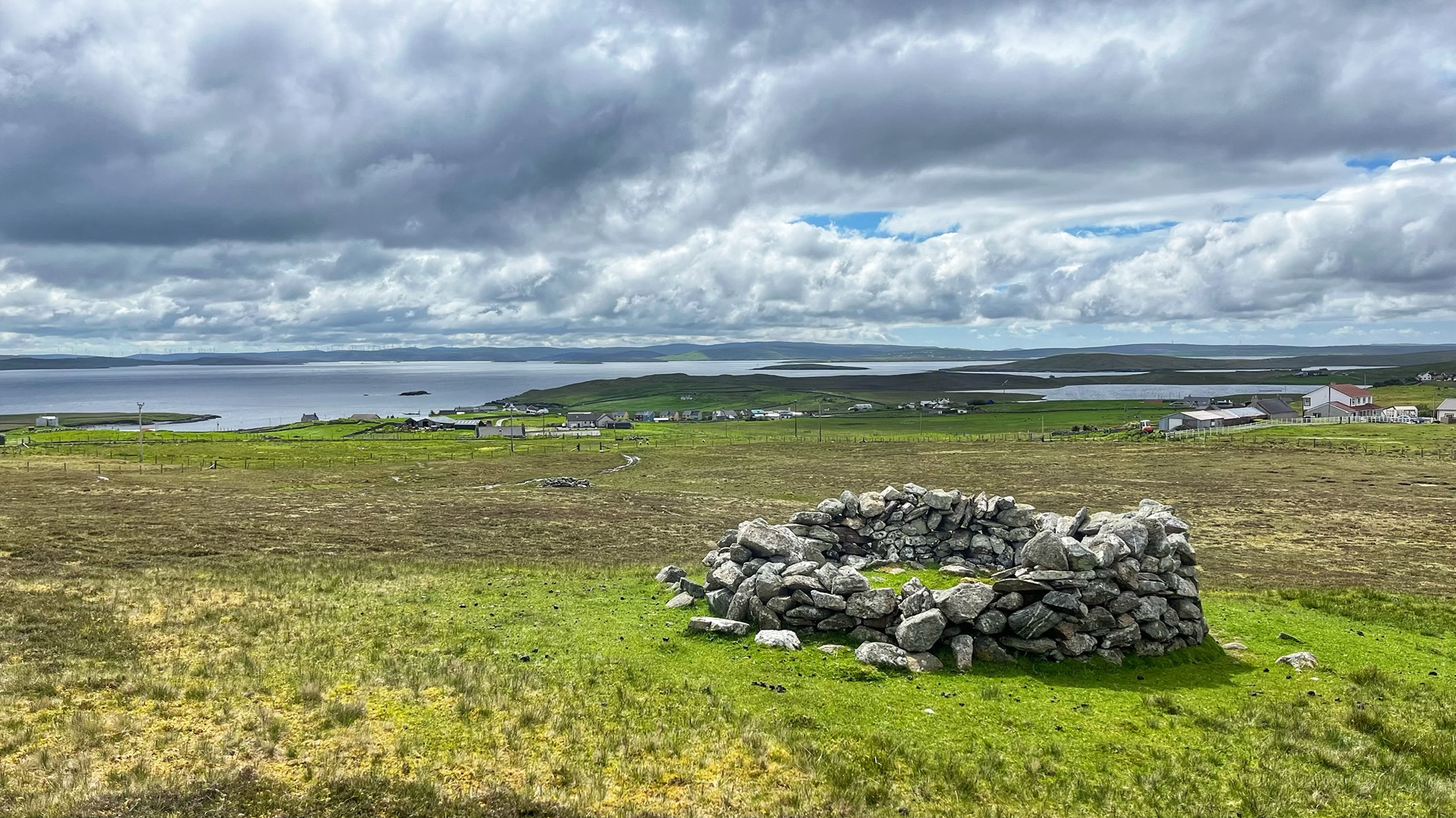
Looking south over the village of Burravoe on the island of Yell, a planticrub sits on the hillside like a small, collapsed fort that never quite finished deciding what it wanted to be.1TANGWICK HAA MUSEUM. Interpretation Panel. 31 May 2026
These dry-stone enclosures are scattered across Shetland in their hundreds, most of them abandoned. They look like the ruins of huts. They were not huts — they were nurseries, built with considerable purpose on ground that does not forgive carelessness.
Shetlanders sowed seeds inside them during summer, mainly native kail. The walls created a sheltered pocket of air, keeping out salt spray and wind fierce enough to flatten anything unprotected. Simple idea. Extremely hard place to grow a cabbage.
No gates. No access. None. The enemy was the Shetland sheep, described, generously, as “bold and curious.”2“A lifetime of Islands: Island 20 – Yell, Shetland.” A lifetime of Islands, 8 Mar. 2011, http://alifetimeofislands.blogspot.com/2011/03/island-20-yell-shetland.html Some crubs were capped with cantilever fences or draped in old fishing nets purely to stop sheep climbing over the walls. One suspects the sheep remained unimpressed.
When the seedlings were strong enough, they were “drawn” — transplanted — during the Voar, the spring season, and moved to the vegetable “rigs” closer to the croft [2]. The stone circles stayed behind. They are still there. A winning cabbage once depended on them entirely.
- 1TANGWICK HAA MUSEUM. Interpretation Panel. 31 May 2026
- 2“A lifetime of Islands: Island 20 – Yell, Shetland.” A lifetime of Islands, 8 Mar. 2011, http://alifetimeofislands.blogspot.com/2011/03/island-20-yell-shetland.html
Leave a Reply