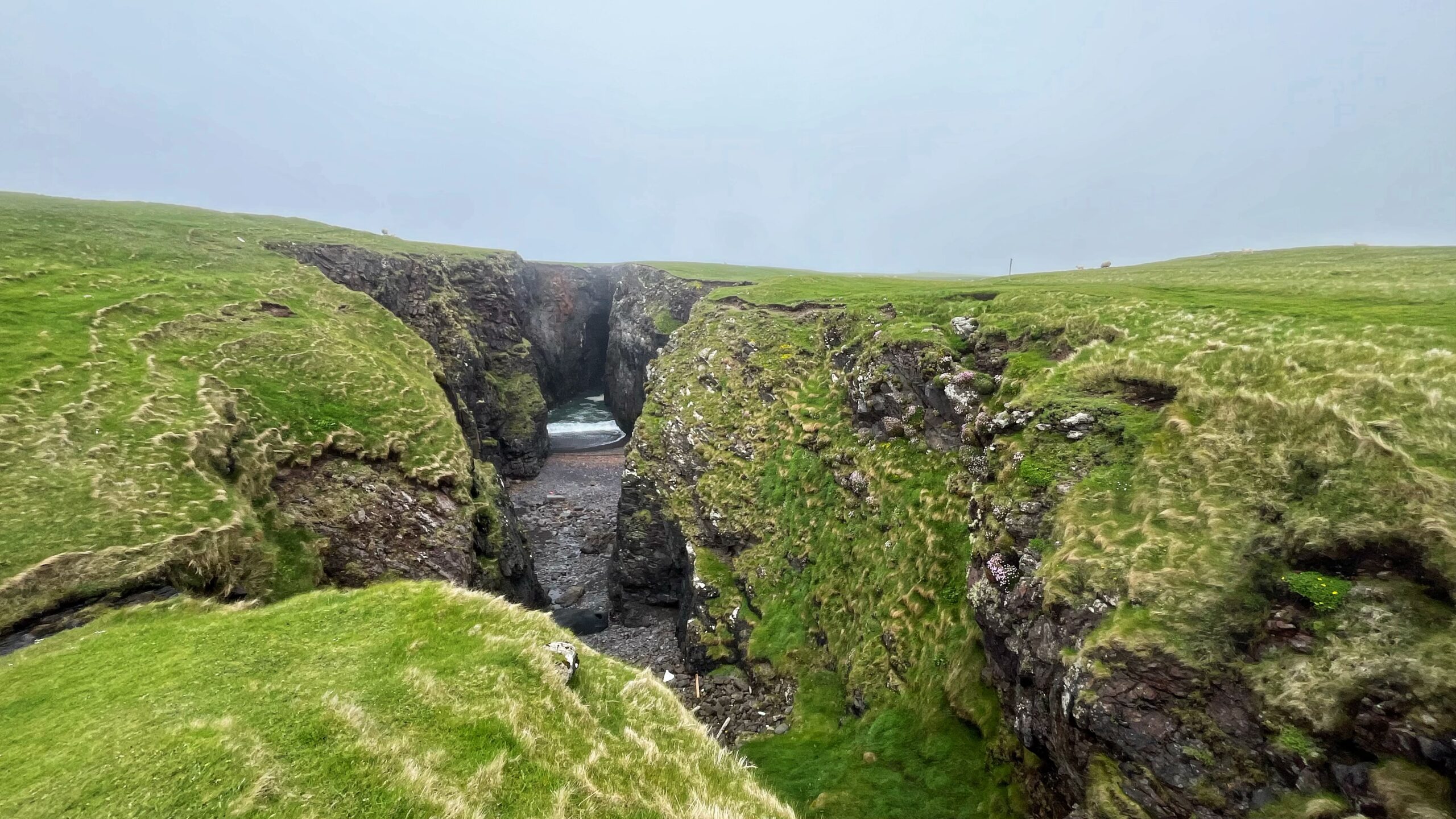
360 million years ago, Eshaness was a volcano throwing a rather spectacular tantrum. Today it is rather more well-behaved, though the Atlantic still does its level best to batter the cliffs into submission.
Over thousands of years the sea has gnawed away at the rock, slicing open a cross-section of the ancient volcano and carving out some of the most jaw-dropping coastal scenery in Shetland.
This is the Hols o Scraada. It began as a sea cave, whose roof eventually gave way, forming what is known as a “gloup” — its name rather cheerfully suggests more than one hole.
Until 1873 it was indeed two gloups, split by a natural rock bridge. That year the bridge fell in, leaving a single hole some 130 metres long. A subterranean tunnel of about 70 metres still runs beneath the headland. When that too collapses, the whole thing will become a very long “geo”.
Eshaness has been quietly telling remarkable stories for rather a long time. It shows no sign of stopping.
Leave a Reply