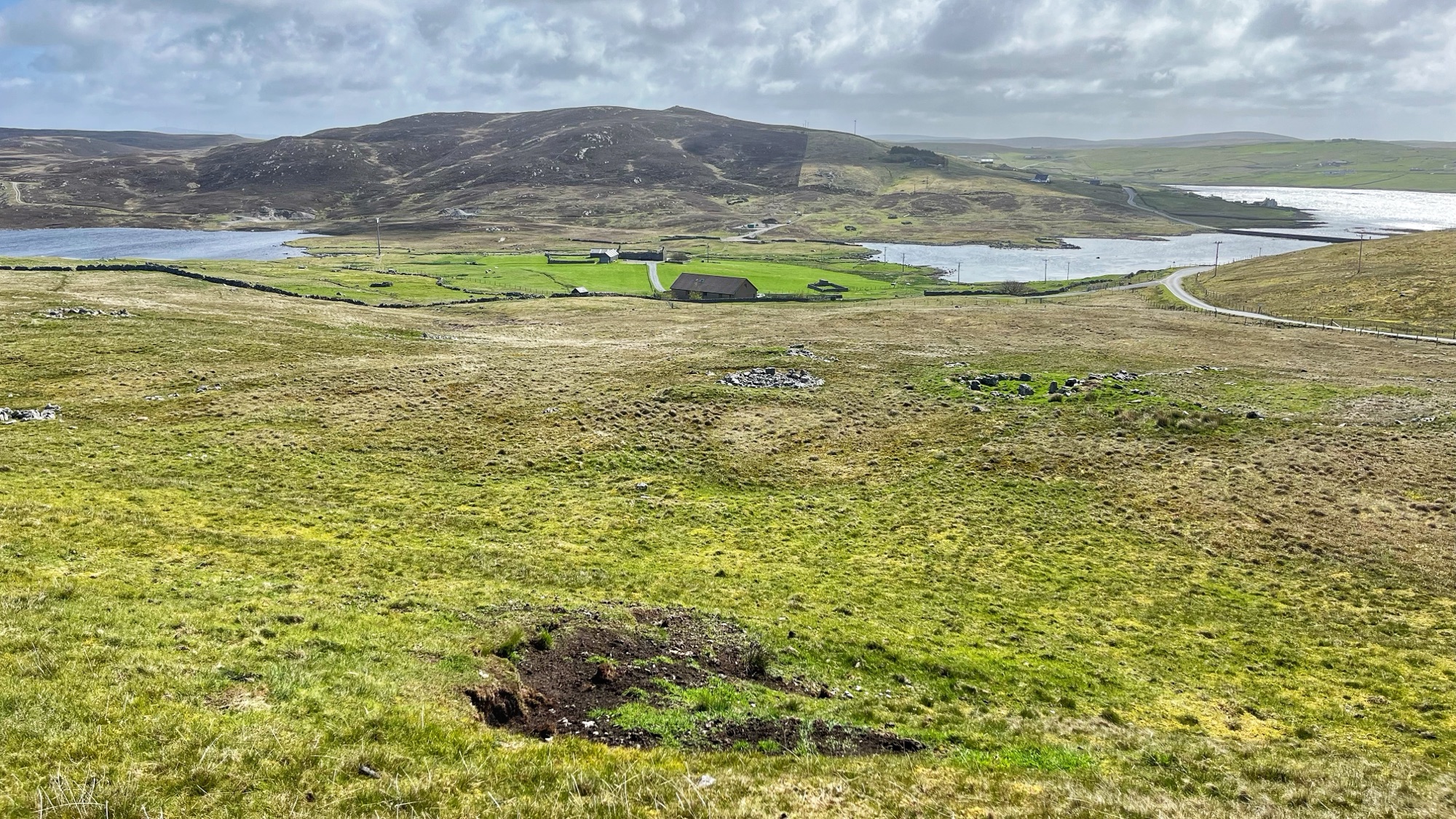
We stumbled upon this site by chance. Hidden on Shetland’s west side sits one of Scotland’s oldest farming puzzles. Over 5,000 years ago, the Scord of Brouster was not the bleak, wind-battered moorland you see today. It was a working farm surrounded by scrubby hazel and birch woodland.1“Shetland.” Wikipedia, 2024, https://en.wikipedia.org/wiki/Shetland.
These were New Stone Age settlers, and they rather got on with things around 3400 BC. They felled the trees, grew primitive hulled barley, kept sheep and cattle, and fed their fields with ash and manure. In the photograph, you can still make out the stone foundations of three round houses and the faint outlines of their walled fields.2On-site Information Board. “Scord of Brouster.” Walls, Shetland, 26 May 2026.
This site is a quietly devastating reminder that nature always has the last word. Around 1500 BC, Shetland’s weather took a turn for the considerably worse. The peat crept in, the fields grew useless, and the farmers packed up and moved to the coast. They left behind 75 broken stone ard points — the tips of their wooden ploughs. The soil here has not felt a plough since.
It is, all things considered, a rather eloquent silence.
- 1“Shetland.” Wikipedia, 2024, https://en.wikipedia.org/wiki/Shetland.
- 2On-site Information Board. “Scord of Brouster.” Walls, Shetland, 26 May 2026.
Leave a Reply