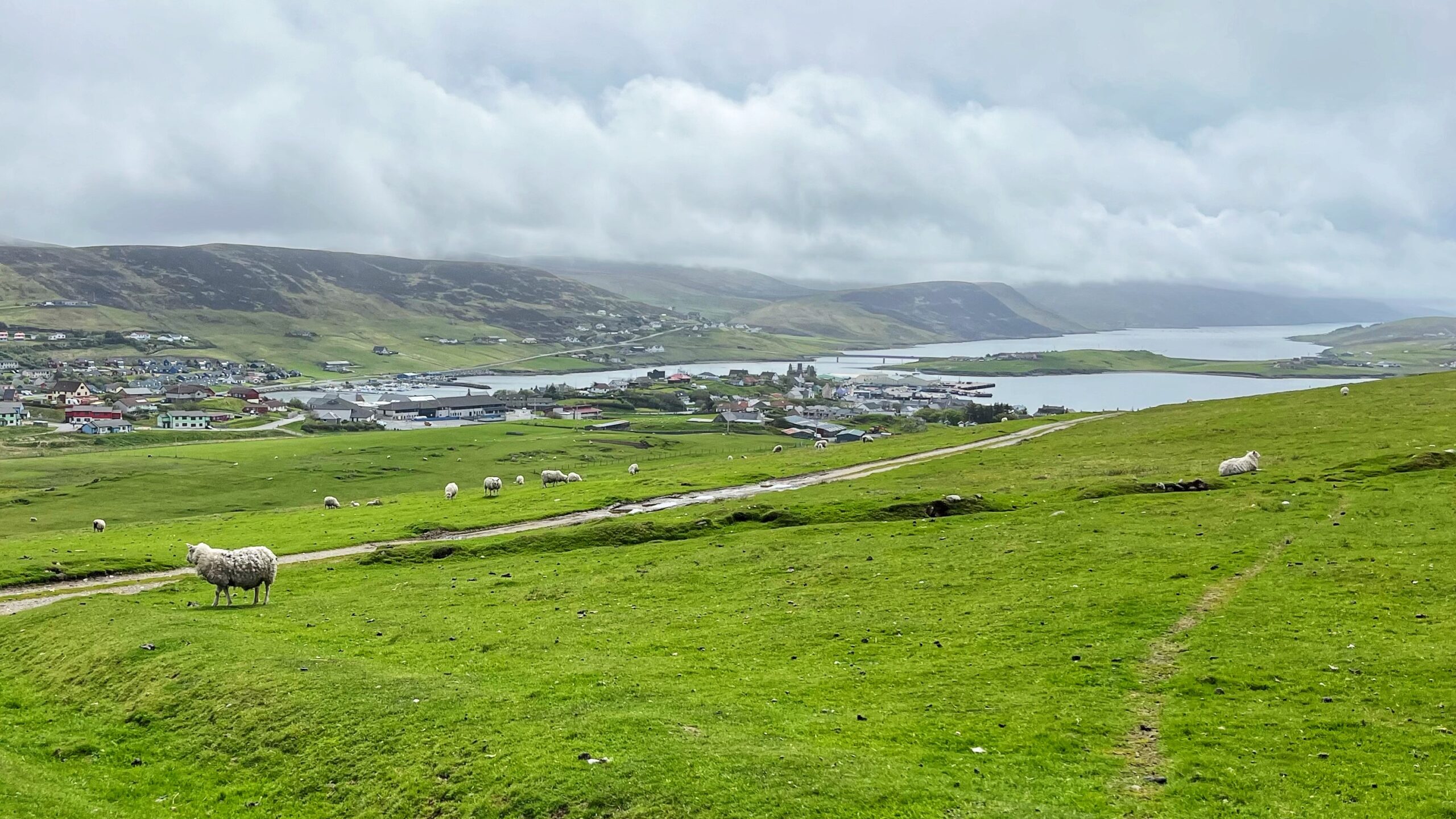
Before the rope and the flames took her, she would have looked out over almost this exact view — the cold East Voe of Scalloway meeting the green hills of Mainland.
In the 17th century, this hill — known variously as the Hill of Berry, the Hill of Houll, and Gallow Hill — served as Scalloway’s place for witchcraft executions1Information Board, Scalloway, 24 May 20262Cluness, Andrew. *The Shetland Isles*, Robert Hale Ltd, 1951, p. 231.3“Da Fateful Tale o Marion Pardone: Witchcraft in Shetland.” Shetland.org, 31 Oct. 2024, https://www.shetland.org/blog/da-fateful-tale-o-marion-pardone-witchcraft-in-shetland . Scalloway Castle, which you can see just right of centre, the tallest building in the old town, was built by that rather unpleasant Earl Patrick Stewart. It was the lot who came after his 1609 imprisonment, though, who really went to town on alleged witches4“World-class archaeology.” Shetland.org, https://www.shetland.org/visit/do/history/archaeology.
The trials held inside those walls tended to go after the poor and the unpopular — as such trials generally did. One such soul was Marion Pardone, condemned in 1644 for “imaginary crimes” like disguised drownings and spoiling produce. She was brought to this steep eastern slope, strangled at the stake, and burned.
The number of victims here — roughly eight — is modest beside central Scotland’s record, though each one was a rank injustice. A memorial now stands a little way along the hill, asking visitors to pause and think, while taking in the same fine and once-fatal view. By the century’s end, the government finally told everyone to stop hanging women for nonsense, leaving only the wind and a long memory on these quiet green slopes.
- 1Information Board, Scalloway, 24 May 2026
- 2Cluness, Andrew. *The Shetland Isles*, Robert Hale Ltd, 1951, p. 231.
- 3“Da Fateful Tale o Marion Pardone: Witchcraft in Shetland.” Shetland.org, 31 Oct. 2024, https://www.shetland.org/blog/da-fateful-tale-o-marion-pardone-witchcraft-in-shetland
- 4“World-class archaeology.” Shetland.org, https://www.shetland.org/visit/do/history/archaeology
Leave a Reply