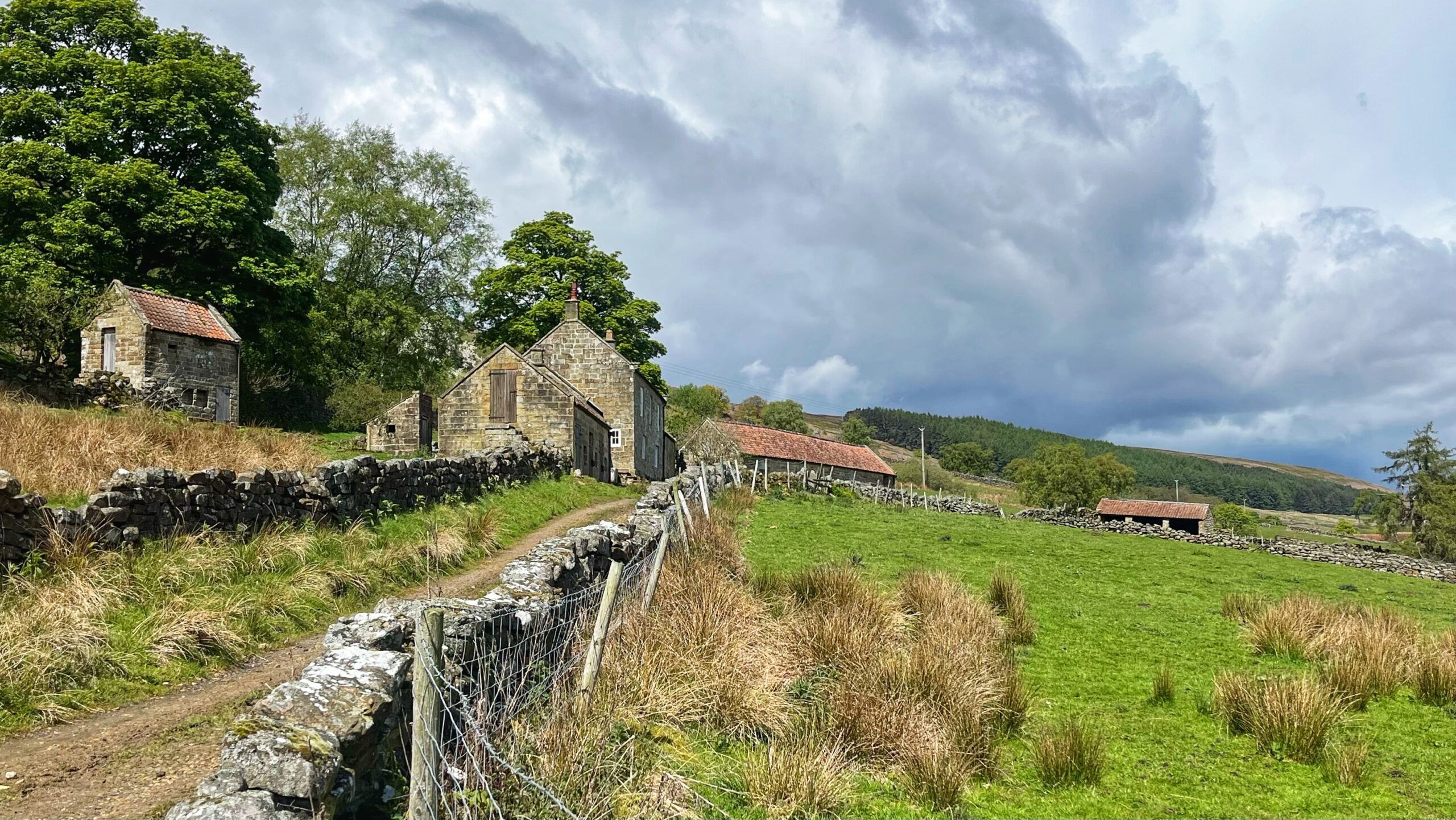
Tucked into a remote part of Bransdale, Elm Houses has a history worth telling. What is today one tidy holiday cottage surrounded by idle farm buildings was once two entirely separate farms: High and Low Elm House.1National Trust. “High Elm House, Bransdale.” National Trust Heritage Records, MNA144944, [https://heritagerecords.nationaltrust.org.uk/record/MNA144944].2National Trust. “Low Elm House, Bransdale.” National Trust Heritage Records, MNA144991, [https://heritagerecords.nationaltrust.org.uk/record/MNA144991].
On the right stands High Elm House, a long 18th-century range. A lintel stone dated 1780 records its purchase by one Thomas Chapman, a detail that makes the wall rather more interesting than usual. To the left, Low Elm House now does duty as the main farmhouse, or rather, holiday cottage. It was given a fresh face in the 1800s, yet a “1666” date stone hints at a considerably older past. By 1828, the Feversham Estate had tidied both holdings into a single 48-acre unit, though modern Ordnance Survey maps still mark the distinction.
History has left its fingerprints all around the yard. Between the two houses stands a late 19th-century cart shed, built over the site of a former water corn mill. Nearby sit a modest stone privy and some mid-19th-century pigsties, the whole lot built of the traditional stone.3National Trust. “Former cart shed, Low Elm House, Bransdale.” National Trust Heritage Records, MNA144943, [https://heritagerecords.nationaltrust.org.uk/record/MNA144943].4Harrison, J.K. Eight Centuries of Milling in North East Yorkshire. North York Moors National Park Authority, 2008, p. 225.5National Trust. “Pigsties, Low Elm House, Bransdale.” National Trust Heritage Records, MNA143642, [https://heritagerecords.nationaltrust.org.uk/record/MNA143642].6National Trust. “Privy, Low Elm House, Bransdale.” National Trust Heritage Records, MNA144644, [https://heritagerecords.nationaltrust.org.uk/record/MNA144644].
The cleverest trick belongs to the two-storey granary on the far left [9]. Grain and flour were stored in the upper loft, directly above the pigs below. The noise and general unpleasantness of the pigs served as a rather effective deterrent to rats with ambitions above their station.7National Trust. “Granary and pigsty, Low Elm House, Bransdale.” National Trust Heritage Records, MNA144584, [https://heritagerecords.nationaltrust.org.uk/record/MNA144584].
- 1National Trust. “High Elm House, Bransdale.” National Trust Heritage Records, MNA144944, [https://heritagerecords.nationaltrust.org.uk/record/MNA144944].
- 2National Trust. “Low Elm House, Bransdale.” National Trust Heritage Records, MNA144991, [https://heritagerecords.nationaltrust.org.uk/record/MNA144991].
- 3National Trust. “Former cart shed, Low Elm House, Bransdale.” National Trust Heritage Records, MNA144943, [https://heritagerecords.nationaltrust.org.uk/record/MNA144943].
- 4Harrison, J.K. Eight Centuries of Milling in North East Yorkshire. North York Moors National Park Authority, 2008, p. 225.
- 5National Trust. “Pigsties, Low Elm House, Bransdale.” National Trust Heritage Records, MNA143642, [https://heritagerecords.nationaltrust.org.uk/record/MNA143642].
- 6National Trust. “Privy, Low Elm House, Bransdale.” National Trust Heritage Records, MNA144644, [https://heritagerecords.nationaltrust.org.uk/record/MNA144644].
- 7National Trust. “Granary and pigsty, Low Elm House, Bransdale.” National Trust Heritage Records, MNA144584, [https://heritagerecords.nationaltrust.org.uk/record/MNA144584].
Leave a Reply