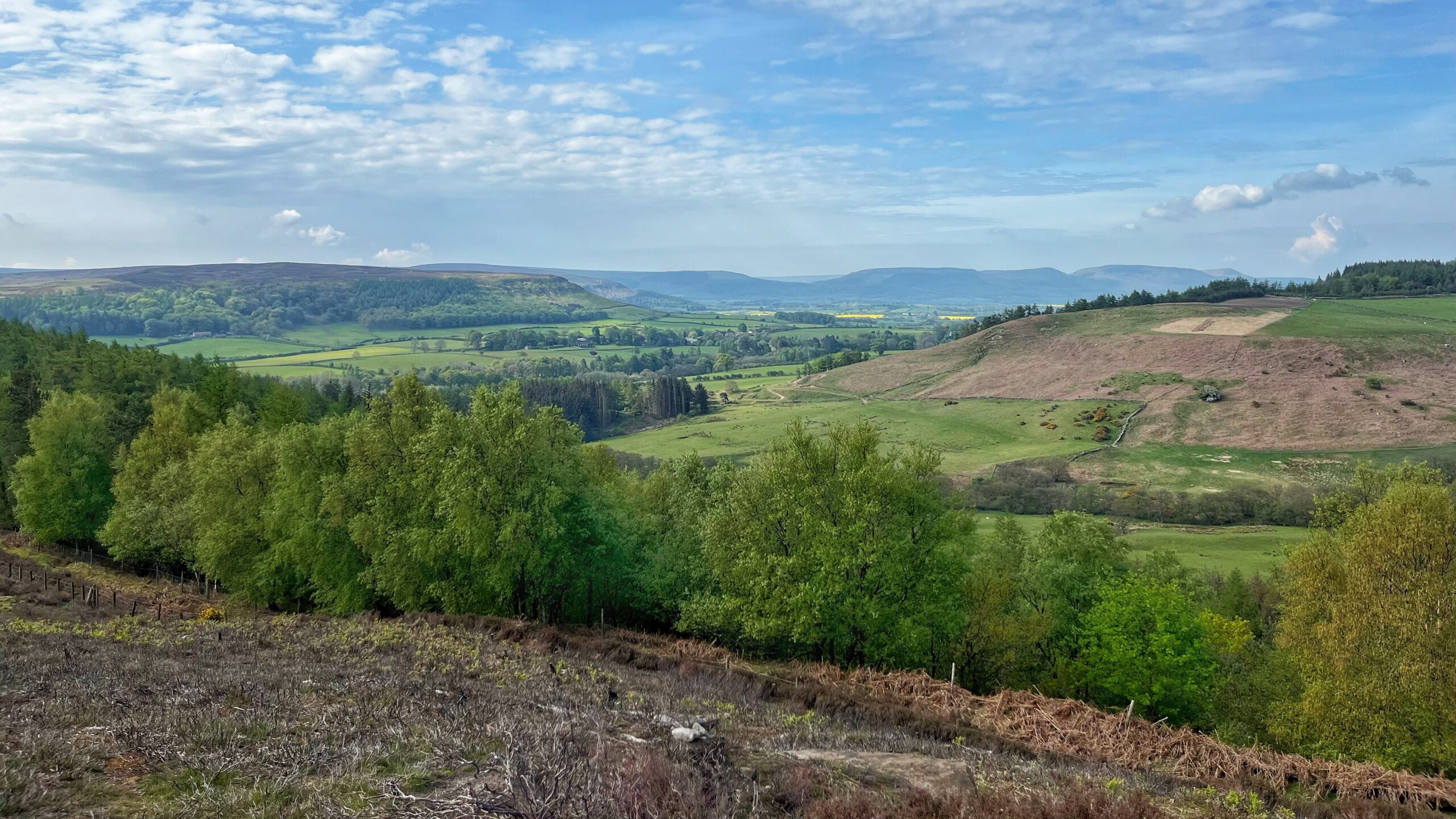
The view from the hills above Kildale, taken yesterday — when the weather was rather more agreeable than today’s thoroughly dreich conditions.
The North York Moors is not the sort of place one associates with violent crime. Yet on the evening of Wednesday 16 August 1871, a quiet farm in Kildale became the scene of a killing that shook the whole of Cleveland1Murder At Kildale, In Cleveland. | Leeds Mercury | Tuesday 22 August 1871 | British Newspaper Archive. [online] Available at: https://www.britishnewspaperarchive.co.uk/viewer/bl/0000076/18710822/023/0006 [Accessed 28 Apr. 2022].2Shocking Event At Kildale. | York Herald | Saturday 26 August 1871 | British Newspaper Archive. [online] Available at: https://www.britishnewspaperarchive.co.uk/viewer/bl/0000499/18710826/057/0010 [Accessed 28 Apr. 2022]..
A Stranger Seeks Work
Samuel Edmunds was a navvy — a labourer — from Enville in Staffordshire. He had spent the previous four months working the ironstone mines at Guisborough, and had been drinking heavily for over a week. On the morning of the 16th, he turned up at West House Farm, Kildale, looking for work. Farmer Matthew Ackroyd took him on. They made hay together, had tea in the field, and by half past nine that evening Edmunds was bedded down on straw in the hay loft above the stable. He seemed perfectly rational.
Things Go Very Wrong Indeed
Half an hour later, Ackroyd heard shouting from the loft. Edmunds emerged stark naked, armed with a heavy bridle bit, smashing windows and threatening to kill his employer. Ackroyd barricaded himself inside and sent his farm servant, John Wilkinson, to fetch help from the cottages at New Row, about a mile away.
Wilkinson roused Francis Wilkinson — a 46-year-old farmer and, as it happened, Ackroyd’s brother-in-law — along with a labourer named John Milburn. The two men set off along the railway towards West House.
The Fatal Blow
At Cragg Bank railway bridge, they found Edmunds standing on the highway, brandishing a five-foot oak stake and threatening to kill the first man who approached him. Milburn urged caution. Francis Wilkinson replied that something must be done, and climbed the fence to reach the road. Edmunds rushed at him and struck him a tremendous blow to the head. Wilkinson fell unconscious among the barley, never to recover. He died the following afternoon at around four o’clock.
Edmunds told Milburn, “I will not kill thee,” then wandered off smashing more windows before being captured in Kildale village after a considerable struggle. He was carted to Stokesley lock-up, where he had to be strapped down.
The Inquest
A post-mortem by Dr W. A. Loy found a deep lacerated wound on the left side of Wilkinson’s head, with blood pressing on the brain — the direct cause of death, entirely consistent with a blow from the recovered stake. The jury returned a verdict of wilful murder. Edmunds was removed to Northallerton gaol to await trial at the York Assizes.
Francis Wilkinson was buried at Guisborough the following Saturday. He left a wife and two children.
In short
A stranger with a week’s drinking behind him arrived at a Kildale farm, lost his mind entirely that night, and killed a good man who simply tried to help. The army had already formed a view of Samuel Edmunds — branding him with D for Deserter and B.C. for Bad Character before washing their hands of him altogether. On the evidence of 16 August 1871, they were not wrong.
- 1Murder At Kildale, In Cleveland. | Leeds Mercury | Tuesday 22 August 1871 | British Newspaper Archive. [online] Available at: https://www.britishnewspaperarchive.co.uk/viewer/bl/0000076/18710822/023/0006 [Accessed 28 Apr. 2022].
- 2Shocking Event At Kildale. | York Herald | Saturday 26 August 1871 | British Newspaper Archive. [online] Available at: https://www.britishnewspaperarchive.co.uk/viewer/bl/0000499/18710826/057/0010 [Accessed 28 Apr. 2022].
Leave a Reply