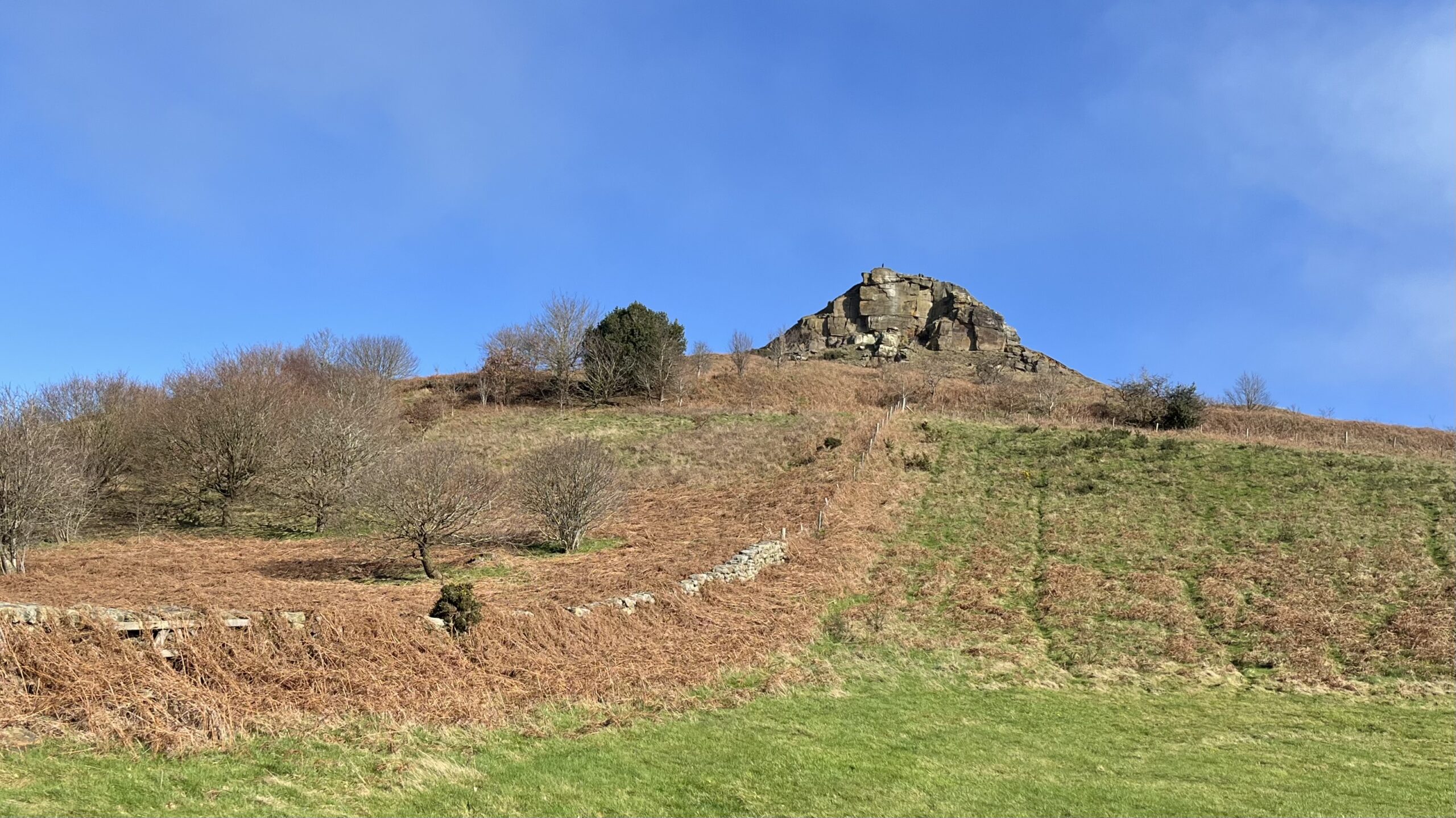
Today’s photo is, of course, of Roseberry Topping. That dry stone wall running up the slope marks the boundary between the parishes of Newton-under-Roseberry and Great Ayton. Before the great landslip of 1912 it ran all the way to the summit.
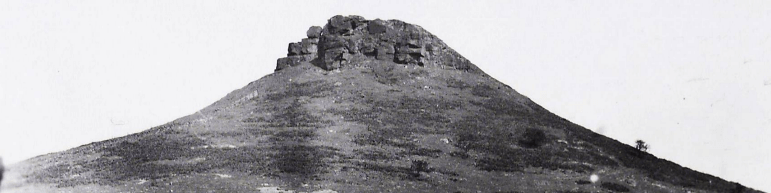
Looking at a photograph taken before 1912, you can see vegetated ground running right to the base of the crag, which appears to have been about half its present height. Then the whole lot — slope, soil and a good chunk of the sandstone crag above — slid down the hillside, leaving behind a large, irregular mound at the foot and exposing a much greater rock face at the summit. The wall, naturally, did not survive the experience.
Whilst we are back in 1912, I recently came across this rather wonderful snippet in the South Bank Express for that year, filed under “Capt. Quiz Wonders — Satire without Vulgarity”1‘Business Withim | South Bank Express | 18 May 1912 | British Newspaper Archive’. 2023. Britishnewspaperarchive.co.uk <https://www.britishnewspaperarchive.co.uk/viewer/bl/0004627/19120518/033/0004> [accessed 31 May 2023]:
“Who were the two pimps who were scouting in Roseberry Wood on Thursday! had they a good time or not! we had“
On first reading, this sounds like a bizarre and potentially dark accusation. Satire, no doubt, as the title says, but completely lost on me. After a bit of digging, though, I think I have cracked the joke — and it is a pun, that most beloved of Edwardian weapons.
In that era, “pimp” did not exclusively mean what it means today. Alongside the less savoury definition, it was also widely used in British dialects to mean “a small bundle of chopped wood, used for lighting fires.” So the “two pimps” were almost certainly not men of ill repute but rather two local characters spotted gathering firewood in Roseberry Wood. Calling them “pimps” was a deliberate, slightly cheeky play on words — the writer deploying the firewood meaning whilst winking broadly at the other one. Hence “Satire without Vulgarity.” The vulgarity is there; it is simply wearing its Sunday best.
There is also a regional footnote worth adding. In north-east Yorkshire, “to pimp” meant “to indulge a squeamish appetite,” giving rise to “pimpish,” meaning “dainty; taking food in small quantities.” I could not squeeze a pun out of that one, so I left it well alone2“The English Dialect Dictionary, Being the Complete Vocabulary of All Dialect Words Still in Use, or Known to Have Been in Use during the Last Two Hundred Years; Founded on the Publications of the English Dialect Society and on a Large Amount of Material Never before Printed”. In six volumes edited by Joseph Wright, 1898. Volume IV. Page 505. Internet Archive, 2014, https://archive.org/details/englishdialectdi04wriguoft. Accessed 10 Apr. 2021..
The phrase “had they a good time or not! we had” suggests the author and a companion were watching these two men from a distance, greatly enjoying the spectacle. The humour, very much of its time, likely came from seeing two figures of some local standing — respectable men, well-dressed, with reputations to uphold — scrambling about in the undergrowth gathering sticks like common peasants. The gap between their dignity and their actions was, apparently, the height of comedy in Edwardian England.
It is a proper time capsule of a joke: very local, very specific, and almost entirely extinct. One can only admire its ambition.
Perhaps not the finest joke ever told, but it has survived over a hundred years, which is more than can be said for the wall.
- 1‘Business Withim | South Bank Express | 18 May 1912 | British Newspaper Archive’. 2023. Britishnewspaperarchive.co.uk <https://www.britishnewspaperarchive.co.uk/viewer/bl/0004627/19120518/033/0004> [accessed 31 May 2023] ↩︎
- 2“The English Dialect Dictionary, Being the Complete Vocabulary of All Dialect Words Still in Use, or Known to Have Been in Use during the Last Two Hundred Years; Founded on the Publications of the English Dialect Society and on a Large Amount of Material Never before Printed”. In six volumes edited by Joseph Wright, 1898. Volume IV. Page 505. Internet Archive, 2014, https://archive.org/details/englishdialectdi04wriguoft. Accessed 10 Apr. 2021. ↩︎
Leave a Reply