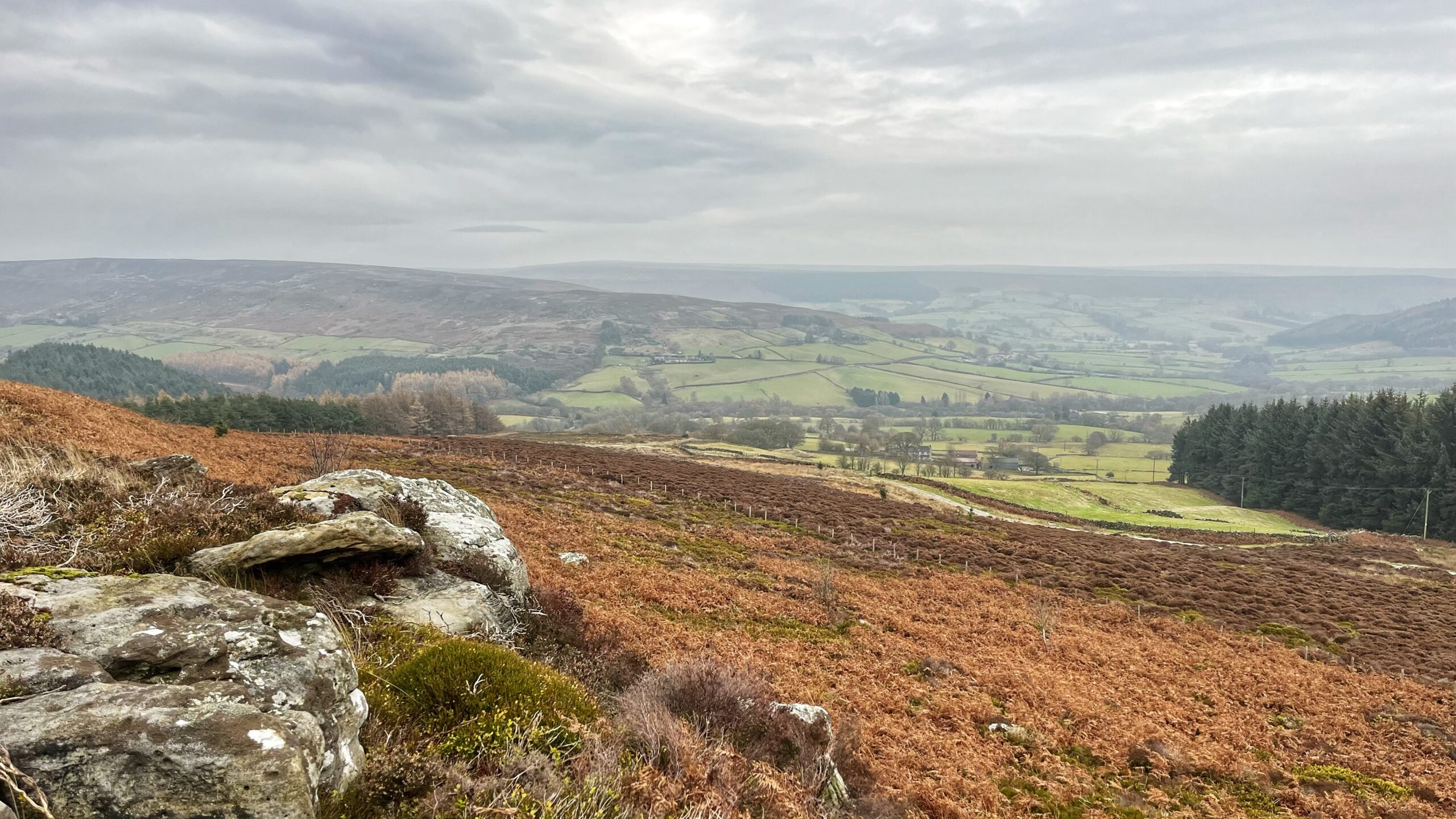
Brass monkey weather. The wind was coming off the North Sea this morning, with the dale lying below it regardless: bracken singed to rust, walled fields, farms spaced well apart.
The pattern is old, though the evidence is thinner than it looks. A 1982 piece in Field, announcing the sale of the Raisdale Estate, gives 1145 as the first record, with Walter L’Espec as its Lord. Rievaulx Abbey received the lands in the thirteenth century, and its Cistercian monks opened the dale as a route northwards. Their sheep stray rights, the article says, have altered little since1Walker, Annabel. “Northern estates.” Field, 25 August 1982, p. 6, via British Newspaper Archive..
By the Dissolution the monastic units had broken into yeoman farms of about 70 acres. Henry VIII granted the land to Thomas, Earl of Rutland, and his wife. The first Duke of Buckingham came by marriage, and Sir Charles Duncombe bought from the second Duke’s trustees in 1695. The Duncombes held it until 1964, when the first Viscount Ingleby purchased it. In 1982 his son was selling 2,519 acres, with agents expecting £640,000. I wonder what it’s worth today.
I haven’t checked any of this so treat it all with the caution due a property column in the Field, a magazine about “country matters and field sports.” The sort of magazine casually on display in solictors’ offices. The selling agents are named, which suggests they supplied the history, but the article does not say so and cites nothing for the medieval claims. Raisdale Mill shows the risk. The article dates it to 1849 and calls it Grade III. Historic England lists the Mill House and attached stable at Grade II, with a lintel dated 18192Historic England, list entry 1294566. https://historicengland.org.uk/listing/the-list/list-entry/1294566.. That sits awkwardly beside 1849, and the entry does not describe the mill itself.
- 1
- 2Historic England, list entry 1294566. https://historicengland.org.uk/listing/the-list/list-entry/1294566. ↩︎
Leave a Reply