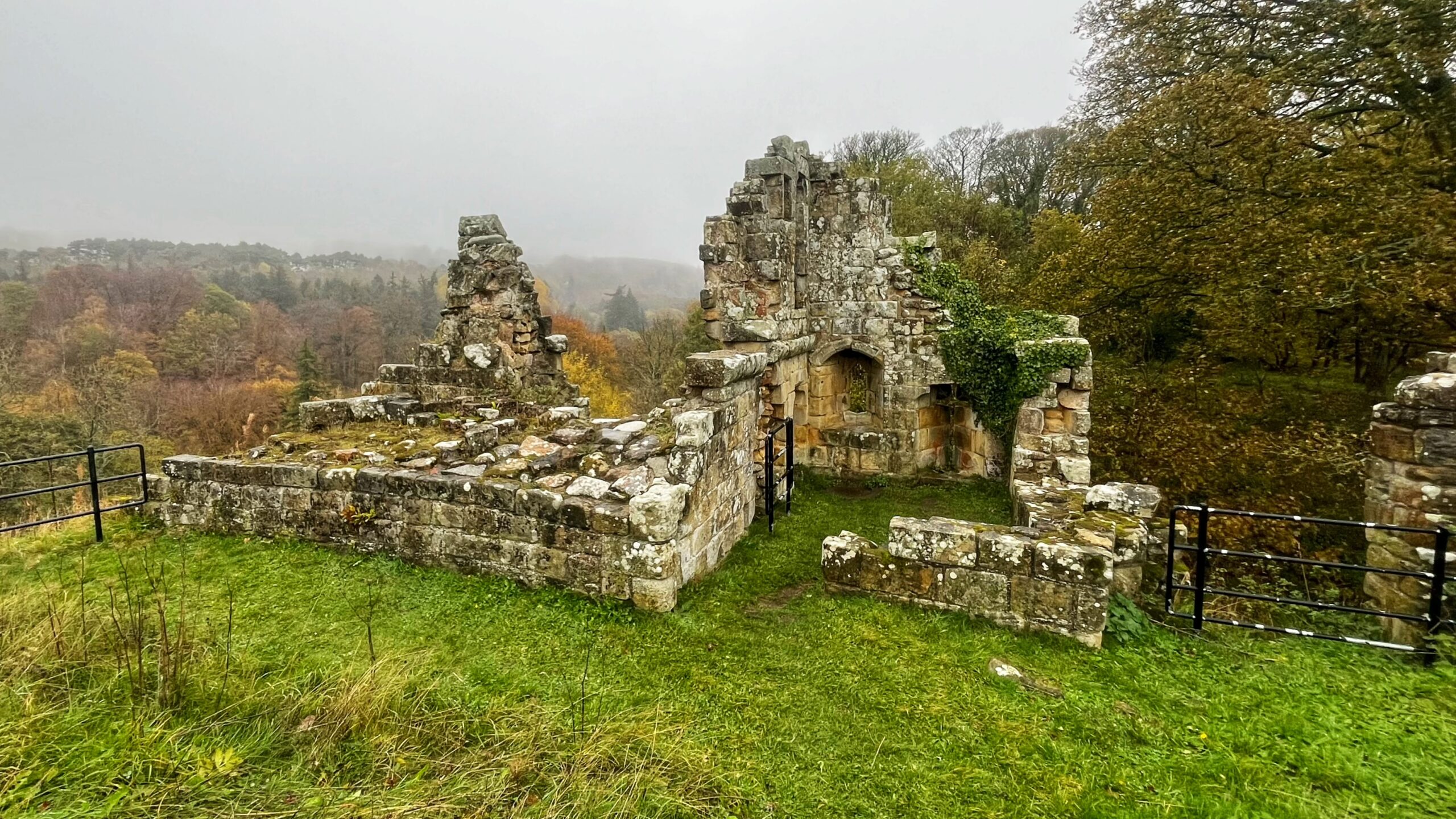
This is the 14th-century north-east lodging tower of Old Mulgrave Castle. The keep was certainly occupied in the 16th century, when mullioned windows were inserted, and the 19th century saw it partly rebuilt.
Nigel Fossard is supposed to have built the castle around 1200 to replace Foss Castle, 700m to the west. Lord Sheffield turned the neglected buildings into a hunting lodge, then had to refortify them against a Royalist force. The Civil War finished the job with an assault and part demolition in 1647, and the ruin became a garden ornament. Hence ‘Old Castle’, which separates it from the newer house that took the Mulgrave name. Look hard through the mist at the far left and you may find that house.
By the early 18th century, the property had passed to the Phipps family. Constantine Phipps, Earl of Mulgrave, was sent out as Governor of Jamaica in 1832, leaving in 1834.
This may be coincidental, but Sarah Sharp, née Woofe, is recorded living at Mulgrave Castle, between 1817 and 1820. She was a rector’s daughter, baptised at Easington in 1754. At 21 she married Stephen Sharp, supposed to be a master mariner, aged 23, in York, and they had five children, all baptised in Scarborough. Her reason for living at Mulgrave is unknown.
Wealthy planters in Caribbean mansions make a tidy picture of slaveholding. Sarah offers a less tidy one. Her attorneys in Jamaica held 29 enslaved people on her behalf in 1817, working on the Cave River Plantation. The count reached 34 by 1829, and in 1832 the attorneys held 35 for her heirs. There is assumed a link to her brother, Dr John Woofe, who held 30 enslaved people in St Ann in 1792.
Sarah Sharp’s story underscores how everyday British families were deeply intertwined with the economy of colonial slavery.
Sources:
- Historic England list entry 1015113
- UCL Legacies of British Slavery, Sarah Sharp
- UCL Legacies of British Slavery, estate 166
- Wikipedia, Constantine Phipps
- Wikipedia, Charles Beaumont Phipps
- Wikipedia, Mulgrave Castle
Leave a Reply