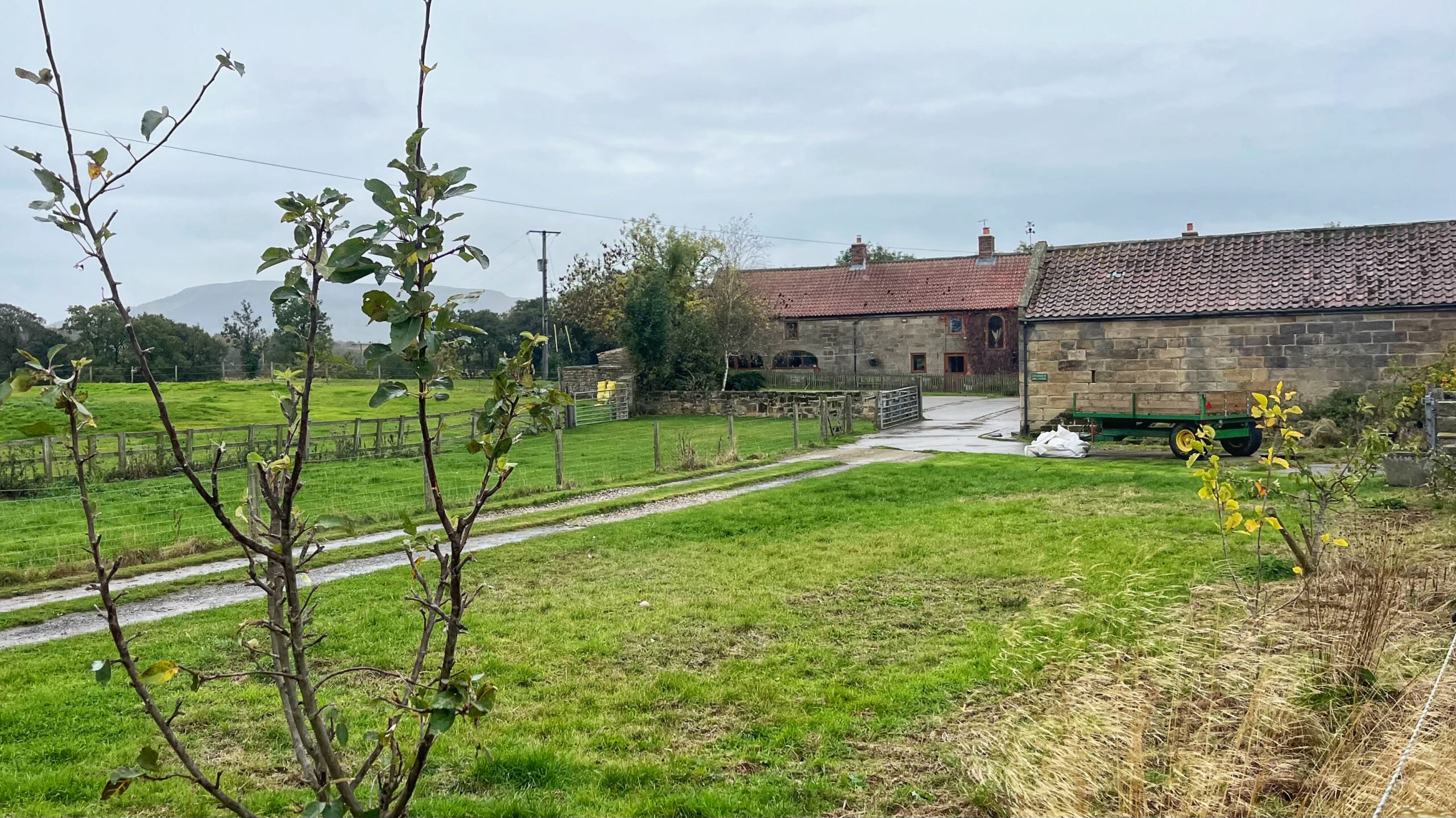
A farm with its own Wikipedia page is a rarity, yet Drummer Hill Farm, near Ingleby Greenhow, has earned one. The reason is its Grade II* listed horse gin, still standing where it was built1Historic England. List Entry Number: 1294490. Barn With Engine House and Attached Cart Lodge With Loft Over, at North West End of Drummer Hill Farmhouse. https://historicengland.org.uk/listing/the-list/list-entry/1294490?section=overview [Accessed 26 Oct 2026]. Many of the wheel sheds that housed these horse-driven threshing mills survive, and a good number have been converted into homes. The octagonal ones make especially fine living rooms. Others are still waiting for a buyer with a mortgage and a vision2as an example: Park Farm, Kildale. http://www.fhithich.uk/2021/08/18/gin-house-park-farm-kildale/. The gin at Drummer Hill is the machinery itself, the engine proper, and students from South Park 6th Form College restored it faithfully in the 1970s and 1980s3Harrison, John K and Peter W Morgan. “Tocketts: the story of a North Yorkshire township and its mill.” The Mills Archive Research Publication No.5., The Mills Archive Trust. 2016..
The hill is a modest affair. The O.S. does not bother with a ring contour and offers a mere Spot Height instead. Elgee noted that it was “filled with glacial detritus,” which is sensible enough, since the face of an ice-sheet would collect debris in front of it. He observed that such mounds are commonly called drumlins, in England at least, and suggested that, although certainty is impossible, a common derivation seems very feasible4Elgee, Frank. A Ramble in Cleveland | Northern Weekly Gazette | Saturday 20 September 1902>.
Visitors will be disappointed, though not surprised, to find no public access. “Private” signs and high fences are everywhere.
North Yorkshire called these buildings ‘wheel sheds’, while Northumberland spoke of ‘gin gans’, and every large farm in the north-east of the county had one. The story begins in 1788, when the Midlothian millwright Andrew Meikle invented the first successful threshing machine. The north east of England and the south east of Scotland took to it so eagerly that within 30 years scarcely a wooden threshing floor remained in use. Elsewhere the spread was slower or did not happen at all. Farm workers in the rural south of England had little other work, and they distrusted machines that took away the all-important winter threshing. That distrust turned violent in 1830 with the Captain Swing riots, when barns were set alight and threshing machines broken up. North Yorkshire had industry to offer alternative employment and more flexible conditions, so farmers could mechanise without stirring up a sense of grievance5Spratt, D.A. & B.J.D. Harrison. NORTH YORK MOORS: Landscape Heritage. Page 164. David & Charles.1989.6Hartley M and lngilby J, Life in the Moorland of North-East Yorkshire. Page 68.Smith Settle. 1972..
The first threshing mill in the area went up at Nunnington in about 1790, built by E. Cleaver. Hundreds followed. One or two ran on waterwheels and a few later ones on stationary steam engines, but the vast majority relied on horses walking clockwise, or ‘with the sun’, inside the wheel shed. The horse turned a heavy overhead wheel, and from it a horizontal ‘tumbler’ shaft passed through the barn wall to the thresher itself. The sheds are still reasonably common, but only two of the wheels have survived. One is here at Drummer Hill Farm. The other was removed from its original site in Urra and now stands in the Rydale Folk Museum.
- 1Historic England. List Entry Number: 1294490. Barn With Engine House and Attached Cart Lodge With Loft Over, at North West End of Drummer Hill Farmhouse. https://historicengland.org.uk/listing/the-list/list-entry/1294490?section=overview [Accessed 26 Oct 2026] ↩︎
- 2as an example: Park Farm, Kildale. http://www.fhithich.uk/2021/08/18/gin-house-park-farm-kildale/ ↩︎
- 3Harrison, John K and Peter W Morgan. “Tocketts: the story of a North Yorkshire township and its mill.” The Mills Archive Research Publication No.5., The Mills Archive Trust. 2016. ↩︎
- 4Elgee, Frank. A Ramble in Cleveland | Northern Weekly Gazette | Saturday 20 September 1902> ↩︎
- 5Spratt, D.A. & B.J.D. Harrison. NORTH YORK MOORS: Landscape Heritage. Page 164. David & Charles.1989. ↩︎
- 6Hartley M and lngilby J, Life in the Moorland of North-East Yorkshire. Page 68.Smith Settle. 1972. ↩︎
Leave a Reply