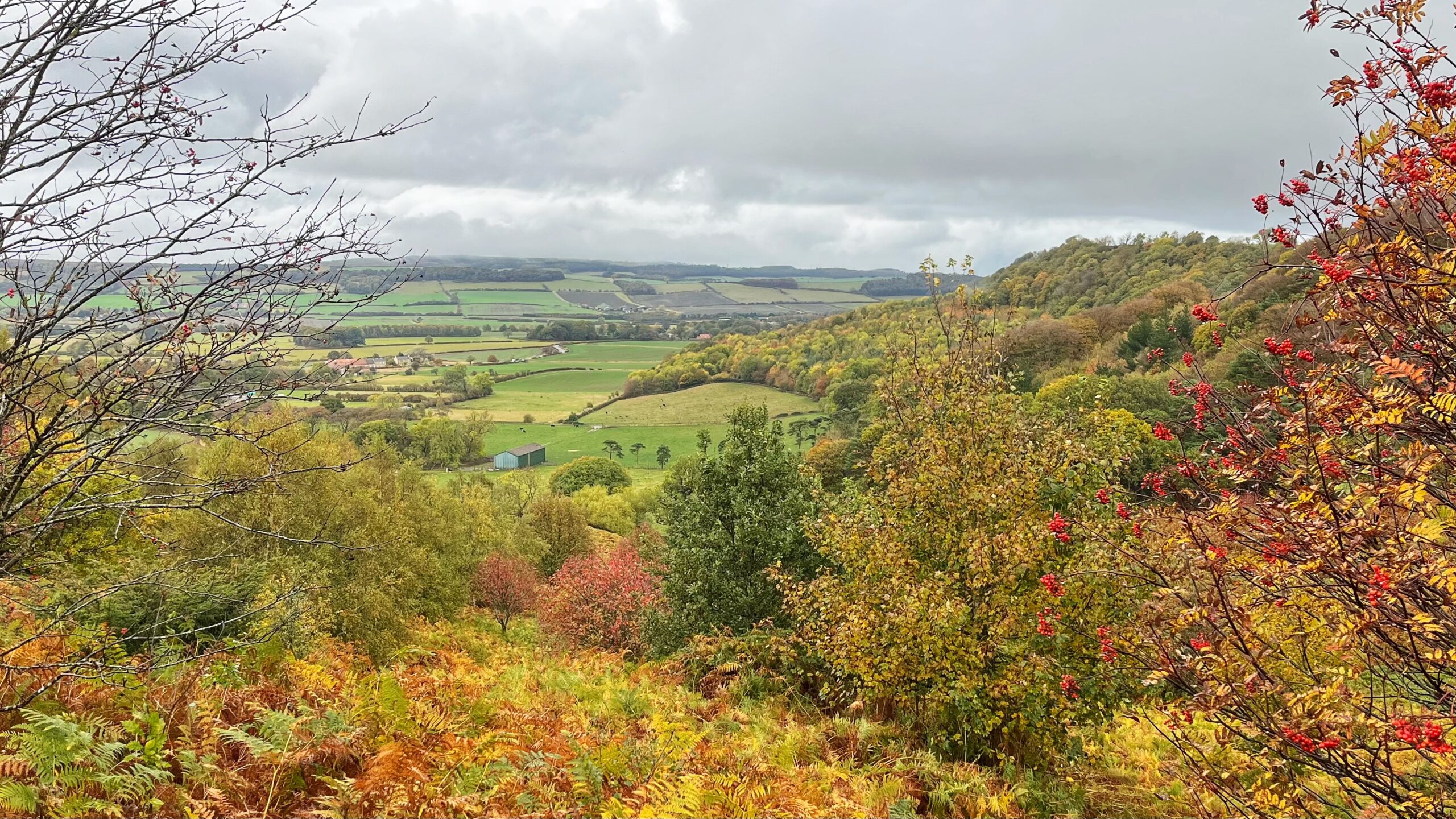
Storm Austen battered the North last night, yet autumn still delivers. This view runs across the bracken on the lower slope of Roseberry Common to the fields of Pinchinthorpe.
Pinchinthorpe takes its name from the ‘Pinciun’ or ‘Pinchun’ family, who held land here in the twelfth century. The township was divided into northern and southern manors, and each went its own way. The southern manor became the Lee estate, which lasted about four centuries after the family acquired it in the late sixteenth century. The northern manor passed from the Brus family to Guisborough Priory to the Bulmers, and the Crown took some portions after they were forfeited. Landowners and the Priory squabbled over grazing rights and manorial authority, which did little for the peace of the young settlement. By the middle of the nineteenth century, parts of the northern manor had joined the Pease estate.
The Lees were a rum lot with a long Catholic record, in their own faith and in their marriages. Around the Northern Rebellion of 1569, Dr Roger Lee was called a “notorious” papist, though he later conformed fully to the Protestant church. His third wife, Isabella Tankard, came from a well-known recusant family. She never conformed and was prosecuted in York.
This recusancy probably explains why the Lees of Pinchinthorpe never held the usual gentry offices, such as Justice of the Peace. Seventeenth-century records show that family members wanted such posts, but there is no sign that any of them got one.
The Catholic ties continued through Roger’s daughter Dorothy. Her second husband was Sir Philip Hungate of Saxton, near Tadcaster, a leading Catholic. Until 1642 their household at Saxton Hall was served by Father Postgate, who also had links with the Tankard family. Their son Francis was killed in battle in 1645, during the Civil War. Dorothy asked to be buried back in Cleveland and became the first of the Lee family to be buried in Guisborough church.
Source: Dixon, Grace. Two Ancient Townships. 1991.
Leave a Reply