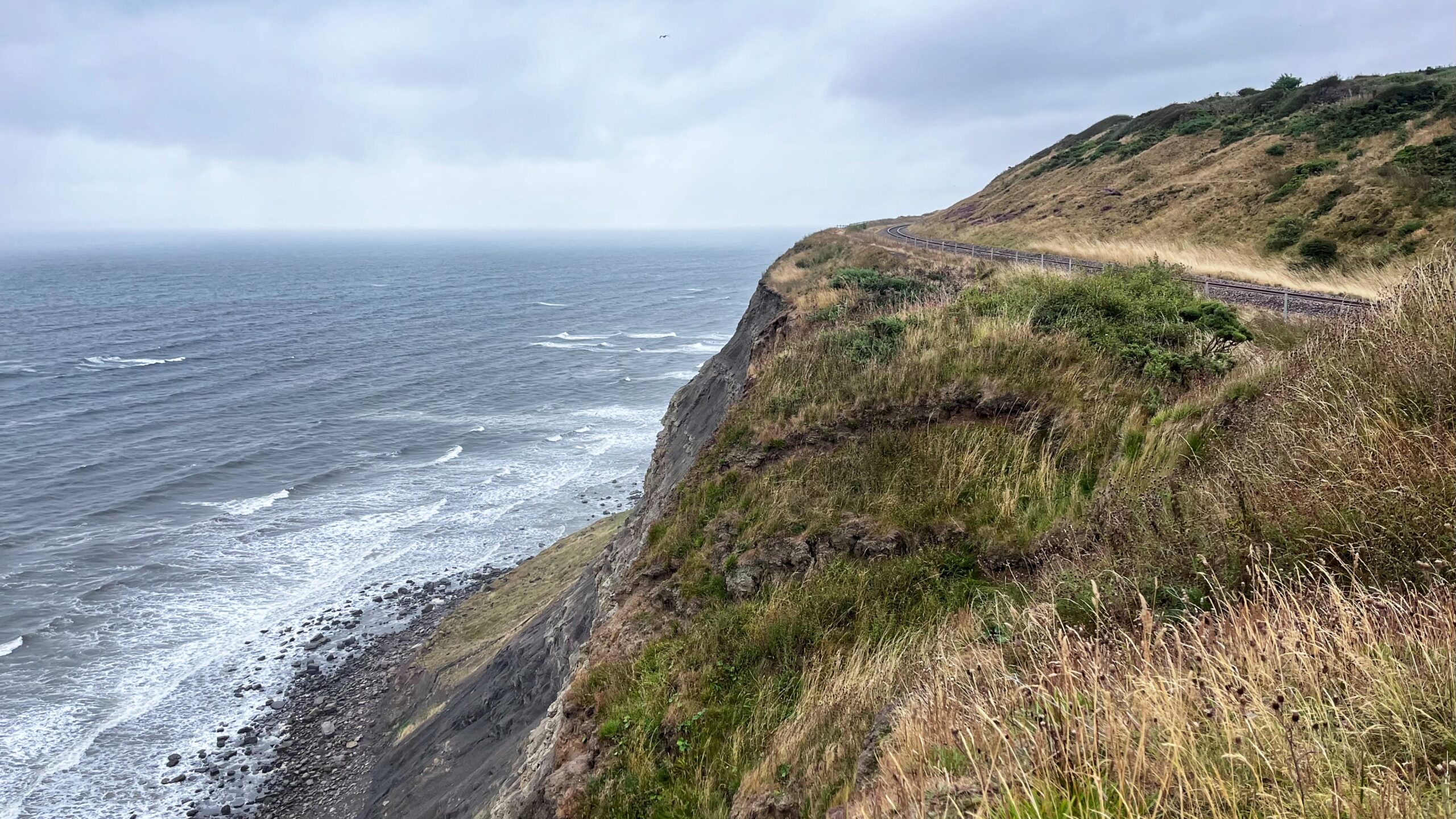
Restoring passenger rail to East Cleveland is a dream that has flickered in and out of local politics since the last carriage left in 1960. Connecting isolated coastal villages, boosting tourism, “levelling up” a corner of the world that feels forgotten. Lovely stuff, on paper.
Geology does not care about lovely stuff.
The Tees Valley Combined Authority recently spent £1 million finding this out. I kid you not, that is not a misprint. After moving past “desktop exercises” and actually looking at the cliffs, the results turned out to be a proper white elephant in the making.
The worst stretch runs around Warsett Hill above Huntcliff, where the track sits a mere 15 metres from the edge. Fifteen metres is nothing. You could put a shot further than that; or at least I think I could once—probably, memory tends to be biased.
The drop is not even the main worry. It is the ground underneath. Maps from 1856 mark a landslide feature at the foot of these cliffs called “Green Turf”, but, and I guess this is a positive, it has not gone anywhere in over a century and a half. Above the line, the consultants found active slope failure, with the topsoil of Warsett Hill creeping steadily downhill toward the track. To run trains here at any decent speed, engineers propose “discrete retention systems”—retaining walls by any other name—plus heavy geotechnical work to stop the ballast washing away with the next good rain.
Then there is the bill. Reopening the line could cost anywhere between £107 million and £329 million, depending on how far it stretches. A fair sum for a line that might slide down a cliff.
The Benefit-Cost Ratio—the government’s way of measuring if a project is worth the cash—sits at 0.03 to 0.05. Spend a pound, get back a few pence. That is not a rounding error. That is a project asking to be quietly forgotten.
Being technically possible and being sensible are two different things, and this study seems to have muddled them. It concludes trains could run here, given enough concrete and steel and money, while also admitting the deliverability risk is rated “High”. A cliffhanger indeed, and not the exciting kind.
Between the ancient landslide at Green Turf and a BCR that would make any accountant wince, the £1 million study starts to look less like due diligence and more like an expensive way of confirming what any local could have told them for free: it’s only a matter of time before the cliff crumbles away.
For now the heights above Huntcliff belong to the slow potash freight trains and the walkers on the Cleveland Way. Whether passengers ever join them depends on ground that, much like the whole scheme, is not exactly stable.
Sources:
- “East Cleveland Railway Line.” Tees Valley Combined Authority, July 2026, https://teesvalley-ca.gov.uk/investments/east-cleveland-railway-line/.
- Ove Arup & Partners Limited. East Cleveland Railway: Detailed Feasibility Study. Tees Valley Combined Authority, Dec. 2025, https://teesvalley-ca.gov.uk/wp-content/uploads/2024/02/East-Cleveland-Detailed-Feasibility-Study.pdf.
- Ove Arup & Partners Limited. East Cleveland Strategic Outline Business Case. Tees Valley Combined Authority, 15 May 2026, https://teesvalley-ca.gov.uk/wp-content/uploads/2024/02/East-Cleveland-Strategic-Outline-Business-Case.pdf.
- Ove Arup & Partners Limited. Enhancing Transport Connectivity in East Cleveland: Options Assessment Report. Tees Valley Combined Authority, 15 May 2026, https://teesvalley-ca.gov.uk/wp-content/uploads/2024/02/East-Cleveland-Options-Assessment-Report.pdf.
Leave a Reply