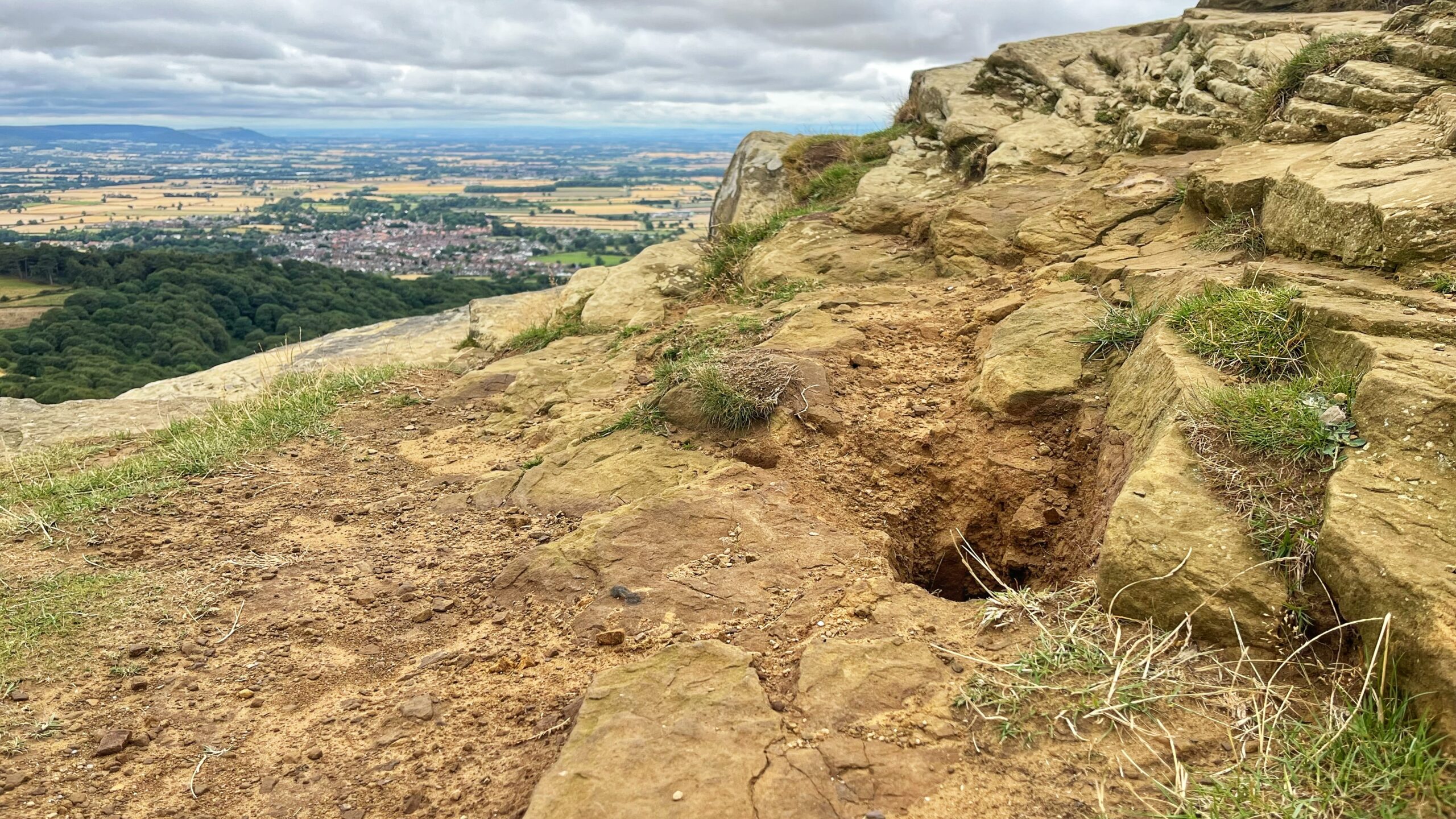
Word on the street was that a subsidence hole had opened up near the summit of Roseberry Topping. Naturally, I decided to go and have a look.
On the face of it, it was not especially dramatic. No great chasm had opened beneath the summit and swallowed half of Cleveland. Still, the hole was deep and wide enough to accommodate a leg, or possibly a small child, which must be concerning.
To my non-geologist eye, it appears to lie along the same line as a smaller hole that appeared, rather coincidentally, around this time last year. That one had been filled in by the National Trust rangers before I got the chance to view it.
So, is there anything to panic about?
Probably not.
Since the glaciers retreated, Roseberry has been subject to landslips and erosion, particularly on the steep western slope below the summit. The geology is almost designed to encourage it. Relatively weak shales support the much harder sandstone cap, while rain, frost and gravity gradually remove the soil and weather the underlying rock. As the shale is eroded, the sandstone becomes undermined. Eventually, gravity wins and another piece of Roseberry goes downhill.
It has happened many times before. The most spectacular “recent” example occurred during the second week of May 1912, when a large section of the exposed rock face collapsed and slid towards Newton Wood. The landslip dramatically altered the familiar profile of Roseberry Topping, leaving the distinctive shape we know today.
There is nothing particularly alarming about this process. Landslides are a perfectly natural part of the landscape. Gravity does most of the work, with a little assistance from the rain and wind. Given enough time, these processes can wear down even substantial hills and mountains, eventually reducing them to much gentler landscapes. Geology has all the patience in the world. We, rather inconveniently, do not.
There is one point worth clearing up about the 1912 landslip. Ironstone mining was once widely blamed for causing it, and that explanation is still repeated surprisingly often. The current view, however, is that mining was not responsible. The landslip was a natural consequence of Roseberry’s geology and would have occurred even without the mining.
So the new hole is unlikely to be the beginning of the end for Roseberry Topping. It is probably just the hill continuing to do what hills have always done: slowly fall apart.
Leave a Reply