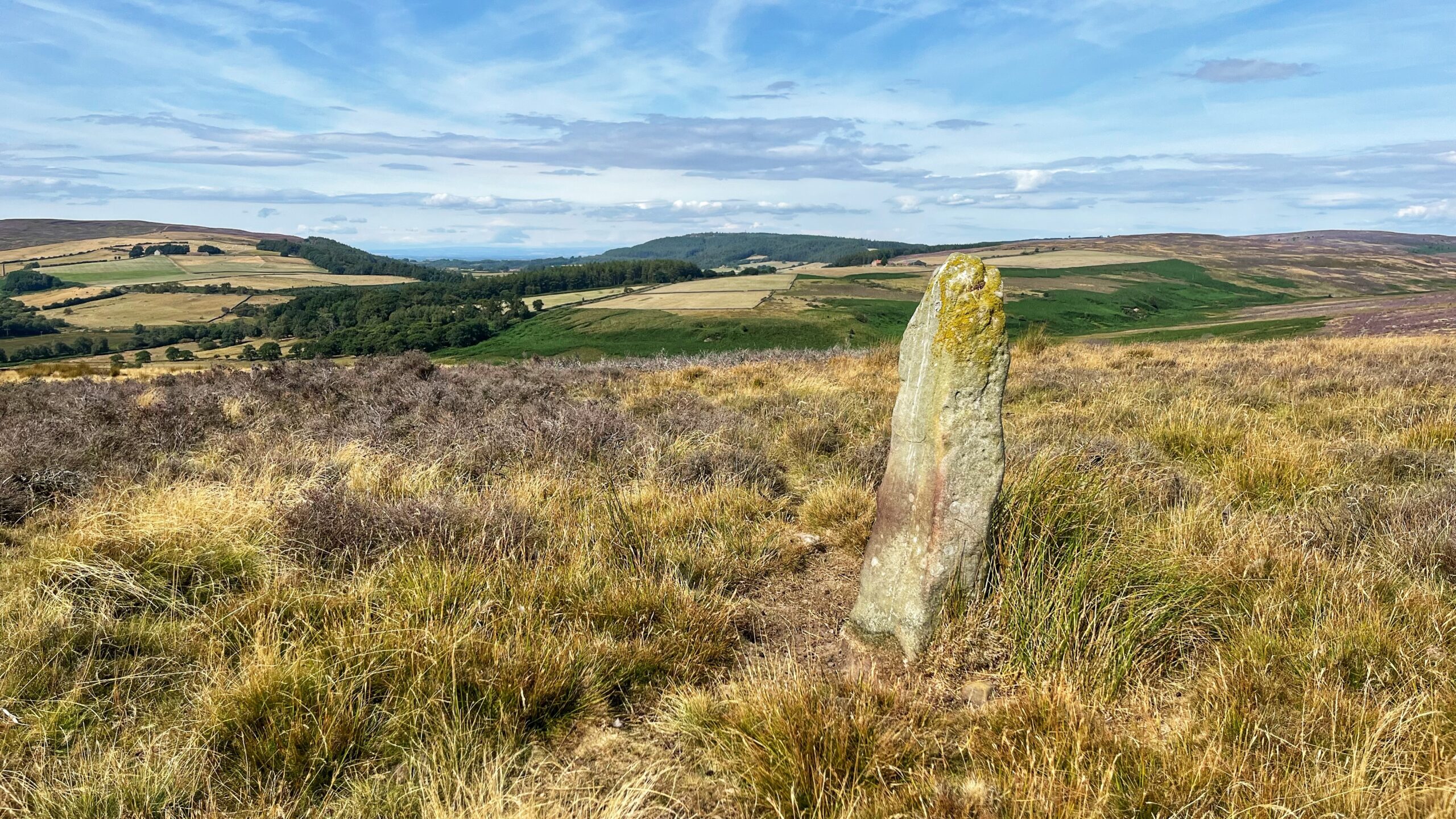
The Moors are littered with standing stones, and behind each is its own little mystery. Some mark old routes. Some are gateposts that have outlived their gates. A few might be medieval crosses, worn down by weather and time until nobody can be certain. Others seem to have drawn an arbitrary line in the earth long ago: this land is mine, keep out.
This stone on Wayworth Moor refuses to explain itself. It sits on a “round cairn”, but beyond that fact, its position makes no sense at all. Why would someone haul a stone up here and plant it upright on ground with nothing to recommend it? No hilltop. No ridge. Nothing. Just moor, slightly sloping but stubborn in every direction.1NYMNPA HER No: 3996. Round cairn on Wayworth Moor north-west of Wayworth Farm.
Wayworth Moor itself is no ordinary patch of heather. It is considered a prehistoric landscape thick with remains, field systems and burial mounds among them, some given Scheduled status for their national importance. Perhaps this stone only makes sense once the whole landscape is read together, rather than puzzled over on its own.2NYMNPA HER No: 51. Prehistoric funerary and agricultural landscape Commondale Moor.
A round cairn, for anyone unfamiliar, is a burial mound built from stone rather than earth. They belong to the Bronze Age, somewhere between 2000 and 700 BC, and were raised over one burial or several.
Picture the round cairn as the round barrow’s tougher upland relative. Same purpose, different materials, and the difference comes down to what was underfoot. Down in the lowlands, diggers had soil to work with. Up here, soil was thin and stone was everywhere, so people stacked what they had rather than dig what they did not. Many are now hardly noticeable, just heather-clad mounds, their stones recycled for dry-stone walls.
Less than a kilometre north stands the Sleddale Stone Circle, quite possibly the only genuine stone circle on the North York Moors3NYMNP HER No: 3983. Stone circle on Wayworth Moor . It’s Neolithic so would have long been part of the landscape when the round cairn was being built. I once called it a henge and was firmly put in my place for the error. Elgee thought it ceremonial, and a 1960s excavation did nothing to disprove him. If he was right, this standing stone might have played some part in whatever ceremony once took place there.4Sleddale Stone Circle. Wayworth Moor. Ironopolis — The Smell of Water. https://teessidepsychogeography.wordpress.com/2013/06/21/sleddale-stone-circle/ [Accessed 15 August 2026]
- 1
- 2
- 3NYMNP HER No: 3983. Stone circle on Wayworth Moor ↩︎
- 4Sleddale Stone Circle. Wayworth Moor. Ironopolis — The Smell of Water. https://teessidepsychogeography.wordpress.com/2013/06/21/sleddale-stone-circle/ [Accessed 15 August 2026] ↩︎
Leave a Reply