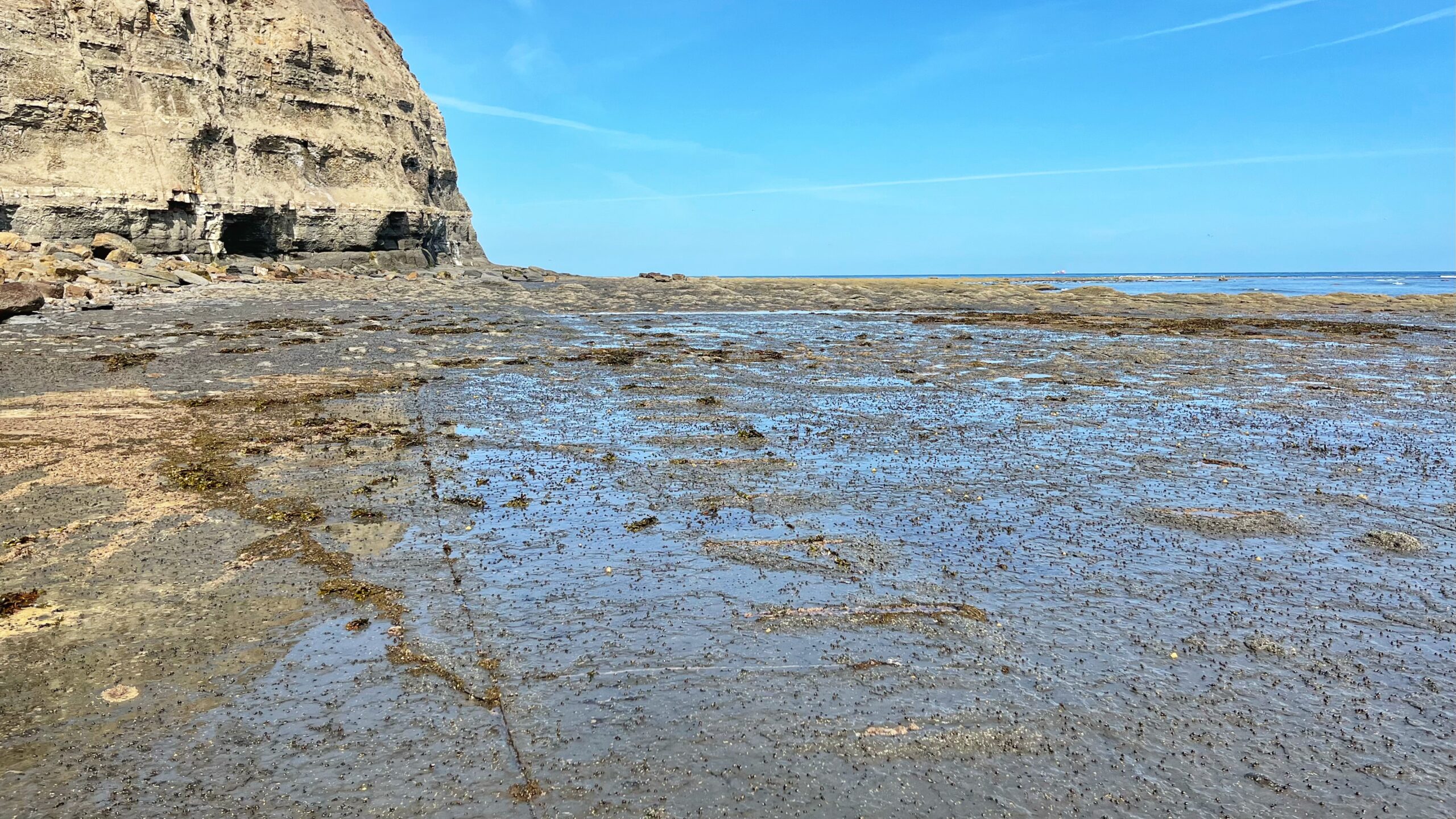
One from Sunday, when the tide finally allowed a proper wander along the scar below Penny Nab at Staithes, hunting for traces of a narrow gauge tramway that once skirted the base of the cliff at Jet Wyke, heading towards Old Nab.
Whatever survives has spent two hundred years being battered twice daily by the North Sea, so I did not expect much. The ebbing tide had not yet given up the post holes, but a series of parallel slots cut into the scar had surfaced, plain as anything, cut to take the sleepers of a narrow gauge tramway. Each one runs about three feet long by eight inches wide, a size that fits neatly with a two foot gauge line. The spacing sits close to four feet, which hints, so I read, that cast iron fish bellied rails were used. Where the tramway had to cross ridges of rock, cuttings were hacked straight through the reef to let it pass.
As for when the thing was actually running, nobody seems entirely sure. Early nineteenth century is the best guess, back when ironstone was being gathered off the beaches. Even that comes with a shrug attached, since the idea that it was ironstone being hauled along here is, strictly speaking, an assumption rather than a fact.
Source: Cleveland Ironstone: A Memorial to John Owen… Cleveland Industrial Archaeology Society/North York Moors National Park Authority. 1998. Section 3.1.
Leave a Reply