A one-way ride to Scorton, near Catterick. New territory.
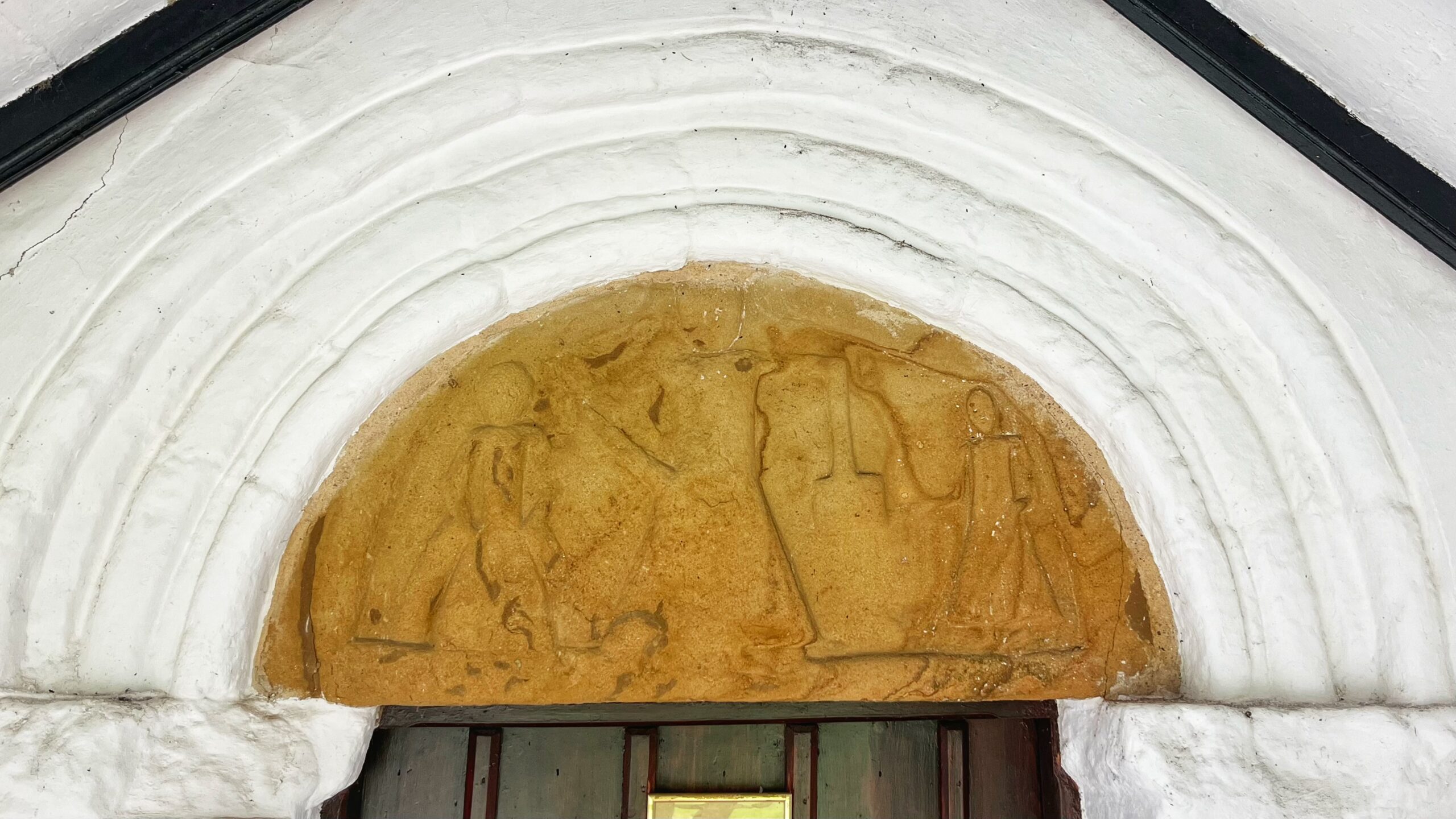
Looking for something worth a detour, I found Pevsner. Nikolaus Pevsner spent decades cataloguing every building in England worth a second look. He had noted the church at Danby Wiske. “The only Norman tympanum in the North Riding still in situ,” he wrote. “On it three standing men in long robes. One is holding a square object. They are as elementary as can be.”1Pevsner, Nikolaus. The Buildings of England: Yorkshire, The North Riding. Penquin Books. 1985. Page 137.
A tympanum is the stone filling the space above a church door, between the lintel and the arch. I had to Google that. Pevsner presumably did not.
His word “elementary” is carrying considerable weight. The stone is Norman. Nine hundred years old. Nine hundred years of Yorkshire weather does not improve sandstone. “Elementary” was possibly generous.
The church itself had a better explanation on display. The carving shows the weighing of the soul. The central figure is the Angel of Judgement, holding in one hand a soul brought forward for sentence, and in the other a balance. Good deeds in one scale. Evil deeds in the other.
The evil deeds are heavier.
The prisoner is about to be condemned when the Angel of Mercy slips a finger under the scale loaded with sins and tips the balance the other way. Acquitted.
Every person entering that church was reminded, before they even sat down, that the day of reckoning was coming. And that without mercy, things were not looking promising.
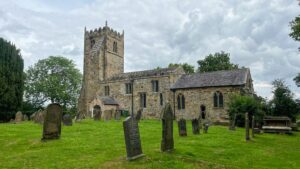
Danby Wiske goes back to Saxon times, when it was known as “Denebi”. The church dedication is unknown; the records were apparently destroyed during the Scottish raids of the twelfth century. It is difficult to prioritise good record-keeping when someone is burning the building down.
“Wiske” comes from the Old English “wisca”, meaning “watery meadow”. The River Wiske is right there. Hardly a puzzle.
“Timpani” — modern kettledrums — shares its root with “tympanum”. Both from the Greek word for drum. The arch above the door is drum-shaped. Once you see it, impossible to miss. Until then, completely invisible.
- 1Pevsner, Nikolaus. The Buildings of England: Yorkshire, The North Riding. Penquin Books. 1985. Page 137. ↩︎
Leave a Reply